







The Unseen Engine of the Digital Age
The future is already here. Movies stream instantly. Video calls span continents. Artificial intelligence (AI) answers questions in fractions of a second. Yet the physical components that make this digital life possible remain largely unseen. That machinery is the global network of data centers—the industrial backbone of the modern economy. As new technology hits the market to make our lives easier, the volume of data generated and processed grows rapidly, driving demand for ever-greater computing capacity.[1] Arizona should embrace the free-market principles that will allow this new digital future to take root.
The Greater Phoenix metropolitan area has emerged as one of the most significant data center hubs in North America, making our state a hotbed for large-scale digital infrastructure development. For Arizona residents, the scale and speed of this transformation have been striking. Industry rankings consistently place Phoenix among the top U.S. data center markets, often second nationwide in planned development. Current projections estimate a 553% increase in capacity, reaching roughly 5,340 megawatts of IT capacity, with more than a gigawatt already under construction.[2]
This growth is part of a broader national competition. The United States leads the world in data center capacity, and states actively court these facilities through regulatory certainty, recognizing their role as economic engines. The result has been the emergence of “data center alley” regions in states such as Virginia, Texas, and Oregon. Virginia alone hosts nearly 600 facilities, leveraging its proximity to federal institutions and core internet infrastructure.[3]
The stakes could not be higher. Data centers will underpin the future of the United States, providing economic strength and national security, driving economic growth, creating thousands of high-paying jobs, and securing the foundation for American technological leadership. As of March 2025, there were 5,426 data centers in the United States. Some industry projections anticipate a doubling or tripling of that number within a few years.[4] McKinsey estimates that “by 2030, companies will invest almost $7 trillion in capital expenditures on data center infrastructure globally,” with over 40% of that invested in the United States.[5]
Artificial intelligence has dramatically accelerated these trends. Demand for data has increased exponentially. How communities, businesses, and policymakers respond to this transformation will shape economic competitiveness for decades to come.
History offers a clear lesson: Innovation sometimes provokes fear, particularly from established interests who often work to trigger anxieties in the population about scale, speed, and control. Caution has a role in policymaking, but fear is not a substitute for good decision-making. The digital age is not a hypothetical future. Public policy must be grounded in economic reality and the protection of private property, not in reflexive opposition or manufactured controversy. Ignoring technological change does not stop it. Instead, it simply guarantees that opportunity will migrate elsewhere.
There’s an easy choice for Arizona leaders: It’s time to choose to embrace the future, not run away from it.
What Are Data Centers, and What Do They Really Do?
Every search query, cloud backup, financial transaction, and AI-generated response relies on massive computing power that rarely lives on a personal device. Instead, it is housed in purpose-built facilities where data is continuously stored, retrieved, and analyzed. We often refer to this system as “the cloud,” but the cloud is not a mere abstraction—it refers to physical infrastructure. Like a traditional library, data centers contain vast shelves of digital information, managed by automated systems that function as digital librarians, ensuring constant access for commerce, research, and communication.[6] Every time a user opens a mobile app, runs a search, or backs up a device, a data center is doing the work.
Data centers cannot be placed just anywhere. Their viability depends on access to key resources, including robust power capacity, dense fiber-optic lines, and geographic proximity to end users to minimize latency. Unlike the electric grid, fiber infrastructure is unevenly distributed across the country, making location a strategic constraint rather than a preference. Low latency is not a luxury. A study by Amazon showed that an additional 100 milliseconds of delay can significantly reduce e-commerce conversions, translating directly into lost revenue.[7]
The proliferation of data centers mirrors the exponential growth of data itself. This infrastructure is a critical enabler of economic growth, underwriting the shift to a digital-first economy. Companies no longer need to build and manage their own extensive IT infrastructure. Instead, they lease capacity or rely on cloud services, lowering startup costs and driving innovation. This has been a major factor in the rise of the “gig economy,” e-commerce, and software-as-a-service (SaaS) business models. At the same time, the data center sector generates high-paying jobs in construction, engineering, and advanced IT operations.
The advent of AI has intensified and concentrated this demand. AI models require immense computational power to train and operate, placing unprecedented strain on existing infrastructure and driving the construction of more powerful data centers. These facilities, equipped with specialized hardware such as graphics processing units (GPUs), are not a niche adjunct to the next technological era. Rather, they are the backbone.
The Arizona boom is fueled by a convergence of strategic, geographic, and economic advantages:
Safety and Stability: The state’s location is highly desirable because it falls outside major hurricane, tornado, and earthquake zones, offering operational stability that critical infrastructure demands.
Favorable Economics: Arizona provides a competitive a pro-business, low tax structure, affordable land for large campus developments, and an environment that promotes free enterprise, which together make the state a promising place to lay down roots.
Strategic Position: Phoenix serves as a vital low-latency nexus on national fiber routes, linking major economic centers across the Southwest.
Common sense and market logic dictate that supply follows demand. In the case of data centers, that means locating infrastructure as close as possible to end users. The market did not choose Arizona by accident; it chose our state because policy aligned with demand and natural constraints.[8]
The Regulatory Crisis: When Politics Overrides Prosperity
The success of data centers has prompted a growing regulatory backlash in communities across Arizona, including Phoenix, Mesa, Chandler, and Tucson. Much of this response is driven not by evidence, but by persistent myths—particularly surrounding electricity and water usage—that mischaracterize how modern data centers actually operate. In response, some cities have moved to retroactively restrict or block development. This approach substitutes misconception for market signals, undermines property rights, and departs from the free-market principles that allow economic growth and technological innovation to flourish.
Many communities with access to essential inputs for data centers—power, fiber-optic connectivity, and non-potable water sources—have begun restricting access to one or to all of these resources in the name of public safety. These decisions are often shaped less by demonstrable risk than by a tendency to take digital services for granted while treating the physical infrastructure that enables them as a nuisance rather than a necessity. In practice, cities have moved to retroactively limit or even preclude the siting of data centers, citing concerns over aesthetics, consumer utility costs, and, at times, a general unease with modern technology itself. But reality is unavoidable: Supply and demand will assert themselves regardless. Regulatory obstacles and political interference do not eliminate costs—they redistribute and often amplify them, distorting markets, raising prices for consumers, and ultimately failing to achieve the policy objectives they claim to serve.
Data is not an exotic exception to economics or public safety. Rather, it is a commodity governed by the same supply-and-demand dynamics as energy, transportation, housing, or any other necessary good. As demand for data increases, pressure to expand capacity inevitably follow. Someone will step up to build a better mousetrap, offering capital, bearing risk, and investing for long-term returns. Industry forecasts indicate that global AI capabilities are now doubling roughly every six months.[9]
Expensive Utilities Is a Policy Choice, Not a Data Center Problem
Energy affordability has emerged as a front-line economic concern for American families. Nearly three-quarters of Americans say they are worried about rising electricity and gas bills this year, and four in five report feeling powerless over what utilities charge. Those concerns are justified. Since 2021, electricity prices in the United States have risen roughly 27%, including a sharp increase in 2025 alone.[10]
That burden is not evenly distributed. Under federal law, states largely control their electricity systems—deciding which fuels supply the grid, which plants are permitted or retired, and whether utilities must comply with renewable mandates, emissions caps, or cost-shifting subsidies. Those policy decisions flow directly into ratepayer bills.
States with electricity prices above the national average are overwhelmingly those that have prioritized aggressive renewable mandates, 100% “carbon-free” targets, restrictions on natural gas infrastructure, net-metering subsidies, and premature coal and nuclear closures. New York and California are the clearest examples. Both have combined shrinking supplies of reliable power with rising demand, driving price increases that now far exceed national trends. New York’s electricity prices have surged more than 30% since 2019, prompting even Democratic leaders to delay parts of their own climate agenda after conceding it would impose “extraordinary and damaging costs” on residents.
California’s rates, now roughly double the national average, are not the product of scarcity but of deliberate policy choices that prioritize emissions targets over affordability. Virginia, by contrast, maintains below-average rates despite hosting one of the world’s largest concentrations of data centers.
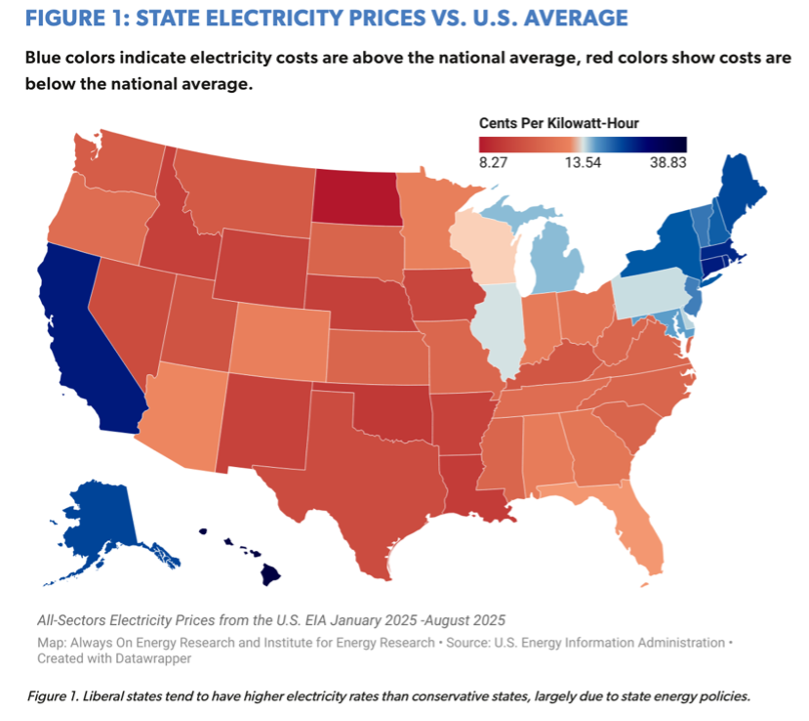
The conclusion is straightforward: Electricity prices reflect state policy choices, not geography or the number of data centers. Large data centers do not drive up residential rates any more than many other kinds of industry. Instead, they often provide steady, predictable demand that supports investment in new power generation and grid upgrades, creating economies of scale that can lower costs systemwide.[11] Where problems arise, they are almost always policy-made.
In Arizona, regulations that limit innovations such as collocated generation and microgrids require data centers to rely exclusively on the shared grid, reducing flexibility and constraining investment options that could otherwise complement broader grid upgrades. The same dynamic applies to water, where market-driven innovation—closed-loop cooling, air-cooled designs, and reclaimed water—has already reduced or eliminated potable water use. Building data centers is not what’s pushing up electricity costs. The real pressure comes from energy mandates and regulatory regimes that sideline reliable power and discourage infrastructure expansion. Arizona can attract investment without rates rising by allowing dispatchable generation, on-site power, and market solutions, or it can repeat California’s mistakes by choosing ideology over affordability and reliability.
The Defense of Property Rights: Arizona Law Versus the Bubble Wrap Mentality
The future of Arizona’s data center industry ultimately turns on whether sound policy or short-term fears will prevail. The desire for safety and security can transform into a stifling “bubble wrap mentality,” in which layer upon layer of restrictions and prohibitions are imposed until productive activity becomes effectively impossible. Economic history is unambiguous: Individuals and businesses thrive when regulations are disciplined, limited, or removed, not when arbitrary hurdles are erected to quell unfounded fears.
The sheer physical size of a data center is no more legally or economically suspect than that of a manufacturing plant. These property owners retain the same fundamental right to use and develop their land as any other private actor. In Arizona, this is not just a policy argument; it is a legal one. Arizona voters approved the Private Property Rights Protection Act (Proposition 207) in 2006, requiring the government to compensate property owners when regulations diminish the value or viable use of their property.[12] Municipal efforts to retroactively restrict or prohibit new data center construction through zoning changes violate both the spirit and the plain language of the law, exposing cities to significant and avoidable litigation risk.
The Arizona Way: Building Future Prosperity Through Freedom
Metropolitan Phoenix has become the second-largest data-center hub in the United States, driven by affordable electricity, a pro-business, low tax structure, relatively lax regulations, predictable weather, and its location along a major fiber-optic corridor. Companies such as Google, Microsoft, and Iron Mountain now operate facilities totaling roughly 707 megawatts of IT capacity.[13]
Arizona’s success reflects deliberate policy choices. In 2013, the state enacted a law providing tax incentives for data-center development, which were expanded again in 2016 to reinforce Arizona’s competitive position. Under the statute, businesses investing up to $250 million in qualifying improvements became eligible for tax relief. A later amendment barred receipt of the credit if a developer collocated a dedicated power-generation facility alongside the data center. Even with this constraint, the incentive framework contributed to the state’s accelerating data-center investment, reshaping Arizona’s industrial and technological landscape.
The result has been capital inflows for data centers, high-wage technical jobs, and a more diversified economy. This growth, however, has also forced serious engagement with sustainability concerns, especially water use in a desert climate. Arizona data centers have responded by pioneering water-efficient cooling technologies, with many new facilities adopting air-cooled or closed-loop systems, demonstrating that economic expansion and environmental stewardship are not mutually exclusive.
This experience illustrates how states can pursue growth while managing legitimate resource constraints, offering a replicable model rather than a cautionary tale.
Falling to Fear: Abandoning What Has Made Arizona Succeed
Many Arizona communities have taken a disciplined, free-market approach to data-center policy, recognizing that clear rules and predictable access to infrastructure and resources are prerequisites for long-term investment and expansion. Others, however, have yielded to short-term political pressure and unwarranted fearmongering, adopting restrictions that not only undermine Arizona’s historically successful pro-growth model but increasingly conflict with state law.
As cities attempt to retrofit legacy zoning frameworks to address data centers, distinct patterns of policy failure have emerged. The responses of Arizona municipalities now offer a clear case study in how local decision-making can either preserve—or erode—the conditions that made growth possible:
- Mesa engaged stakeholders and took the legally prudent step of grandfathering properties already under consideration for data-center development, thereby limiting immediate exposure to Proposition 207 claims. However, by requiring subsequent waivers for future data centers, city officials added an unnecessary layer of bureaucracy and unpredictability to the market.
- Phoenix exemplified reactive, non-market governance, driven by political fear rather than legal constraint. The city passed an ordinance that effectively funnels new data centers into areas with inadequate access to critical infrastructure, a decision that has already drawn multiple Prop 207 claims.
- Tucson attempted to restrict data center development by repurposing water-use ordinances as a de facto zoning tool, a strategy that conflates resource management with land-use control and leaves the city particularly vulnerable to litigation.
Securing the Digital Future
Arizona can lead the country by resisting reactionary policies rooted in anxiety rather than evidence. Data centers are not some exotic experiment—they are core infrastructure for modern life, much like transportation networks, agricultural supply chains, or energy systems scaled to meet the demands of the 21st century. Modern living comes with tradeoffs. Rejecting data centers means rejecting the physical foundation of the digital economy itself.
The future should be met with freedom, not restrictions. State government should streamline zoning and permitting so investment can move forward predictably and efficiently. A low-touch regulatory environment—one that respects property rights and allows the market to allocate resources—will address sustainability challenges better than fear-driven local obstruction. Government’s role is not to micromanage outcomes, but to set clear rules and then step aside.
The tradeoff is equally clear. Local restrictions do not eliminate demand; they merely raise costs. Efforts to block or constrain data centers result in reduced access and higher prices for the very consumers such policies claim to protect. History testifies to the consequences of this pattern. Every major infrastructure expansion—from railroads to electrification to modern logistics—faced local resistance rooted in disruption and uncertainty. Demand persisted regardless, and investment simply relocated. Communities that said no paid more later.
That adaptation is already underway. Data-center developers continuously improve site selection, facility design, construction, and operations because inefficiency is a direct financial liability and innovation a competitive necessity. Cooling systems, power architecture, and water use are no longer peripheral concerns—they are central business decisions shaped by cost, reliability, and customer demand. In arid regions such as Arizona, this has driven air-cooled and closed-loop designs, reduced reliance on potable water, and lowered overall resource intensity. When customers demand greater efficiency and sustainability, developers respond by innovating and eliminating many costs from their business models.
The same market dynamic governs the cost of energy. Large users like data centers work to be efficient and do not inherently drive electricity prices higher. Policy mandates do. States with aggressive renewable-energy mandates and restrictive generation policies consistently charge electricity rates well above the national average, while states that allow energy production to develop through market signals routinely deliver power at significantly lower per-kilowatt-hour costs—often by a wide margin. Virginia again illustrates the point: It hosts one of the nation’s densest data-center clusters while maintaining comparatively affordable electricity.
Data centers are not a passing trend. They are a durable component of the modern economy, and Arizona’s choices will determine whether it benefits from hosting that infrastructure or pays a premium to rely on it from elsewhere. The evidence is consistent: Markets innovate to conserve resources, electricity prices are heavily impacted by policy decisions, and attempts to suppress demand by constraining large users only raise costs and shift investment across borders. Arizona’s success has never come from fear-driven regulation, but from predictable rules, respect for property rights, and a willingness to let innovation work within an economic environment that supports free enterprise. The question is not whether data centers will exist, but whether Arizona will continue to lead—or retreat in the face of the future.
End Notes
[1] Cliff Saran, “Microsoft Ignite: AI Capabilities Double Every Six Months,” Computer Weekly, November 20, 2024, https://www.computerweekly.com/news/366615931/Microsoft-Ignite-AI-capabilities-double-every-six-months.
[2] “North America Data Center Market Overview,” JLL, 2024.
[3] USA Data Centers – 4049 Facilities from 1710 Operators
[4] “U.S. Data Center Powerhouses: The 5 Fastest-Growing Hubs,” Upwind, November 12, 2024, https://www.upwind.io/industry-research/data-center-powerhouses.
[5] “The Cost of Compute: A $7 Trillion Race to Scale Data Centers,” McKinsey Quarterly, April 28, 2025, https://www.mckinsey.com/industries/technology-media-and-telecommunications/our-insights/the-cost-of-compute-a-7-trillion-dollar-race-to-scale-data-centers.
[6] Luiz André Barroso, Jimmy Clidaras, and Urs Hölzle, “The Datacenter as a Computer: An Introduction to the Design of Warehouse-Scale Machines, Second Edition,” Morgan & Claypool Publishers, 2013, https://research.google/pubs/the-datacenter-as-a-computer-an-introduction-to-the-design-of-warehouse-scale-machines-second-edition/.
[7] Steven van Vessum, “Amazon Study: Every 100ms in Added Page Load Time Cost 1% in Revenue,” Conductor, accessed January 17, 2026, https://www.conductor.com/academy/page-speed-resources/faq/amazon-page-speed-study/.
[8] Brett Walton, “Data Centers a Small, but Growing Factor in Arizona’s Water Budget,” Water Desk, April 4, 2025, https://waterdesk.org/2025/04/data-centers-a-small-but-growing-factor-in-arizonas-water-budget/.
[9] Saran, “Microsoft Ignite.”
[10] Thomas J. Pyle, Kenny Stein, and Alexander Stevens, “Blue States, High Rates,” Institute for Energy Research, December 10, 2025, https://www.instituteforenergyresearch.org/the-grid/blue-states-high-rates/.
[11] Tanner Avery, “What Most Montanans Need to Know About Data Centers,” Frontier Institute, December 22, 2025, https://frontierinstitute.org/what-most-montanans-need-to-know-about-data-centers/.
[12] “An Initiative Measure Amending Title 12, Chapter 8, Arizona Revised Statutes, by Adding Article 2.1; Relating to the Private Property Rights Protection Act,” accessed January 17, 2026, https://apps.azsos.gov/election/2006/General/BallotMeasureText/PROP%2020X%20(I-21-2006).htm.
[13] Russ Wiles, “Here’s Why Metro Phoenix Is Now the Biggest Data Center Hub in the Western US,” AZ Central, March 4, 2024, https://www.azcentral.com/story/money/business/2024/03/04/metro-phoenix-now-second-biggest-data-center-hub-united-states/72804095007/.