







Arizona State University (ASU) and the University of Arizona (UA) together enroll nearly 90% of public university students in the Grand Canyon State,[i] so it is no surprise that these two universities educate many of Arizona’s best and brightest students, particularly through their respective honors colleges. Unfortunately, “Barrett, The Honors College” at ASU and the W. A. Franke Honors College at UA have been transformed into vehicles of faculty activism no longer in line with the interests of students, taxpayers, or even the leaders of these institutions. It is thus imperative that members of the Arizona Board of Regents, state lawmakers, and/or the university administrations restore the academic integrity of these programs. In particular, they must confront and address the faculty groupthink that has rendered these programs increasingly unrepresentative of the state of Arizona and potentially undeserving of continued taxpayer support.
Key Findings
- After nearly 80% of ASU Barrett Honors College faculty protested the university’s decision to allow Charlie Kirk and Jewish intellectual Dennis Prager to speak on campus in 2023, these same faculty have successfully infused their mandatory introductory honors course sections with “Diversity, Equity, and Inclusion” content, including anti-Israeli, anti-capitalist, and sexually explicit “LGBTQ” material.
- Over 70% of all Barrett course sections for the mandatory “The Human Event” (HON 272) reviewed by Goldwater pushed DEI content, including:
-
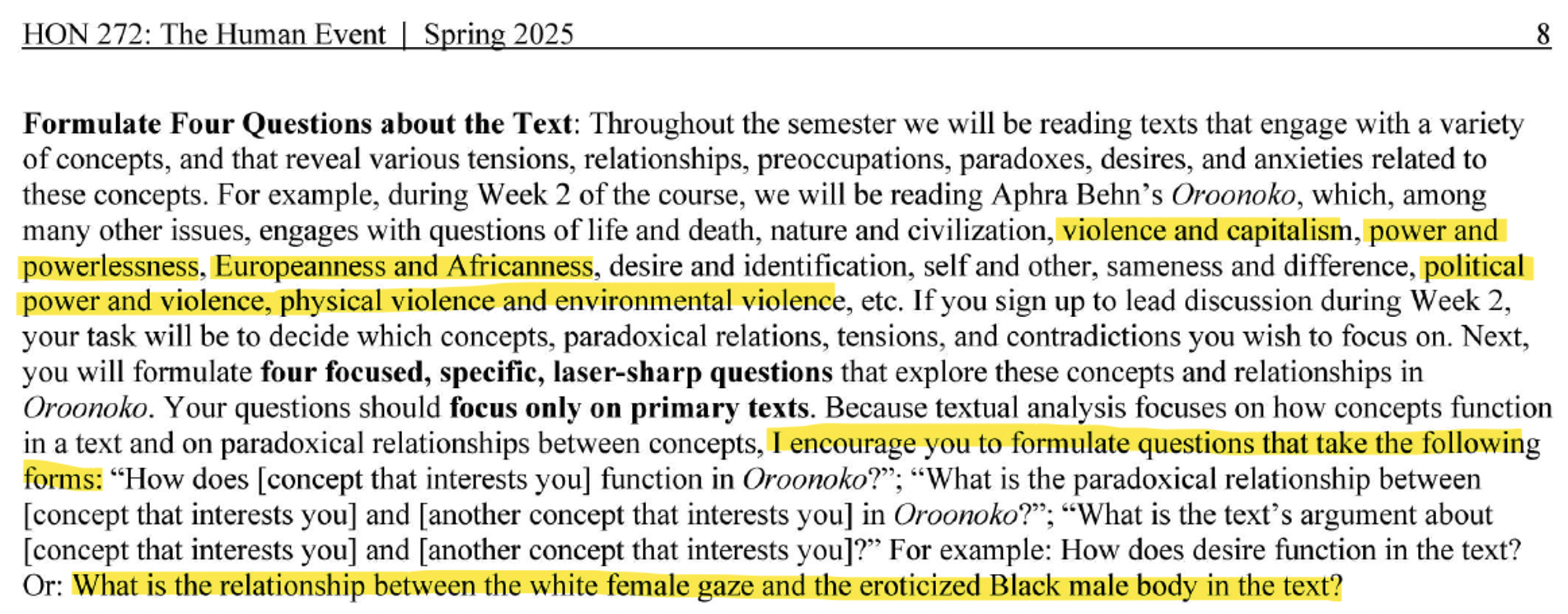
- One instructor directing students to engage with readings focused on “violence and capitalism, power and powerlessness, Europeanness and Africanness, physical violence and environmental violence” and instructing students to ask questions including, “What is the relationship between the white female gaze and the eroticized Black male body in the text?”
- One instructor declaring that the class was intended “to work toward imagining yet unimaginable future liberatory possibilities”
- An instructor presenting students with a one-sided view of the Israeli-Palestinian conflict, assigning readings that are exclusively critical of Israel and Zionism, including “Zionism from the Standpoint of Its Victims”
- Another proclaiming in the syllabus that “our classroom space . . . is an anti-racist space”
- An instructor assigning Postcolonial Love Poem, a book that explores “the wounds inflicted by America onto an indigenous people” and declares that America is “predicated [on] the diminishment and ultimate erasure of bodies like [the author’s]”
- Readings promoting identity politics and narratives of systemic oppression, including essays on “Compulsory Heterosexuality and Lesbian Experience” and “Demarginalizing the Intersection of Race and Sex”
- Syllabus instructions directing students to “put your pronouns on your name card”
- Barrett Honors College faculty have hidden syllabi for up to 85% of all course sections of the mandatory “The Human Event” (HON 272) course, despite ASU administrators having built a robust platform to publicly post syllabi for all courses across the campus.
- Barrett resisted disclosing syllabi for “The Human Event” sections for nearly 10 months even after the Goldwater Institute submitted a lawful public records request, and then redacted the names of all instructors despite faculty in other departments publicly posting their syllabi by name so that students can navigate course offerings by faculty.
- At the UA Franke Honors College, where students are forced to complete a required “Honors Seminar” course, allowable selections include a combination of ideologically extreme and academically unserious offerings, including among others:
-
- HNRS 195H-008: “Eating the Globe: The Diverse, Weird, and Queer Food Politics,” in which students must grapple with the “global interplay of identity . . . reproductive labor, ethics of health and care, racism, Orientalism,” and ask “Can food be colonized and decolonized?”
- HNRS 195H-101: “#Black Lives Matter Across the Americas,” exploring “beyond the usual understanding of racial violence as in the case of police brutality (as targeted by Black Lives Matter activists in the U.S.)”
- HNRS 195J-001: “Why Does Difference Matter? Constructing the Self and the Other,” examining “within the context of social justice . . . our own assumptions about race, gender, religion, class and forms of social violence”
- HNRS195K-002: “Cut and Paste: Constructing Identity Through Collage,” in which college students will use scissors and glue to understand “personal examinations of identity [and] political activism”
- Peer reviewed “research” from Franke Honors College faculty includes articles arguing that it is immoral for parents to have more than two biological children, while other Franke instructors boast research interests in “decolonial pedagogies, affect theory, gender politics and Disability activism in global social movements.”
- State lawmakers should consider restricting a portion of university appropriations until all Barrett and Franke honors college faculty hires, job postings, and course syllabi for sections of required courses are brought under a process of direct review and approval by the Board of Regents.
- State lawmakers should also 1) consider implementing provisions of the Goldwater Institute’s American Higher Education Restoration Act to shut off automatic state funding for activist researchthat fails to advance human knowledge or warrant taxpayer subsidy and 2) ensure passage of a state constitutional amendment (HCR2044) to prohibit mandatory DEI coursework in public higher education.
“The Human Event”: A Required Course for Barrett Students
The Barrett Honors College at ASU requires all first-year students to take a two-semester seminar titled “The Human Event.” According to Barrett, this course “forms the foundation of the first-year honors experience,” focusing on “key social and intellectual currents in the history of human thought from the earliest written texts to the present.” The instructors who teach this course have wide discretion to select the themes and texts that they will examine. As Barrett explains, “each section of The Human Event explores a unique set of texts according to the professor’s areas of expertise.” Thus, the texts assigned for this course vary widely from instructor to instructor.[ii]
Barrett Resists Transparency in Syllabi Even After an Open Records Request
Arizona State University maintains an exemplary online course catalog system that enables instructors to upload syllabi for their courses. Providing public access to syllabi through this online catalog gives students crucial information about the courses they may take or are required to take. Syllabi contain information about the readings, assignments, and expectations for a course, which helps students make informed decisions about their plans of study.
However, many instructors fail to attach a syllabus to their course in the online catalog. According to a Goldwater analysis of the course catalog in the fall 2024 semester, Barrett provided syllabi for only 27 percent of “The Human Event” course sections. In spring 2026, Barrett hid a whopping 85 percent of “The Human Event” syllabi from the catalog. Barrett students are being left in the dark about the content of their sections prior to the beginning of the semester. This lack of transparency prevents students from having clear information about the content of the sections they must choose from for this required course.
To better understand the content of typical “The Human Event” sections, Goldwater requested 14 syllabi from the spring 2025 semester that were not provided on the online course catalog.
In response to this lawful public records request, Barrett did not produce these syllabi for nearly 10 months. When Barrett finally provided these syllabi, the college redacted the names of the instructors on each syllabus.
Both of these actions—the extreme delay in complying with a request for only 14 syllabi and the redaction of instructors’ names—indicate a resistance to basic transparency on the part of Barrett’s administration. The redaction of instructors’ names is particularly inexplicable, as thousands of course sections on ASU’s online catalog include syllabi clearly identifying the instructors. Yet Barrett refuses to allow the same level of transparency when it comes to one of its signature courses.
Over 70% of Reviewed Syllabi Contain “Diversity, Equity, and Inclusion” Content
Perhaps Barrett resists transparency because many sections of “The Human Event” contain politicized DEI content that focuses on alleged systemic oppression based on such categories of “identity” as race, gender, and sexual orientation. Goldwater found that over 70% of the syllabi in the public records request (10 of 14) contained such content.
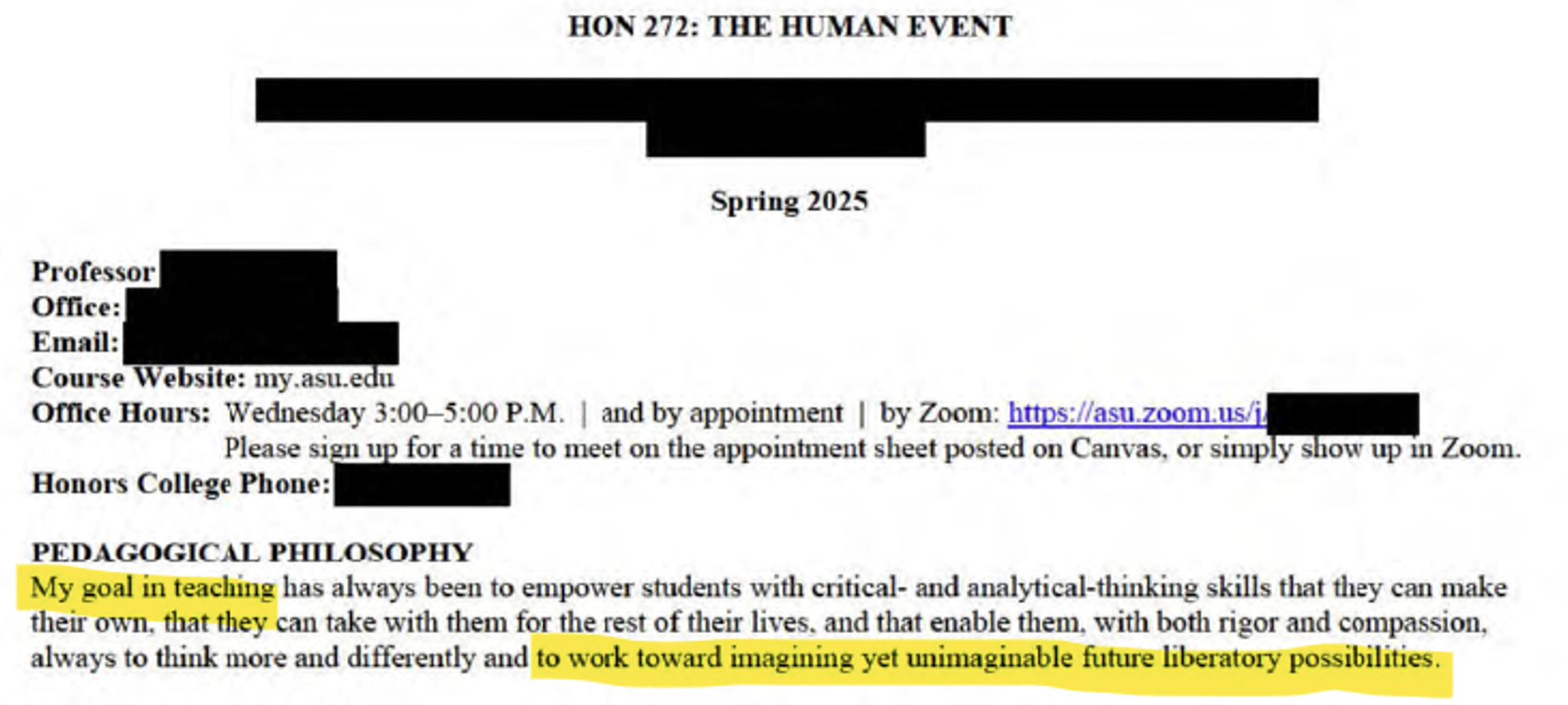
Several instructors explicitly stated goals aligning with DEI ideology. Instructors stated that their courses would examine “perceived inequality or marginalization related to a variety of factors including race, class, citizenship, gender and disability.” One instructor proclaimed that his or her teaching was intended “to work toward imagining yet unimaginable future liberatory possibilities.”
Figure 1: Excerpt of Barrett Honors College “The Human Event” course syllabus
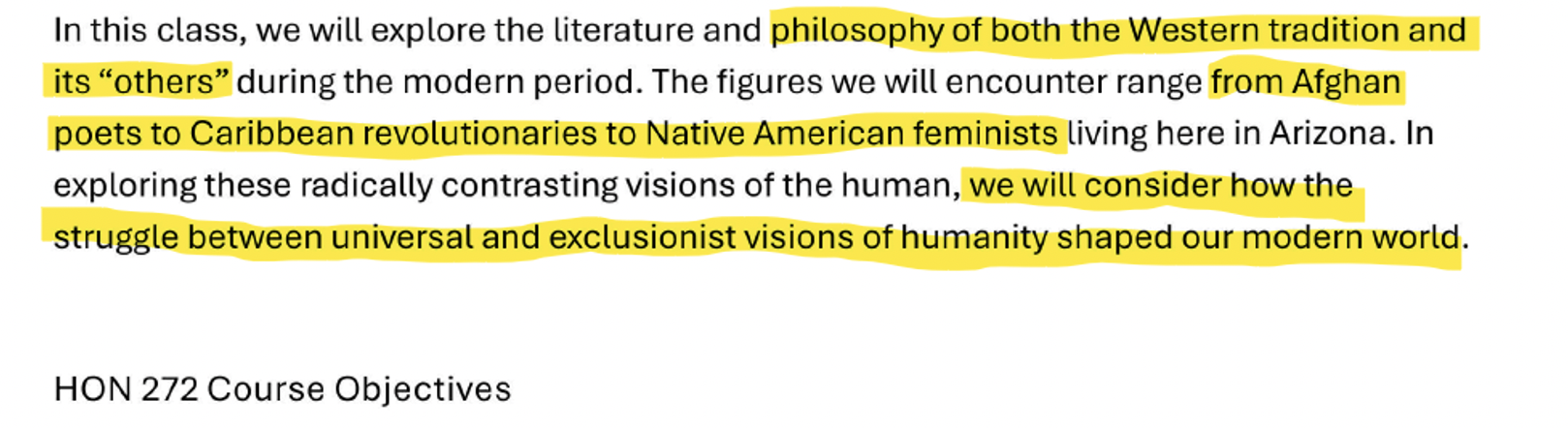
Another syllabus makes clear the instructor’s priority to explore the “struggle between universal and exclusionist visions of humanity” using readings from “Afghan poets to Caribbean revolutionaries to Native American feminists.”
Figure 2: Excerpt of Barrett Honors College “The Human Event” course syllabus
Yet another syllabus declared that “our classroom space . . . is an anti-racist space.” (The term “anti-racist space” might appear to merely assert that the instructor will not tolerate discrimination in the classroom, a worthy principle. But in reality, the proponents of “anti-racist” pedagogy believe that the entire educational system is currently “racist,” and that teachers must adopt an “anti-racist” framework to counter this supposedly oppressive system. “Anti-racist” pedagogy rejects the objective consideration of ideas and demands that teachers use their classrooms to indoctrinate students in an identitarian ideology. In fact, proponents of “anti-racism” argue for discrimination against people deemed “oppressors” to level the purportedly uneven playing field.[iii])
This same instructor included a “land acknowledgement” on the syllabus, stating that “we wish to acknowledge that Tempe is the homeland of Native people who have inhabited this landscape since time immemorial. . . . We must all accept the responsibility of stewarding those places and consider this commitment in our every action.”
Many of these syllabi “encourage” students to inform the class of their preferred pronouns.
“Human Event” Sections Assign Readings That Promote Identity Politics and Narratives of Systemic Oppression
This emphasis on DEI is also reflected in the assigned readings.
In one course section, for example, students were required to read the following:
- Frantz Fanon’s Black Skin, White Masks, a foundational text in postcolonial studies and theories of “decolonization”
- An interview with Angela Davis, a radical activist and former Black Panther Party member who collaborated with the Soviet Union and continues to support the “Boycott, Divestment, and Sanctions” (BDS) movement against Israel[iv]
- Kate Millett’s Sexual Politics, a book that “documents the subjugation of women in great literature and art . . . and builds a damning profile of literature’s patriarchal myths and their extension into psychology, philosophy, and politics”[v]
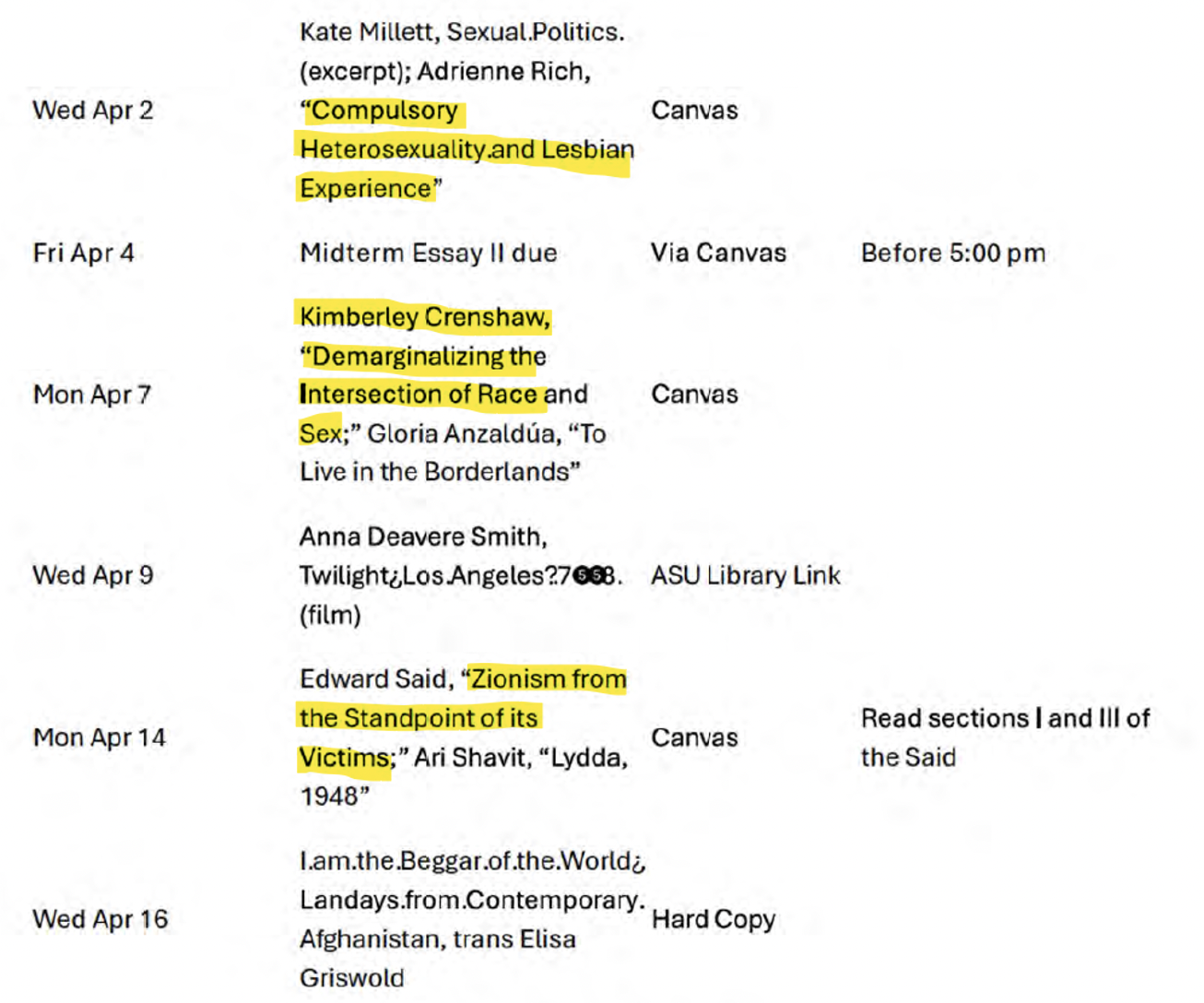
- Adrienne Rich’s “Compulsory Heterosexuality and Lesbian Experience,” an essay on the supposed erasure of relationships between women
- Kimberlé Crenshaw’s “Demarginalizing the Intersection of Race and Sex,” a key text in the theory of “intersectionality” (the idea that categories of race and sex work together to oppress women who are racial minorities)
All of these readings were assigned in a single section. Because the syllabus was not available prior to registration, students would have no indication that this particular section would focus heavily on identity politics and alleged systemic oppression.
Figure #: Excerpt of Barrett Honors College “The Human Event” course syllabus
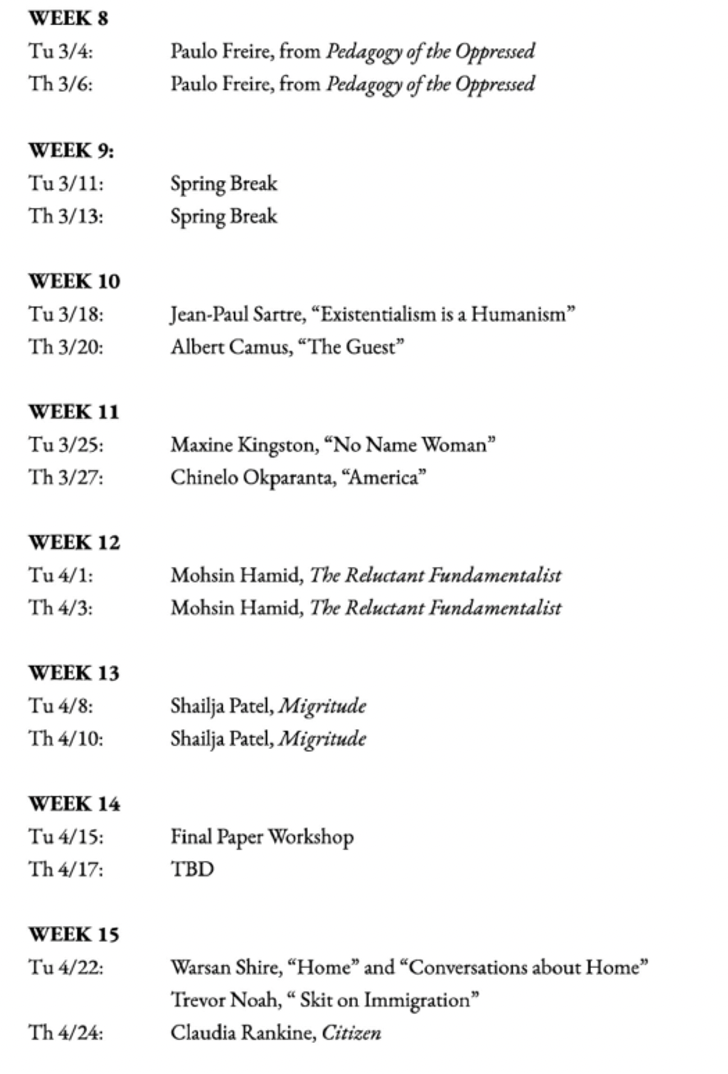
The following readings were assigned in other sections of “The Human Event”:
- Natalie Diaz’s Postcolonial Love Poem: “Through these poems, the wounds inflicted by America onto an indigenous people are allowed to bloom pleasure and tenderness. . . . Diaz defies the conditions from which she writes, a nation whose creation predicated the diminishment and ultimate erasure of bodies like hers and the people she loves.”[vi]
- Mohsin Hamid’s The Reluctant Fundamentalist: This book is a “9/11 novel, written from the perspective of Changez, a young Pakistani whose sympathies, despite his fervid immigrant embrace of America, lie with the attackers.”[vii]
- Abdellah Taia’s A Country for Dying: “Zannouba . . . formerly known as Aziz, prepares for gender confirmation surgery and reflects on the reoccurring trauma of loss, including the loss of her pre-transition male persona.”[viii]
- Warsan Shire’s “Conversations about Home” and “Home”: These “poems” feature such lyrics as: “I hear them say, go home, I hear them say, f[***]ing immigrants, f[***]cking refugees. Are they really this arrogant? Do they not know that stability is like a lover with a sweet mouth upon your body one second and the next you are a tremor lying on the floor covered in rubble and old currency waiting for its return.”
Other works appearing throughout the syllabi include “Indigenous Feminist Representations of Southern California,” “Reporting from the Frontlines of Climate Change,” Paulo Freire’s Pedagogy of the Oppressed, Ngugi wa Thiong’o’s Decolonizing the Mind, immigration skits by Trevor Noah, “Deep Heterosexuality,” and more.
Figure #: Excerpt of Barrett Honors College “The Human Event” course syllabus
Syllabus Warns of Sexually Explicit Material
One syllabus warns students that “the material covered in this course includes mature subject matter, such as . . . explicit sexual depictions (e.g., Happy.Together).” The instructor requires students to view Happy Together, an unrated film with graphic scenes of sexual activity, which “Set[s] out to depict the dynamics of a queer relationship” in Hong Kong.[ix] Whether or not faculty believe such content conveys substantive academic value, students should certainly know prior to enrolling in a mandatory course that they will be required to view such graphic content.
Honors Faculty Guiding Questions Even More Extreme than Readings
Beyond the overwhelmingly ideologically slanted selections of readings chosen by faculty for their sections of this mandatory honors course, the guidance provided by the faculty is perhaps even more egregious. For example, after declaring that the themes to be covered in assigned readings include “violence and capitalism, power and powerlessness, Europeanness and Africanness . . . political power and violence, physical violence and environmental violence,” one instructor tells students, “I encourage you to formulate questions that take the following forms. . . . For example . . . What is the relationship between the white female gaze and the eroticized Black male body in the text?”
Figure #: Excerpt of Barrett Honors College “The Human Event” course syllabus
“Human Event” Section Presents a One-Sided View of Israel and Zionism
One of the “Human Event” sections devotes a class period to readings on Israel. But instead of providing a balanced assessment of the Jewish state, the instructor assigns two readings that criticize Israel and Zionism.
The first reading is “Zionism from the Standpoint of Its Victims” by Edward Said, a Palestinian-American academic. Said asserts that Palestinians were “made to pay and suffer” for Zionism. He also comments about support for Israel and Zionism in the United States. “In no other country, except Israel,” Said states, “is Zionism enshrined as an unquestioned good, and in no other country is there so strong a conjuncture of powerful institutions and interests—the press, the liberal intelligentsia, the military-industrial complex, the academic community, labor unions—for whom . . . uncritical support of Israel and Zionism enhances their domestic as well as international standing.”[x]
The instructor pairs this attack on Israel and Zionism with Ari Shavit’s “Lydda, 1948.” Shavit is an Israeli reporter and writer, so the inclusion of this essay would seem to balance Said’s Palestinian perspective. But Shavit’s essay, like Said’s, also emphasizes the suffering of Palestinian Arabs because of Zionist actions, specifically the expulsion of Arabs from the city of Lydda during the 1948 Arab-Israeli War. Although Shavit acknowledges that the expulsion occurred following Arab aggression against the newly created state of Israel, he uses the events in Lydda to reflect on the supposedly dark aspects of Zionism. As Shavit writes, “The conquest of Lydda and the expulsion of Lydda’s population were no accident. Those events were a crucial phase of the Zionist revolution, and they laid the foundation for the Jewish state. . . . I see that the choice is stark: either reject Zionism because of Lydda or accept Zionism along with Lydda.”[xi]
The Israeli-Palestinian conflict is a complex topic that merits examination in college courses. The instructor’s choice of two readings critical of Israel—without the balance of opposing perspectives—raises the concern that students will only consider arguments hostile to Israel and Zionism.
Barrett Students Confront a Black Box in Meeting Course Requirements
Because of Barrett’s lack of transparency, students confront a black box when selecting sections for the required “The Human Event” course. Undoubtedly, there are sections of “The Human Event” that challenge students to examine classic texts from important authors. But as this report demonstrates, many instructors instead cram their sections with DEI content that focuses on identity politics and supposed systemic oppression. Without access to syllabi prior to registration, students are effectively forced to blindly select “The Human Event” sections at random. They could hope to end up with an excellent professor, but they are more likely to find themselves trapped in a DEI indoctrination session.
UA Franke Honors College Seminars
Unfortunately, the corrosion of academic quality within Arizona honors colleges is not confined to ASU. The University of Arizona (UA)’s Franke Honors College has likewise become a vessel for faculty to advance academically unserious and/or ideological pet projects that supplant more substantive core knowledge for students.
In addition to completing standard UA general education requirements—which already force all students to complete diversity, equity, and inclusion coursework[xii]—UA honors students are also directed to enroll in designated “Honors Seminar” courses: “all Franke Honors students must take at least one to graduate with honors.”[xiii]
Among the curated list of approved courses that students may choose from are:
-
- HNRS 195H-008: “Eating the Globe: The Diverse, Weird, and Queer Food Politics,” in which students must grapple with the “global interplay of identity . . . reproductive labor, ethics of health and care, racism, Orientalism,” and ask, “Can food be colonized and decolonized?”[xiv]
- HNRS 195H-101: “#Black Lives Matter Across the Americas,” exploring “beyond the usual understanding of racial violence as in the case of police brutality (as targeted by Black Lives Matter activists in the U.S.)”[xv]
- HNRS 195J-001: “Why Does Difference Matter? Constructing the Self and the Other,” examining “within the context of social justice . . . our own assumptions about race, gender, religion, class and forms of social violence” [xvi]
- HNRS195K-002: “Cut and Paste: Constructing Identity Through Collage,” in which college students use scissors and glue to conduct “personal examinations of identity [and] political activism” [xvii]
- HNRS 195H-007: Getting Into Good Trouble: When Government Threatens Civil Rights,” in which students “Explore how civil rights are challenged—and defended—when government actions cross constitutional lines. Focusing on real legal battles, including over 400 lawsuits against the Trump administration” [xviii]

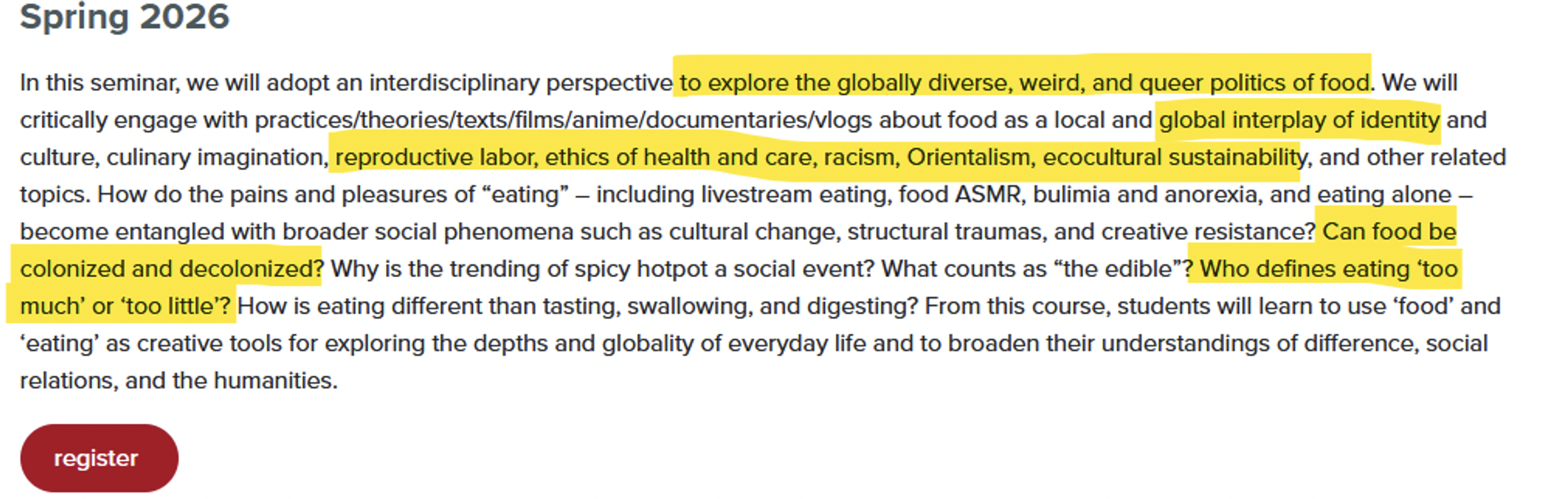
Various other seminar sections are less ideologically driven, but the carefully curated list that honors students must choose from betrays the fundamental corrosion of UA’s honors program. The fact that UA considers completing a course asking “Can food be colonized and decolonized?” to be the differentiator between honors and non-honors students is a troubling indictment of the academic priorities and rigor of the Franke Honors College.
Moreover, while the courses such as HNRS 195H-007 (listed above) may invite “diverse perspectives and fearless inquiry” as advertised, the explicitly stated emphasis against a particular administration (Trump) reflects a nationwide trend pushing an explicitly partisan narrative via higher education coursework.[xix]
Franke Honors College Instructors’ “Research” Amounts to Taxpayer Funded Ideological Activism
In addition to routing students toward academically unserious “honors” content, the faculty affiliated with the Franke Honors College also devote their taxpayer subsidized positions to activist “research.” For example, the same faculty member whose course “Eating the Globe: The Diverse, Weird, and Queer Food Politics” has been designated as satisfying the criteria for the mandatory Franke Honors Seminar course describes her work explicitly:
As an education activist, I am interested in cultivating and experimenting [sic] knowledge production practices in universities, schools and beyond. . . . I teach, research, and write about education and social changes, decolonial pedagogies, affect theory, gender politics and Disability activism in global social movements. I look at how bodies, emotions, perceptions, and resistance take shape in everyday life.[xx]
Other Franke Honors faculty have utilized their time and taxpayer supported positions to propose “research” focused on climate change featuring such conclusions as: “I have argued the proper way to balance these competing moral considerations is for each couple to have no more than two biological children.”[xxi]
While economic, environmental, and philosophical questions are of course legitimate areas of discussion within these respective disciplines, taxpayers might legitimately ask why they are required to fund the public musings of faculty on such opinion-based issues, rather than more substantive academic activity.
Solutions for Restoring ASU and UA Honors Colleges
In light of the concerning state of the Barrett and Franke Honors College program requirements and the “scholarship” of both institutions, state lawmakers should consider restricting a portion of university appropriations until all Barrett and Franke honors college faculty hires, job postings, and course syllabi for sections of required courses are brought under a process of direct review and approval by the Board of Regents. This process should involve the elimination or wholesale reform of the existing Human Event course framework.
State lawmakers should also 1) consider implementing provisions of the Goldwater Institute’s American Higher Education Restoration Act to shut off automatic state funding for activist research that fails to advance human knowledge or warrant taxpayer subsidy[xxii] and 2) ensure passage of a state constitutional amendment to prohibit mandatory DEI coursework in public higher education.[xxiii]
Moreover, the administration of ASU and UA, the Board of Regents, and/or the state legislature should require Barrett and Franke affiliated instructors to post all syllabi—including all assigned readings by section and faculty member—for all courses, including “The Human Event” and “Honors Seminar.”
End Notes
[i] FY 2027 Baseline Book, Arizona Joint Legislative Committee, Arizona Board of Regents, https://www.azjlbc.gov/27baseline/unibor.pdf(accessed February 10, 2026).
[ii] Lower Division Curriculum, Barrett, Arizona State University, https://barretthonors.asu.edu/academics/lower-division-curriculum(accessed December 18, 2025).
[iii] Coleman Hughes, “How to Be an Anti-Intellectual,” City Journal, October 27, 2019, https://www.city-journal.org/article/how-to-be-an-anti-intellectual.
[iv] David Harsanyi, “Remembering Joe Biden’s Newest Fan, Angela Davis,” National Review, July 14, 2020, https://www.nationalreview.com/corner/remembering-joe-bidens-newest-fan-angela-davis/.
[v] Kate Millett, Sexual Politics (New York: Columbia University Press, 2016), https://cup.columbia.edu/book/sexual-politics/9780231174244/.
[vi] Natalie Diaz, Postcolonial Love Poem (Minneapolis: Gray Wolf Press, 2020), https://www.graywolfpress.org/books/postcolonial-love-poem.
[vii] “The Reluctant Fundamentalist,” Publishers Weekly, https://www.publishersweekly.com/9780151013043 (accessed March 3, 2026).
[viii] Abdellah Taia, A Country for Dying, translated by Emma Ramadan (New York: Seven Stories Press, 2020), https://www.sevenstories.com/books/4204-a-country-for-dying.
[ix] Shiv Kotecha, “Wong Kar-Wai’s ‘Happy Together’ Traces a Romance in Exile,” Frieze, February 11, 2022, https://www.frieze.com/article/wong-kar-wai-happy-together-2021; Happy Together, 1997, https://tv.apple.com/us/movie/happy-together/umc.cmc.1tc9skduvbxofsl43p89w5t68.
[x] Edward Said, “Zionism from the Standpoint of Its Victims,” available at Jewish Voice for Peace, https://www.jewishvoiceforpeace.org/wp-content/uploads/2016/06/Edward-Said-Excerpt.pdf (accessed March 3, 2026).
[xi] Ari Shavit, “Lydda, 1948,” The New Yorker, October 14, 2013, https://www.newyorker.com/magazine/2013/10/21/lydda-1948.
[xii] Tim Minella, “Anti-Bug Bigotry? The Academically Unserious DEI Mandates of University of Arizona,” Goldwater Institute, June 4, 2024, https://www.goldwaterinstitute.org/policy-report/anti-bug-bigotry/.
[xiii] Spring 2026 Franke Honors Seminars, https://frankehonors.arizona.edu/spring-2026-franke-honors-seminars (accessed February 10, 2026).
[xiv] HNRS 195H-008, University of Arizona, https://frankehonors.arizona.edu/hnrs-195h-008-eating-globe-diverse-weird-and-queer-food-politics (accessed February 10, 2026).
[xv] HNRS 195H-101, University of Arizona, https://frankehonors.arizona.edu/hnrs-195h-101-black-lives-matter-across-americas(accessed February 10, 2026).
[xvi] HNRS 195J-001, University of Arizona, https://frankehonors.arizona.edu/hnrs-195j-001-why-does-difference-matter-constructing-self-and-other (accessed February 10, 2026).
[xvii] HNRS 195K-002, University of Arizona, https://frankehonors.arizona.edu/195k-002-cut-and-paste-constructing-identity-through-collage, (accessed February 10, 2026).
[xviii] HNRS 195H-007, University of Arizona, https://frankehonors.arizona.edu/hnrs-195h-007-getting-good-necessary-trouble-when-government-threatens-our-civil-rights, (accessed February 10, 2026.)
[xix] Matt Beienburg, “Billions for DEI in Higher Ed: The Cost of Indoctrination
How DEI Mandates in Higher Ed Cost Students and Taxpayers Billions, and What Lawmakers Can Do About It,” Goldwater Institute, January 15, 2025, https://www.goldwaterinstitute.org/policy-report/billions-for-dei-in-higher-ed-the-cost-of-indoctrination/.
[xx] Junzi Huang, University of Arizona, College of Social & Behavioral Sciences School of Global Studies, https://globalstudies.arizona.edu/person/junzi-huang (accessed February 10, 2026).
[xxi] Trevor Hedberg, “New on the Conversation: Children Are Expensive – Not Just for Parents, but the Environment – So How Many Is Too Many?,” University of Arizona, March 1, 2024, https://news.arizona.edu/employee-news/new-conversation-children-are-expensive-not-just-parents-environment-so-how-many-too.
[xxii] American Higher Education Restoration Act, https://defendinged.org/wp-content/uploads/2025/12/2025-American-Higher-Education-Restoration-Act-Model-Policy.pdf (accessed February 10, 2026).
[xxiii] HCR2044, Fifty-Seventh Legislature, Arizona House of Representatives, https://apps.azleg.gov/BillStatus/BillOverview/84743(accessed February 10, 2026).