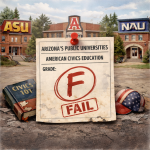
This year, a survey found that over 60 percent of Gen Z failed to identify what America’s 250th anniversary commemorated. According to a 2025 study, fewer than half of all Americans know that their state has its own constitution.
There are many culprits to blame for this shocking civic illiteracy, but America’s universities must be near the top of the list. To fix this blind spot and to better prepare students for citizenship, several state governments have created civics schools at major public universities. Unfortunately, these independent academic units have faced continuous opposition from an establishment hostile to the study of American liberty.
It is vital that these civics schools are positioned to succeed. The Goldwater Institute’s new report, Educating Citizens for the Next 250 Years: Promoting the Flourishing of Civics Schools at Public Universities, provides a roadmap to ensure they are.
The need for enhanced civics education is clear: in a major study, fewer than 20 percent of over 1,100 universities required a general education course in American history or government. Furthermore, academia has systematically favored teaching on race, gender, and oppression over individual rights, limited government, and liberty.
Civics schools were created to correct this misalignment and to restore teaching and scholarship on American civics to public universities. Of course, many in academia are actively fighting this common-sense approach. At Ohio State, for example, the faculty senate actually voted to oppose the establishment of a civics school on campus. The American Association of University Professors, the most prominent faculty union in the country, started a targeted public relations campaign intended to “knock out” the civics schools.
Goldwater’s report provides needed guidance for protecting these institutions from the academic activists opposed to educating students about American ideals. To ensure the success of the civics schools, state legislatures must give these institutions the independence to do their important work without interference from an often hostile academic establishment.
Drawing from the experience of civics schools across the country, the report lays out specific provisions in state law that will ensure the autonomy and independence of civics schools. These include:
- Guaranteeing that the civics school can hire its own faculty without approval from other university departments
- Ensuring that state funds for the civics school are for the exclusive use of the school and cannot be appropriated for other university functions
- Allowing the civics school to offer its own courses, majors, and minors without approval from other departments
- Guaranteeing that the civics school can sponsor public events without excessive security fees and without approval from the university administration
- Charging the civics school, where applicable, with developing an American civics general education course that all undergraduate students must complete
States with existing civics schools can look to the report for ways to strengthen these institutions, while states intending to found their own civics schools can use this report to establish them on the strongest possible basis.
As Jenna Robinson, President of the James G. Martin Center for Academic Renewal, stated:
“The Goldwater Institute’s research on civics schools at public universities is a significant contribution to our understanding of the nascent civic thought movement. It identifies gaps in existing legal protections for civics schools and offers a practical blueprint for safeguarding the autonomy of their budgets, hiring, and curricula. Goldwater’s model policies will help to ensure that future schools are truly effective and independent. The Martin Center is proud to endorse these recommendations.”
The movement to restore civics education represents one of the most significant reforms of public universities in decades. To set civics schools up for success, state governments must ensure that they have the autonomy and capability to accomplish their important missions. Goldwater’s report offers a clear prescription for promoting the flourishing of civics schools.
Click here to read the full report, co-authored by Sean Beienburg, former Associate Director of the School of Civic and Economic Thought and Leadership at Arizona State.
Timothy K. Minella is the Director of Higher Education at the Goldwater Institute’s Van Sittert Center for Constitutional Advocacy.