






Executive Summary
Download a PDF of this report here.
Prescription drug affordability is a problem Americans face every day, and lawmakers are right to examine every part of the drug supply chain to help consumers. But well-intentioned reforms aimed at reducing costs can also risk patients’ access to pharmacies, especially when the reforms restructure pharmacy markets without policymakers fully understanding how patients could be affected.
That risk of decreased access is greatest for patients who already have limited pharmacy choices. In many rural communities, low-income neighborhoods, and areas with large senior populations, the local pharmacy often functions as basic health care infrastructure. It is where patients pick up refills, resolve medication questions, receive routine immunizations, access basic testing, and get help managing multiple prescriptions.
Losing local pharmacy access can have a ripple effect: studies have linked pharmacy closures to lower medication adherence and reduced prescription fills. Research on pharmacy deserts — communities that are both low-income and have limited access to pharmacies — emphasizes the broad role pharmacies play in dispensing medicine, vaccination, point-of-care testing, and medication management.[1]
A 2025 JAMA Network Open study of open-door pharmacies (drugstores open to the general public) in the contiguous 48 states and Washington, D.C. found that 57.1 million Americans live in pharmacy deserts and another 28.9 million rely on a single keystone pharmacy. (A keystone pharmacy is defined as the sole pharmacy serving a census tract.) The risk is especially acute in small and isolated rural areas. Although residents of such areas represented 7.0 percent of the study population, they made up 14.3 percent of the population living in single-pharmacy-risk tracts.[2]
Table 1.
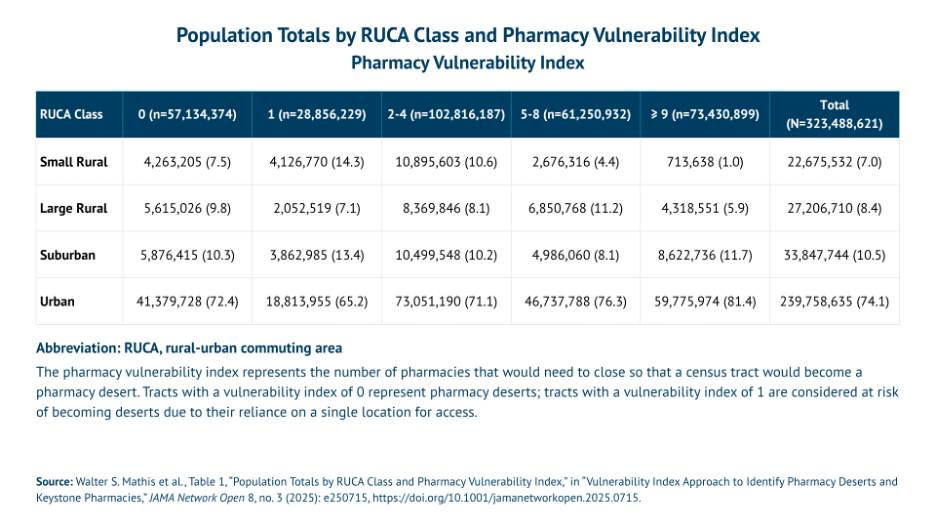
Source Adapted from Table 1, “Population Totals by RUCA Class and Pharmacy Vulnerability Index,” in Walter S. Mathis et al., “Vulnerability Index Approach to Identify Pharmacy Deserts and Keystone Pharmacies,” JAMA Network Open 8, no. 3 (2025): e250715, https://doi.org/10.1001/jamanetworkopen.2025.0715. Licensed under CC BY 4.0.
Lawmakers face calls from a wide variety of interested parties to ban pharmacy benefit managers (PBMs) and insurers from owning pharmacies. PBMs have drawn increased attention due to questions about transparency, spread pricing, patient steering, market concentration, and vertical integration. A sweeping ownership ban, however, is a blunt instrument. As we have seen in states such as Arkansas and Tennessee, such bans can create legal uncertainty, disrupt pharmacy operations, and lead to pharmacy closures for patients who already have the fewest options.
The better path is through targeted reform, not sweeping state and federal mandates. Policy conversations should focus on transparency, stronger audit rights, limits on abusive practices, protection for patient choice, and access standards that make pharmacies more available, not harder to reach.
The Issue
Americans are frustrated with high prescription drug costs. According to the Kaiser Family Foundation’s (KFF) March 2026 Health Tracking Poll, 59 percent of U.S. adults said they were worried about affording prescription drug costs for themselves or their families, while 43 percent said they had not taken medication as prescribed in the past year because of cost.[3]
That frustration has produced a wave of PBM-related legislation. According to the Associated Press, lawmakers in at least 26 states introduced more than 120 PBM-related bills this year, with legislators in at least a dozen states passing laws to limit PBM compensation, set minimum payments to pharmacists, or require more disclosure.[4]
Some of these proposals target specific industry practices. Others go much further by attempting to separate PBMs from pharmacies altogether. The difference between the two approaches is striking, and the consequences for patients and pharmacy access could be substantial.
What PBMs Do — and Why They Are Garnering Attention
PBMs, such as CVS Caremark and Express Scripts, act as intermediaries between drug manufacturers, health plans, employers, public programs, and pharmacies. They support the healthcare system by negotiating rebates and discounts for patients, processing claims, reimbursing pharmacies, designing pharmacy networks, and determining formularies, utilization rules, and cost-sharing requirements.[5]
Many employers, unions, insurers, and public programs do not have the scale or expertise to manage pharmacy benefits on their own. PBMs can aggregate purchasing power and help health plans control costs.
But PBMs increasingly operate within vertically integrated health care companies that may also own insurers, specialty pharmacies, mail-order pharmacies, and retail pharmacies. KFF reports that the three largest PBMs managed 79 percent of U.S. prescription drug claims in 2023. KFF also notes that policymakers have raised concerns that market concentration and vertical integration may allow PBMs to steer patients to preferred pharmacies, mark up drugs dispensed through affiliated pharmacies, reimburse affiliated pharmacies more favorably, or disadvantage independent pharmacies through contractual pressure.[6]
Why does this matter? Pharmacy market structure can become a patient-access problem. A healthy pharmacy market depends on allowing a range of options, including chain and independent pharmacies. When reimbursement pressure, network design, or patient steering affects which pharmacies survive, patients may face fewer choices, higher costs, and more difficulty obtaining medications, especially in communities that already have limited pharmacy access.
Pharmacy deserts are best understood as both a health care access problem and a competition problem.[7] Scholars have linked pharmacy closures and reduced access to changes in the retail pharmacy market, including consolidation; competition from supermarket and big-box store pharmacies; the growth of mail-order pharmacy services; PBM market power; vertical integration among insurers, PBMs, and pharmacies; and reimbursement and network pressures.[8] Similar to other industries, purchasing power, scale, and integrated supply chains may produce efficiencies and consumer benefits. The policy concern is not scale itself, but whether concentration or particular business practices reduce competition, limit patient choice, threaten pharmacy viability, and ultimately make it more difficult for patients to access care.
At the same time, pharmacy access is not determined by market structure alone. Access also depends on travel time, urban and rural geography, transportation and vehicle access, neighborhood income, payer mix, and whether a community depends on a single keystone pharmacy.[9]
The policy challenge is to address anticompetitive or abusive conduct without assuming that ownership restrictions alone will solve the access problem, and not overlooking the rural and low-income patients who could be most harmed by additional pharmacy closures.[10]
That means lawmakers should be careful not to oversimplify the problem. PBMs are part of the story. But they are not the entire story.
The Ownership-Ban Approach
At the federal level, the Patients Before Monopolies Act, introduced by Sens. Elizabeth Warren (D-Mass.) and Josh Hawley (R-Mo.), would make it unlawful for any entity to directly or indirectly own, operate, control, or direct any part of a pharmacy while also directly or indirectly owning, operating, or controlling any part of an insurer or PBM.[11] It would also require divestiture within one year of enactment and allow enforcement by federal agencies, state attorneys general, and private parties.
This bill is not a modest transparency rule or a targeted prohibition of a specific abusive practice. It is a structural mandate. Transparency rules, spread-pricing limits, audit rights, and anti-steering protections address whether a PBM is engaging in conduct that is detrimental to patients, payers, taxpayers, or pharmacies. An ownership ban goes much further by assuming that a business structure itself should be prohibited, even if lawmakers have not shown that divestiture will lower patient costs, preserve pharmacy access, and avoid disrupting care.
Supporters argue that ownership bans would reduce conflicts of interest, promote competition, and lower prescription drug costs. But it is the manufacturers who set list prices, while PBMs, insurers, pharmacies, wholesalers, and other participants all influence what plans and patients ultimately pay.[12] Robust competition and patient choice are admirable policy goals, but protecting one type of pharmacy from competition or using legislation to determine which business models may participate in the market is not a clear path to achieving these goals.
Indeed, a policy presented as protecting patients could ultimately hurt them. Ownership bans focus on corporate structure rather than whether particular conduct harms—or benefits—patients. These proposals, if enacted, could force restructuring, disrupt pharmacy networks, and shift substantial prescription volume without ensuring that other pharmacies have the capacity to serve those patients.
Rite Aid’s bankruptcy illustrates the scale of this challenge: after its Pennsylvania pharmacies closed, prescription files from 173 locations were transferred to CVS, which hired approximately 600 former Rite Aid employees to help manage the transition.[13] Independent pharmacies remain important, particularly in underserved communities, but they cannot necessarily absorb the demand created by widespread chain closures.[14] A policy that favors one ownership model while reducing overall pharmacy capacity risks picking winners and losers at the expense of patient access.
Furthermore, Congress has already enacted several PBM reforms through the Consolidated Appropriations Act, 2026. Beginning in 2028, these reforms will delink PBM Medicare Part D compensation from drug prices and rebate arrangements, create new Part D transparency and reporting requirements, expand reporting requirements for PBMs serving most employer health plans, and require 100% pass-through of rebates and discounts to Employee Retirement Income Security Act (ERISA)-regulated employer health plans. Because several of these provisions phase in over time and do not apply uniformly across all markets, lawmakers should be cautious before adding a far more disruptive ownership mandate on top of reforms that have not yet had time to work.[15]
State Experience: Arkansas and Tennessee
State experience should give Congress and other state lawmakers additional reason to pause.
Arkansas enacted a first-in-the-nation law barring PBMs from owning or operating pharmacies in the state.[16] A federal judge temporarily blocked the law before it took effect, and the case has become an early warning sign about the legal vulnerability of these ownership bans.[17] Media reports indicated that a major PBM-linked pharmacy operator warned that Arkansas’s law could force the closure of its retail pharmacies in the state.[18]
Tennessee has now followed with its own PBM-pharmacy ownership ban, scheduled to take effect July 1, 2028.[19] Bloomberg Law reports that the law has already drawn multiple federal lawsuits alleging constitutional violations and federal preemption under ERISA, Medicare, and TRICARE.[20]
Supporters of these ownership bans do have a serious argument: PBMs can provide valuable negotiating scale, but if a PBM can set reimbursement terms, design pharmacy networks, and also benefit from affiliated pharmacies, conduct-based rules may not fully eliminate the incentive to steer patients or disadvantage competitors. At the same time, focusing narrowly on PBM ownership overlooks the many participants and market forces that shape drug costs, competition, and patient access—including insurers, wholesalers, pharmacies, employers, public programs, and manufacturers that set list prices.
Tennessee’s own fiscal analysis reflects that concern, noting recent audits and federal inquiries involving spread pricing, affiliated-pharmacy steering, and retention of manufacturer rebates. The research stated that structural separation may improve transparency, reduce spread pricing, and increase competition among pharmacies.[21]
But the same fiscal analysis also shows why lawmakers should move carefully.
It stated that the FAIR Rx Act may increase expenditures for TennCare and the State Group Insurance Program because of higher drug acquisition costs, dispensing fees, and administrative costs tied to modifying or renegotiating pharmacy networks, while concluding that the net fiscal impact cannot be reasonably determined.[22] Politicians may be comfortable with uncertainty around future costs, but Tennessee taxpayers are unlikely to welcome a law that translates into higher state spending.
The fiscal analysis also noted that pharmacy closures or operational disruptions may occur, that any rural closures could have the largest economic impact in areas with fewer pharmacy providers, and that effects on business revenue, expenditures, and jobs cannot be quantified with reasonable certainty.[23] That uncertainty is the point: even if structural separation addresses a real conflict, lawmakers should not assume it will lower costs or preserve access.
Additionally, pharmacy access claims are important. The Associated Press reported that CVS filed suit to avoid having to close 136 pharmacies in Tennessee.[24] The company’s motivations should be examined carefully. If a policy designed to protect pharmacy access could also force pharmacy closures, lawmakers need a clearer, more patient-centered analysis before moving forward.[25]
Carve-Outs, Costs, and Patient Access
The access concerns also raise a practical question: in the wake of a PBM ownership ban, who is protected from disruption, and who is not?
State experience shows how quickly a categorical ownership ban can be shot through with exceptions. Tennessee’s FAIR Rx Act includes exceptions or “clarifications” for hospital or health-system pharmacies; employer-owned arrangements that serve only employees, retirees, and dependents; certain orphan or REMS-limited drugs; and pharmacy services provided under certain federal health care program contracts.[26] Arkansas’s law likewise included limited-use permits and temporary off-ramps for rare, orphan, or limited-distribution drugs, same-day access to critical services while pursuing a sale, and a narrow employer-only arrangement.[27] These carve-outs may be reasonable—and even necessary to protect vulnerable patients or secure political support—but they underscore the larger point: a categorical ownership ban can disrupt existing pharmacy access and benefit arrangements.
The same dynamic would likely occur in Congress. When federal cost-control or structural reforms threaten existing benefit arrangements, affected constituencies often ask lawmakers for protection. The Affordable Care Act’s Cadillac tax is a useful example.[28] The tax would have imposed a 40 percent excise tax on high-cost employer-sponsored health plans, but it was delayed repeatedly and was ultimately repealed before taking effect.[29] Labor unions and employer groups opposed the tax because it threatened negotiated or established benefit designs.[30] The lesson is not that unions are wrong to protect their members. It is that benefit disruption quickly becomes a political problem.
A federal PBM ownership ban could trigger similar pressure. Union-sponsored and collectively bargained health plans, including multiemployer or Taft-Hartley arrangements, often depend on PBM contracts, mail-order options, specialty pharmacy arrangements, and pharmacy networks negotiated for their members.[31] If a federal divestiture mandate threatened those arrangements, unions would have a strong incentive to seek an exemption or transition protection.
But a union carve-out would make the bill less coherent as a policy matter. If common ownership is the problem, it is not obvious why the same structure should be prohibited for one set of patients but allowed for another. And if the rationale for a carve-out is to avoid disrupting existing pharmacy access, that concern applies just as strongly to rural patients, seniors, small-business employees, public employees, and other nonunion workers. A carve-out may reduce disruption for a politically salient group, but it would also create new line-drawing disputes, invite claims of preferential treatment, and leave patients outside the exception with fewer protections.
Tennessee’s fiscal analysis reinforces the concern. The state concluded that the FAIR Rx Act may increase expenditures for taxpayer-funded healthcare programs’ pharmacy benefit and fulfillment and that the net impact on state expenditures could not be reasonably determined.[32] That uncertainty should be central to the debate. Lawmakers should not assume that an ownership ban will lower costs, protect access, or avoid disruption simply because it is framed as reform.
Why Pharmacy Deserts Must Be Central to the Discussion
A policy debate about PBMs cannot be separated from the reality of pharmacy deserts. The attached maps adapted from a JAMA Network Open analysis show that pharmacy desert exposure and dependence on keystone pharmacies vary widely by state, underscoring that the problem is not confined to one region or one type of community.[33] See Figure. 1.
Figure 1.
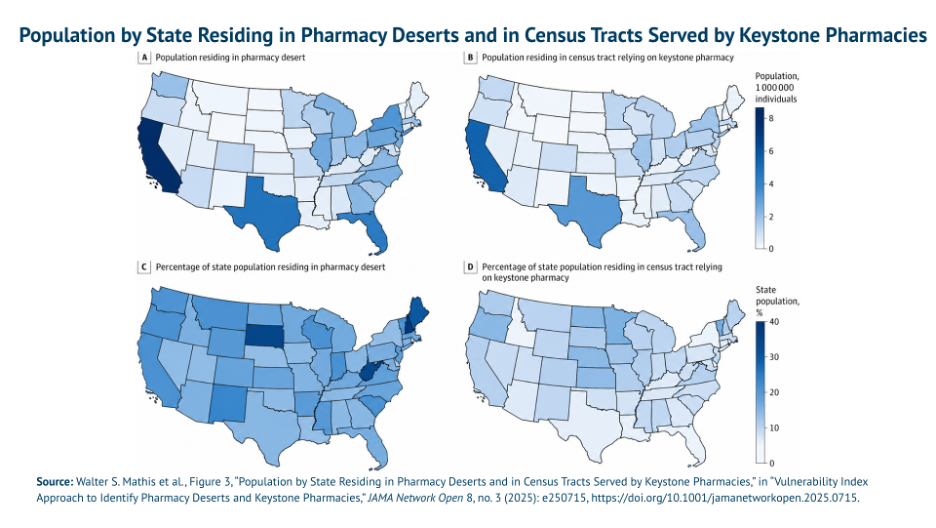
Source: Adapted from Figure 3, “Population by State Residing in Pharmacy Deserts and in Census Tracts Served by Keystone Pharmacies,” in Walter S. Mathis et al., “Vulnerability Index Approach to Identify Pharmacy Deserts and Keystone Pharmacies,” JAMA Network Open 8, no. 3 (2025): e250715, https://doi.org/10.1001/jamanetworkopen.2025.0715. Licensed under CC BY 4.0.
The same study’s Table 1 shows that more than 57 million people live in pharmacy deserts and nearly 29 million more live in areas where the loss of one pharmacy would create a desert. It also shows that small rural communities are disproportionately dependent on a single pharmacy.[34]
Table 1.
Source: Adapted from Table 1, “Population Totals by RUCA Class and Pharmacy Vulnerability Index,” in Walter S. Mathis et al., “Vulnerability Index Approach to Identify Pharmacy Deserts and Keystone Pharmacies,” JAMA Network Open 8, no. 3 (2025): e250715, https://doi.org/10.1001/jamanetworkopen.2025.0715. Licensed under CC BY 4.0.
That knowledge should change how lawmakers approach reform. Before any state or the federal government forces divestiture or restricts pharmacy ownership, policymakers should require an access impact assessment. That assessment should, at a minimum, identify affected pharmacies, patient travel times, rural and low-income impacts, specialty drug access, mail-order disruptions, Medicare and Medicaid implications, and contingency plans for patients who would need to change pharmacies.
A Better Path
PBMs should not be exempt from legislative attention. Their role in prescription drug pricing is too consequential to ignore, even though drug prices ultimately reflect the incentives and decisions of many participants across the health care system, including manufacturers of brand-name, generic, and biosimilar medications. Effective policy should account for the roles and incentives of each. But lawmakers can address PBM business practices without forcing a sweeping restructuring of pharmacy ownership.
A more targeted, patient-centric reform agenda could include:
→Transparency and audit rights. Employers, public programs, and regulators should be able to see whether negotiated savings are reaching patients and plan sponsors.[35]
→Limits on spread pricing. Taxpayers and plan sponsors should not be left guessing whether a PBM is profiting from the gap between what it pays a pharmacy and what it charges a plan.[36]
→Protection against steering. Patients should have reasonable in-network options and clear notice when they are being directed to an affiliated pharmacy.[37]
→Patient counter relief. Patients should be able to pay the lower of their insurance copay or the cash price when the cash price is cheaper.[38]
→Timely use of generics and biosimilars. Formularies and substitution rules should make lower-cost competition available as soon as possible.[39]
→Rural access protections. States should modernize telepharmacy rules, support safe remote dispensing, and measure pharmacy access before and after major policy changes.[40]
These approaches would address concerns around PBM opacity, unfair reimbursement, patient steering, and weak competition. They would also avoid making patients collateral damage in a broader fight over corporate structure.
Conclusion
Lawmakers are right to pursue policies that improve transparency, ensure fair dealing, and secure stronger protections for patients. PBM ownership bans may sound like a clean answer to legitimate concerns about industry behavior, but they aim at the wrong target: they prohibit a business structure rather than the specific conduct that may harm patients, payers, taxpayers, or pharmacies.
Ownership bans are being framed as a clean fix, but they gamble with the very access policymakers claim to protect. In practice, they risk disrupting pharmacy networks, increasing costs, and reducing access in communities that already have the fewest options. They also invite the predictable scramble for exemptions: politically powerful interests will seek protection from disruption, while ordinary patients will be left to live with the consequences, including fewer choices of pharmacies and more difficulty accessing basic pharmacy care.
Millions of Americans already live in pharmacy deserts, and millions more depend on a single keystone pharmacy that may be the difference between access and isolation. For these patients, pharmacy policy is not an abstract debate about market structure. It is about whether they can fill a prescription, get a vaccine, ask a question, or stay on a medication that keeps them out of the hospital.
Lawmakers have the authority and responsibility to address the very real problems in healthcare without making pharmacy access even more difficult. The better path is targeted reform that addresses bad behavior, improves transparency, and protects patients who had no role in creating the problem.
Health care reform should make care more available, not harder to reach. For millions of Americans, the pharmacy desert is already real. Lawmakers should not make it larger.
End Notes
[1] Dima M. Qato et al., “Association Between Pharmacy Closures and Adherence to Cardiovascular Medications Among Older US Adults,” JAMA Network Open 2, no. 4 (2019): e192606, https://doi.org/10.1001/jamanetworkopen.2019.2606; Kelly E. Anderson et al., “Pharmacy Closures and Anticonvulsant Medication Prescription Fills,” JAMA 332, no. 21 (2024): 1847– 49, https://doi.org/10.1001/jama.2024.19993; Walter S. Mathis et al., “Vulnerability Index Approach to Identify Pharmacy Deserts and Keystone Pharmacies,” JAMA Network Open 8, no. 3 (2025): e250715, https://doi.org/10.1001/jamanetworkopen.2025.0715.
[2] Mathis et al., “Vulnerability Index Approach.” The study used pharmacy-location and census data, GIS analysis, OpenStreetMap routing, and travel-time thresholds rather than simply drawing mileage circles around pharmacies.
[3] Audrey Kearney et al., “Public Views on Prescription Drug Costs: Regulation, Affordability and TrumpRx,” KFF, March 13, 2026, https://www.kff.org/public-opinion/public-views-on-prescription-drug-costs-regulation-affordability-and-trumprx/. The survey was conducted February 24 to March 2, 2026, among a nationally representative sample of 1,343 U.S. adults; the margin of sampling error was ±3 percentage points.
[4] John Hanna, “States Seek to Lower Drug Prices by Targeting the Companies That Manage Them for Health Plans,” Associated Press, June 27, 2026, https://apnews.com/article/e44ae3a9f19fe55811fcb64f2849abf6.
[5] Meredith Freed et al., “What to Know About Pharmacy Benefit Managers (PBMs) and Federal Efforts at Regulation,” KFF, February 9, 2026, https://www.kff.org/other-health/what-to-know-about-pharmacy-benefit-managers-pbms-and-federal-efforts-at-regulation/.
[6] Freed et al., “What to Know About Pharmacy Benefit Managers.”
[7] Christopher R. Leslie, “Pharmacy Deserts and Antitrust Law,” Boston University Law Review 104, no. 6 (2024): 1593–1655, https://www.bu.edu/bulawreview/files/2024/12/LESLIE.pdf; Theodosia Stavroulaki, “Can Antitrust Law Cure the Pharmacy Desert Problem in America?,” Boston University Law Review 104, no. 6 (2024): 1657– 68, https://www.bu.edu/bulawreview/files/2024/12/STAVROULAKI.pdf.
[8] Leslie, “Pharmacy Deserts and Antitrust Law”; Federal Trade Commission, Pharmacy Benefit Managers: The Powerful Middlemen Inflating Drug Costs and Squeezing Main Street Pharmacies, Interim Staff Report, July 2024, https://www.ftc.gov/reports/pharmacy-benefit-managers-report; and Jenny S. Guadamuz et al., “More US Pharmacies Closed Than Opened in 2018–21; Independent Pharmacies, Those in Black, Latinx Communities Most at Risk,” Health Affairs 43, no. 12 (2024): 1703– 11, https://doi.org/10.1377/hlthaff.2024.00192; Stavroulaki, “Can Antitrust Law Cure the Pharmacy Desert Problem?”
[9] Guadamuz et al., “More US Pharmacies Closed Than Opened”; Mathis et al., “Vulnerability Index Approach”; and Dima M. Qato et al., “‘Pharmacy Deserts’ Are Prevalent in Chicago’s Predominantly Minority Communities, Raising Medication Access Concerns,” Health Affairs 33, no. 11 (2014): 1958– 65, https://doi.org/10.1377/hlthaff.2013.1397.
[10] Leslie, “Pharmacy Deserts and Antitrust Law”; Stavroulaki, “Can Antitrust Law Cure the Pharmacy Desert Problem?”; and Mathis et al., “Vulnerability Index Approach.”
[11] U.S. Congress, Senate, Patients Before Monopolies Act, S. 4509, 119th Cong., 2nd sess., introduced May 13, 2026, https://www.congress.gov/bill/119th-congress/senate-bill/4509; U.S. Congress, House, Patients Before Monopolies Act, H.R. 8779, 119th Cong., 2nd sess., introduced May 13, 2026, https://www.congress.gov/bill/119th-congress/house-bill/8779. In addition to requiring parent companies that own a PBM or insurer to divest their pharmacy businesses, the legislation would prohibit a person from directly or indirectly owning, operating, or controlling any part of a pharmacy while also owning, operating, or controlling any part of an insurer or PBM. “Pharmacy” is broadly defined to include mail-order, specialty, retail, long-term-care, hospital, infusion, and other pharmacy operations.
[12] Freed et al., “What to Know About Pharmacy Benefit Managers.”
[13] Erin McCarthy, “All Rite Aid Pharmacies Are Officially Closed in Pa., N.J.,” Philadelphia Inquirer, August 23, 2025, https://www.inquirer.com/business/health/rite-aid-pharmacies-closed-pennsylvania-new-jersey-20250823.html.
[14] Pennsylvania Insurance Department, “Shapiro Administration Urges Insurers and PBMs to Prioritize Patient Care, Access to Prescription Medications Amid Rite Aid Closures,” August 8, 2025, https://www.pa.gov/agencies/insurance/newsroom/shapiro-admin-urges-insurers-pbms-prioritize-patient-care-rite-aid-closures.
[15] Freed et al., “What to Know About Pharmacy Benefit Managers.” The brief was originally published December 18, 2025, and updated February 9, 2026, to reflect provisions enacted in the Consolidated Appropriations Act, 2026, Pub. L. No. 119-75, 140 Stat. 173 (2026), https://www.govinfo.gov/app/details/PLAW-119publ75.
[16] Arkansas General Assembly, Act 624 of 2025, H.B. 1150, 95th Gen. Assemb., Reg. Sess., approved April 16, 2025, https://arkleg.state.ar.us/Acts/FTPDocument?ddBienniumSession=2025%2F2025R&file=624.pdf&path=%2FACTS%2F2025R%2FPublic%2F; and Andrew DeMillo and Kim Chandler, “Arkansas Bans Pharmacy Benefit Managers from Owning Pharmacies in State,” Associated Press, April 17, 2025, https://apnews.com/article/arkansas-pharmacies-pbms-sarah-huckabee-sanders-alabama-9e2449a2ac7f7aa206cd49f9211447b3.
[17] CVS Pharmacy, Inc. v. Arkansas State Board of Pharmacy, No. 4:25-cv-00524-BSM, order granting preliminary injunction (E.D. Ark. July 28, 2025), https://law.justia.com/cases/federal/district-courts/arkansas/aredce/4%3A2025cv00524/147877/24/; Andrew DeMillo, “Federal Judge Blocks Arkansas Law Barring Pharmacy Benefit Managers from Owning Pharmacies in State,” Associated Press, updated July 30, 2025, https://apnews.com/article/arkansas-pbms-pharmacies-lawsuit-bfb96d7a25667c192205507c3ce8d01a.
[18] DeMillo and Chandler, “Arkansas Bans Pharmacy Benefit Managers.”
[19] Tennessee General Assembly, Freedom, Access, and Integrity in Registered Pharmacy (FAIR Rx) Act, S.B. 2040, Pub. Ch. No. 1111, 114th Gen. Assemb., signed May 22, 2026, https://publications.tnsosfiles.com/acts/114/pub/pc1111.pdf; Lauren Clason, “Tennessee Pharmacy Law Aims to Avoid Arkansas’ Fate (Correct),” Bloomberg Law, June 23, 2026, updated June 29, 2026, https://news.bloomberglaw.com/health-law-and-business/tennessee-pharmacy-law-aims-to-avoid-arkansas-fate-in-court.
[20] Clason, “Tennessee Pharmacy Law Aims to Avoid Arkansas’ Fate.”
[21] Tennessee General Assembly, Fiscal Review Committee, Fiscal Memorandum: SB 2040 – HB 1959, March 3, 2026, https://capitol.tn.gov/Bills/114/Fiscal/FM2140.pdf.
[22] Tennessee General Assembly, Fiscal Memorandum: SB 2040 – HB 1959.
[23] Tennessee General Assembly, Fiscal Memorandum: SB 2040 – HB 1959.
[24] Hanna, “States Seek to Lower Drug Prices.”
[25] DeMillo and Chandler, “Arkansas Bans Pharmacy Benefit Managers”; Clason, “Tennessee Pharmacy Law Aims to Avoid Arkansas’ Fate”; and Hanna, “States Seek to Lower Drug Prices.”
[26] Tennessee General Assembly, FAIR Rx Act, Pub. Ch. No. 1111.
[27] Arkansas General Assembly, Act 624 of 2025, § 2, adding Ark. Code Ann. §§ 17-92-416–417.
[28] Further Consolidated Appropriations Act, 2020, Pub. L. No. 116-94, div. N, tit. I, § 503, 133 Stat. 2534, 3119–20 (2019), https://www.congress.gov/bill/116th-congress/house-bill/1865.
[29] Matthew Rae, Gary Claxton, and Larry Levitt, “How Many Employers Could Be Affected by the High-Cost Plan Tax,” KFF, July 12, 2019, https://www.kff.org/private-insurance/issue-brief/how-many-employers-could-be-affected-by-the-high-cost-plan-tax/.
[30] “Unions, Democratic Leaders and White House Reach Agreement on ‘Cadillac’ Health Insurance Plans,” Kaiser Health News, January 15, 2010, https://kffhealthnews.org/morning-breakout/cadillac-tax-agreement/.
[31] Pension Benefit Guaranty Corporation, “Introduction to Multiemployer Plans,” updated December 17, 2022, https://www.pbgc.gov/employers-practitioners/multiemployer/introduction.
[32] Tennessee General Assembly, “SB 2040/HB 1959,” Fiscal Summary, 114th Gen. Assemb. (2026), https://wapp.capitol.tn.gov/apps/BillInfo/Default?BillNumber=SB2040&ga=114.
[33] Mathis et al., “Vulnerability Index Approach.”
[34] Mathis et al., “Vulnerability Index Approach.”
[35] Freed et al., “What to Know About Pharmacy Benefit Managers”; U.S. Department of Labor, Employee Benefits Security Administration, “Improving Transparency Into Pharmacy Benefit Manager Fee Disclosure,” 91 Fed. Reg. 4348 (January 30, 2026) (proposed rule), https://www.federalregister.gov/documents/2026/01/30/2026-01907/improving-transparency-into-pharmacy-benefit-manager-fee-disclosure.
[36] Freed et al., “What to Know About Pharmacy Benefit Managers”; U.S. Government Accountability Office, Prescription Drugs: Selected States’ Regulation of Pharmacy Benefit Managers, GAO-24-106898, March 18, 2024, https://www.gao.gov/products/gao-24-106898.
[37] Federal Trade Commission, Pharmacy Benefit Managers; Freed et al., “What to Know About Pharmacy Benefit Managers.”
[38] Karen Van Nuys et al., Overpaying for Prescription Drugs: The Copay Clawback Phenomenon, USC Schaeffer Center for Health Policy & Economics, March 13, 2018, https://schaeffer.usc.edu/research/overpaying-for-prescription-drugs/; Know the Lowest Price Act of 2018, Pub. L. No. 115-262, 132 Stat. 3670 (2018); Patient Right to Know Drug Prices Act, Pub. L. No. 115-263, 132 Stat. 3672 (2018).
[39] U.S. Food and Drug Administration, Center for Drug Evaluation and Research, “Generic Competition and Drug Prices,” https://www.fda.gov/about-fda/center-drug-evaluation-and-research-cder/generic-competition-and-drug-prices; and U.S. Department of Health and Human Services, “Fact Sheet: Bringing Lower-Cost Biosimilar Drugs to American Patients,” October 29, 2025, https://www.hhs.gov/press-room/fact-sheet-bringing-lower-cost-biosimilar-drugs-to-american-patients.html.
[40] Benjamin Y. Urick, Jessica K. Adams, and Maimuna R. Bruce, “State Telepharmacy Policies and Pharmacy Deserts,” JAMA Network Open 6, no. 8 (2023): e2328810, https://doi.org/10.1001/jamanetworkopen.2023.28810; Rural Health Information Hub, “Rural Pharmacy and Prescription Drugs,” updated February 19, 2026, https://www.ruralhealthinfo.org/topics/pharmacy-and-prescription-drugs; Mathis et al., “Vulnerability Index Approach.”