






Introduction
Off-cycle elections are not an accident of scheduling. They are a costly feature of local governance that deliberately and systematically narrows the electorate to amplify organized special interests while weakening democratic accountability, especially with respect to government spending. Currently protected by the Arizona Constitution, off-cycle election laws separate major local elections from high-turnout federal and state contests, allowing a small, unrepresentative slice of voters to decide questions involving billions of dollars in public spending and long-term tax burdens. The result is a system that is formally legal but substantively undemocratic.
This report examines off-cycle elections in Arizona, outlines their economic and democratic costs, and makes the case for reforming election timing to restore transparency, accountability, and broad voter participation in local government. Those who desire good governance should seek maximum voter participation in elections. A broad electorate strengthens democratic legitimacy while reinforcing fiscal discipline and accountability.
Off-cycle elections are currently protected by the Arizona Constitution and remain common across the state, particularly among municipalities and school districts. Arizona’s two largest cities, Phoenix and Tucson, conduct their municipal elections off-cycle, as do Tempe, Flagstaff, Yuma, and Surprise. This pattern extends beyond municipalities, as well. In 2025 alone, dozens of school district bond and override elections were held off-cycle, as were Tucson City Council elections and the vote to incorporate San Tan Valley.
Arizona is not unique in this respect. Major cities across the country employ off-cycle election schedules that result in similarly depressed turnouts. New York City, for example, holds mayoral and city council elections in the year following a presidential election, a timing decision that regularly leads to low turnouts—below 30%. Chicago holds an even stranger election: Its voters are forced to march to the polls in the middle of February to choose who will run their city. Turnout there averages under 40%.
Yet low voter turnout is far from inevitable in large cities. When municipalities align their elections with high-participation federal or statewide contests, participation surges dramatically. San Francisco, for example, holds elections for its mayor and board of supervisors at the same time as presidential elections, with turnout exceeding 75% in 2024.
Election timing does more than shape who turns out to vote. It also determines how elections are administered and who exercises control over major fiscal decisions. By separating local contests from high-turnout state and federal elections, off-cycle schedules require counties to administer stand-alone elections while concentrating major fiscal decisions in the hands of a relatively small electorate.
The direct administrative costs of off-cycle elections are real, though modest relative to overall county expenditures. Large counties such as Maricopa and Pima spend millions of dollars running elections in off-cycle years—amounts comparable to what they devote to parks and recreation. The marginal cost of a single off-cycle race is difficult to isolate but likely ranges from hundreds of thousands to several million dollars. Even so, these costs account for less than one percent of total county spending in off-cycle years.
That narrow budgetary view, however, obscures the true economic impact of off-cycle elections. The much larger costs are indirect: Massive sums of public spending are decided by the outcomes of these elections, especially for school districts. In 2023 alone, $4.036 billion in school district spending was on the ballot in Maricopa County. For comparison, the total county annual budget was $4.35 billion.
Taxes approved under these conditions have major economic consequences. If that $4 billion in spending is assumed to be approved and amortized over 20 years, the fiscal impact of school bond elections decided off-cycle in Maricopa County alone is equivalent to the economic output of roughly 85,000 average jobs, 50,000 small businesses, or 28,000 high-wage semiconductor jobs.
The democratic costs of off-cycle elections are inseparable from the economic ones. Turnout at recent off-cycle Arizona municipal elections averaged 26.9%, over 44 percentage points lower than comparable on-cycle elections. Local elections tend to attract an older, wealthier, whiter, and more organized electorate, particularly groups with a direct financial stake in expanded public spending, such as public sector unions. The combination of large fiscal impact with low, unrepresentative turnout makes off-cycle elections democratically problematic as officials use them to validate fiscal irresponsibility.
Off-cycle elections convert community decision-making into a procedural rubber stamp, providing a democratic varnish of approval to policies pushed by special interests that benefit from growing local governments and ballooning municipal budgets. They allow a small, unrepresentative electorate to decide enormous public spending commitments at the local level and should be reformed.
Off-Cycle Voting in Arizona
Arizona’s most important elections are held “on-cycle” in early November of even-numbered years. Federal general election dates are set by Congress, as established by the U.S. Constitution.[1] Since 1875, they have been held in even-numbered years, on the first Tuesday after the first Monday in November.[2] The Arizona State Constitution regulates general election timing for “state, county and precinct officers” the same way. It allows for special elections to fill vacancies due to officials’ resignation, death or any other cause.[3]
However, elections for Arizona cities and other political subdivisions, and for bonds or special assessments, are not constitutionally restricted to the date of federal and state elections.[4] This allows for off-cycle elections below the state level. Under current Arizona law, off-cycle elections may be held in March, May, August, or November of any year.[5]
In 2018, a bill was enacted by the state legislature attempting to force all Arizona elections—except special or recall elections—on-cycle. However, the legislation was challenged by the City of Tucson in 2020. The Arizona Supreme Court held that city charters, authorized by the state Constitution, cannot be overridden by the legislature except in matters of statewide concern. The timing of city elections was not deemed to be a matter of statewide concern and therefore remains outside of legislative control.[6]
Municipal Elections
| City | Off-Cycle | Recent Elections (Turnout) |
| Phoenix | Yes | |
| Tucson | Yes | |
| Mesa | No | |
| Gilbert | No | |
| Chandler | Yes | |
| Glendale | Yes | |
| Scottsdale | Yes | |
| Peoria | No | |
| Tempe | Yes | |
| Surprise | Yes | |
| Yuma | Yes | |
| Flagstaff | Yes |
Table 1. Recent Elections in Arizona’s Ten Largest Cities, plus Yuma and Flagstaff
Today, Arizona has elections scattered across March, May, July, August and November of every year. This is perhaps best illustrated by the municipal elections listed in Table 1, which includes the two most recent elections for Arizona’s ten largest cities by population, plus Yuma and Flagstaff.[7] Most of these municipalities had at least one election off-cycle. Only three—Mesa, Gilbert and Peoria—did not hold off-cycle elections.
Some, such as Phoenix, Scottsdale, Yuma and Flagstaff, held special elections off-cycle while electing their mayors and councilmembers on-cycle. Others, such as Chandler and Glendale, do not hold run-offs if a primary candidate secures a majority of votes cast. This leads off-cycle primary elections to effectively function as general elections. Tucson held its last general election off-cycle in November 2023, and Tempe held its last general election off-cycle in March 2024.
School District Elections
Arizona’s school districts also frequently hold elections in off-cycle years. Some of these are recall elections that can force a seated governing board member to stand for re-election. Others are for authorization of bonds and budget overrides. It is not uncommon for a single election to determine tens or hundreds of millions of dollars of district capital spending, typically funded through property tax increases.[8]
As I show in Table 2, almost all of Arizona’s counties with a population of over 100,000 held off-cycle school district elections in 2023. A total of 43 of these elections were held.
| County | Number of Elections (Turnout) |
| Maricopa | 23 (25%). |
| Pima | 6 (32%). |
| Pinal | 5 (27%). |
| Yavapai | 2 (31%, 42%). |
| Mohave | NA. |
| Yuma | 1 (13%). |
| Coconino | 3 (41%). |
| Navajo | 3 (28%). |
Table 2. 2023 Off-Cycle School District Bond and Override Elections in Arizona Counties with Populations over 100,000
Off-Cycle Elections in 2025
As in most off-cycle years, there were a wide variety of elections in 2025. One attracted statewide attention: the special election to represent Arizona’s vacant 7th Congressional District in the U.S. House of Representatives. The district, which covers western Tucson and the southwestern corner of the state, was long represented by Raúl Grijalva, a Democrat, until his death on January 3, 2025. The Tucson City Council primary election also garnered wider notice, with the Democratic incumbent in Ward 3 only narrowly defeating a challenger endorsed by the Democratic-Socialists of America.[9]
| City/County | Upcoming Off-Cycle Election |
| U.S. Congressional District 7 | Special Election |
| Maricopa County | School District Bond & Override (26x) |
| Pima County | Tucson Unified School District M&O Override |
| Pinal County | |
| Yavapai County | School District Override (3x) |
| Tucson | City Council (Wards 3, 5, 7) |
| Chandler | Bonds (4x) and Charter Amendments |
| Glendale | Bonds (2x) |
Table 3. Off-Cycle Elections in Cities and Counties, 2025
As shown in Table 3, most elections held in the 2025 off-cycle year were local and saw limited press coverage or public attention. Dozens of school district bonds and budget overrides were on the ballot across the state. Municipal bonds were up for voter approval in Chandler and Glendale. On August 5, voters in Pinal County approved the incorporation of San Tan Valley as a town.
Economic Costs of Off-Cycle Elections
Compared to a system in which all elections are on-cycle, Arizona’s scattered election timetable imposes additional costs on taxpayers. The direct costs of running elections are difficult to assess but are likely small. The indirect costs of off-cycle elections are more significant. Very large expenditures, especially by cities and school districts, are decided by small numbers of voters at off-cycle elections. These expenditures have the same economic effects as municipal taxes, reducing economic activity. Higher turnout tends to be associated with lower approval for school district bonds. It is therefore possible that overall tax rates and government spending would be reduced by eliminating off-cycle elections, with significant positive effects on the broader economy.
The Direct Cost of Running Elections
The direct costs of running elections—staffing polling locations and printing, posting, and processing ballots—are difficult to estimate from publicly-accessible data. County budgets do not give detailed information on these expenditures. Most counties only report total annual Recorder Office or election spending. They do not detail costs by specific elections, election dates, or uses. The cost of running a specific race no doubt varies across counties, due to differences in general price levels or the relative dispersion of the population and required number of polling places and staff.
Through public records requests, the Goldwater Institute obtained data on the direct marginal costs of off-cycle races. Maricopa County provided information on the cost of running the City of Tempe’s general election in March 2024 and the City of Glendale’s zoning referendum in May 2025. For both, the cost billed to cities per registered voter was $2.12, with the total cost for the Tempe general election amounting to $179,244 and the Glendale referendum, $262,727. The per-voter cost of these elections was reportedly very similar to that for all-mail off-cycle elections.
Other evidence suggests much greater costs for off-cycle races. In FY 2026, the Pima County budget included $6.6 million in additional funds to administer the special election for Arizona’s 7th Congressional District (CD 7), which was vacant due to the death of Congressman Raúl Grijalva in March 2025. With a little over 480,000 voters registered in CD 7, this amounts to $11.60 per voter. These figures likely account for fixed costs for staff and equipment, unlike Maricopa County’s per-voter billing, and could therefore be a more accurate measure of the real direct costs of running off-cycle elections.
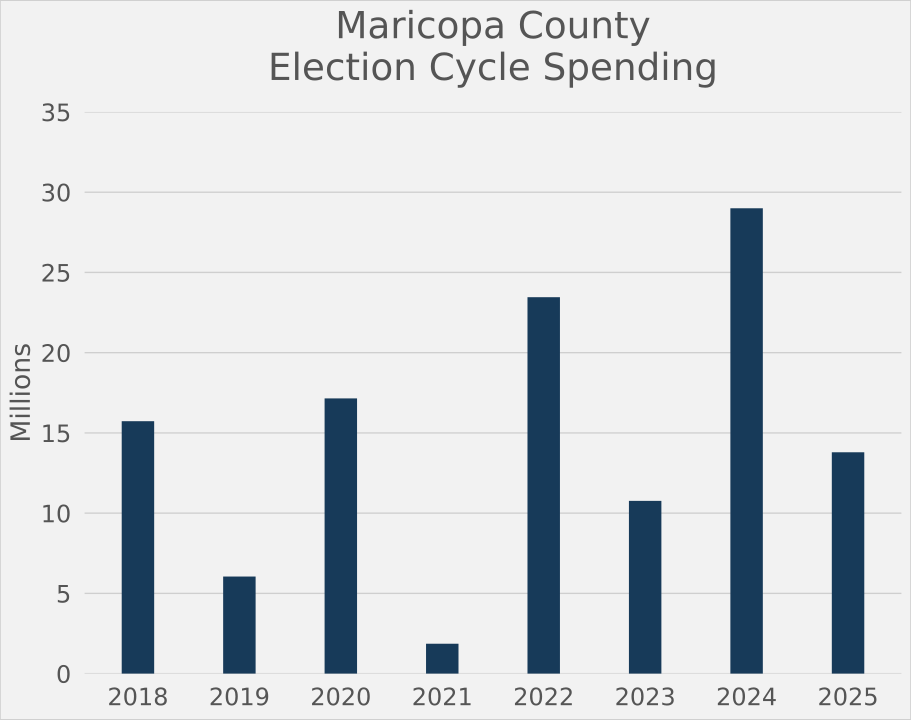
Figure 1. Election Cycle Spending, Maricopa County, by Election Year, 2018–2025
Maricopa County offered more information on election spending than other Arizona counties. It provided more detailed spending specifically related to each election cycle.[10] Because fixed costs such as permanent Recorder’s office staff and technology used for many elections were itemized separately, these data gave a better indication of how much it costs to run off-cycle elections in Arizona. As shown in Figure 1, these data show a significant variation from on-cycle to off-cycle election years from 2018–2025. Average spending during on-cycle years was $21.3 million. Spending in off-cycle years remained significant, at $8.1 million on average.
These figures do not tell us exactly how much it costs to run an election in Maricopa County. The number of races, and how many individuals are registered to vote in each race, can vary dramatically from one election year to another, and across dates within an election year. The marginal cost of adding a race to an existing, on-cycle ballot is likely relatively low. But the fact that on-cycle election spending is so much greater than off-cycle spending suggests that adding races to existing ballots does carry a significant cost. Eliminating off-cycle races would not eliminate the cost of these elections but instead shift some of it to on-cycle years.
Furthermore, the costs of elections are relatively small compared to the county’s total budget. For example, the FY 2025 Maricopa County budget was $3.87 billion. Election cycle spending totaled $29 million—a little under 1% of the total. This is in line with other large Arizona counties. In Pinal County, FY 2025 spending on the Recorder Department and Election Office was $9 million, 0.8% of the total county budget. In Pima County, FY 2025 spending on elections was $7.6 million, 0.4% of the county budget.[11]
Nonetheless, in absolute terms spending is still significant. In 2025, election cycle spending of $29 million in Maricopa County was only slightly less than the county’s total parks and recreation budget of $31 million. In Pinal County, spending on the Recorder & Elections Office ($9 million) was similar to spending on the Superior Court ($9.8 million). In Pima County, elections spending ($7.6 million) was greater than county’s parks and recreation spending ($6.2 million).
Indirect Costs of Off-Cycle Elections
The economic stakes of off-cycle elections are high and often decide very large expenditures by entities such as cities and school districts. In Phoenix, a special bond election in November 2023 decided four questions whereby the district sought $497 million in additional funding.[12] For comparison, the city’s annual budget in FY 2023–24 was approximately $6 billion. Turnout at the 2023 bond election was 22%, compared to 77% at the Phoenix City general election in 2024. In Tucson, a special election in March 2023 decided over a proposed $800 million in spending on affordable housing, police, emergency response, public safety, and “community resilience.” Turnout at the election was 25%.
| Bonds (Million) | Approval | Turnout | |
| Total | $4,035.9 | 53.1% | 24.7% |
| Approved | $2,849 | 58.4% | 22.4% |
| Rejected | $1,186.9 | 40.1% | 30% |
Table 4. School District Bonds Considered, Special Election, Maricopa County, November 2023
Large sums of school district spending were also decided by off-cycle elections. As shown in Table 4, on a single off-cycle election day in November 2023, over $4 billion in school bond approvals were presented to voters in Maricopa County alone. Remarkably, this was more than 90% of the annual budget of $4.35 billion approved by the Maricopa County Board of Supervisors in FY 2024. Around 70% of the school board spending on the ballot in 2023 was approved. Turnout at elections where bonds were rejected was 30%, 7.4 percentage points higher than at elections where bonds were approved.
If the $4 billion in bonds decided in Maricopa County in November 2023 were paid for over a 20-year period, the resulting $200 million increase in annual local taxes would have a significant impact on the local economy. Economic modeling indicates that generating this tax revenue would require 85,000 average jobs, 50,000 average small businesses, or 28,000 high-wage semiconductor jobs.
Although the direct costs of running off-cycle elections may be relatively modest when compared to counties’ total expenditures, the magnitude of public sector spending decided by the voters participating in these elections renders them economically consequential.
Democratic Costs of Off-Cycle Elections
In a democratic system, the public holds officials accountable.[13] Those who don’t want to lose an election must shift their policies toward the preferences of the electorate.[14] Off-cycle elections, marked by low voter turnout, are a means of dodging this democratic ideal.
| On-Cycle | Off-Cycle | |
| Turnout (Mean) | 71.5% | 26.9% |
| Count | 13 | 11 |
Table 5. Turnout at Recent On-Cycle and Off-Cycle Elections in Arizona’s Ten Largest Cities, plus Yuma and Flagstaff[15]
A broad portion of political science scholarship examines local elections in the United States.[16] It identifies one core problem with these elections: “turnout in local elections is abysmally low.” In fact, across America “less than 30% of voting-age adults and less than 40% of registered voters participate in mayoral and city council elections.” [17] Here, Arizona is in line with the rest of the nation. As I show in Table 5, at the largest municipalities’ most recent elections, off-cycle turnout averaged only 26.9%. That is 44.6 percentage points lower than at on-cycle elections.
Low turnout creates significant differences between the voting population at large and those who cast a ballot in local elections. Local politics increasingly mirrors state-level politics, becoming more partisan and polarized. But the voting electorate at elections below the state level is very different. It is much more likely to be white, wealthy, elderly, and organized. Public-school employees, homeowners and the elderly are the most likely to turn out at local elections.[18]
Low turnout leads to a significantly different turnout from the broader electorate, which is a problem for democratic accountability and responsiveness. If only a biased segment of the population participates in elections, and small minorities within that segment are very well-organized, we should expect that politicians’ policies will reflect the preferences and interests of this segment over those of the population at large.
Indeed, there is little evidence that local politicians are held accountable for outcomes such as crime, unemployment, and school performance. Instead, there is growing evidence that local politicians are expected to mirror the state- or national-level stances of their respective parties, rather than deliver on local priorities. One partial exception exists: Evidence shows that mayors are more often punished for poor road and infrastructure maintenance within the cities they lead.[19]
There is a remarkable consensus on the causes of low turnout at local elections in America—off-cycle voting. Georgetown University’s Christopher Warshaw puts it bluntly: “the most important explanation for the low turnout . . . is that many local elections are not held concurrently with high-profile federal elections.”[20] U.C. Berkeley’s Sarah F. Anzia goes further, demonstrating that “shifting from on-cycle to off-cycle election timing has the effect of increasing the electoral presence of the organized,” that is, special interests, such as public sector unions. This is because low turnout greatly increases these organized groups’ share of the vote and, thus, their political influence.[21] A recent study of 1,600 large American cities found that off-cycle elections cause cities to be more swayed by organized interests, most importantly by increasing city employee salary expenditures.[22]
In sum, low turnout is a real, significant concern for democratic accountability and responsiveness in Arizona local politics, as in the rest of America. A large and growing political science literature demonstrates that the main cause of low turnout and associated unresponsiveness is off-cycle voting.
Conclusion
Off-cycle elections are not a quirk of Arizona history. They are a governing choice that predictably narrows participation, concentrates power, and weakens political accountability for decisions carrying enormous fiscal consequences. By separating local elections from high-turnout state and federal contests, Arizona has created a system in which billions of dollars in long-term public spending are routinely approved by a small, unrepresentative subset of voters, often with little sustained public scrutiny.
The economic costs of off-cycle voting are real, though largely indirect. Although the administrative expense of running stand-alone elections is relatively modest compared to other expenditures, the scale of public spending authorized through these low-participation contests exerts a decisive influence over the future of Arizona cities and schools. Local leaders regularly place bond measures, overrides, and long-term tax commitments on off-cycle ballots, with approvals totaling hundreds of millions of dollars each year. These decisions impose enduring tax burdens on Arizona’s economy, despite being ratified by only a narrow slice of the electorate.
These economic burdens cannot be separated from the democratic costs of off-cycle elections. Turnout in off-cycle elections in Arizona averages below 30 percent of registered voters, a figure consistent with national patterns and deeply unrepresentative of the population at large. Off-cycle voters skew older, wealthier, whiter, and more organized, often amplifying the influence of groups with a direct financial stake in expanded public spending.
When elections that determine enormous fiscal commitments attract so little participation, democratic accountability is diminished in favor of special interests. For a state committed to self-government and fiscal responsibility, reforming election timing is essential to the future of Arizona democracy.
End Notes
[1] U.S. Const., Art. II, §1, Cl. 4.
[2] R.S. §25; Mar. 3, 1875, ch. 130, §6, 18 Stat. 400 ; June 5, 1934, ch. 390, §2, 48 Stat. 879.
[3] A.R.S. Const., Art. VII, §11; A.R.S. Const., Art. VII, §17.
[4] See, for example, A.R.S. Const., Art. VII, §13; A.R.S. Const., Art. XIII, §2; A.R.S. Const., Art. XIII, §3.
[6] A.R.S., Ch. 2, § 16-204.01; “Arizona Court Rules for Tucson in Election Date Dispute,” Associated Press, April 14, 2021, https://apnews.com/article/legislature-local-elections-arizona-elections-tucson-6d4f3ee58f0a854325aaff6297b01114.
[7] As of July 2025. Off-cycle elections in bold. This list excludes true primaries, that is, candidate elections that did not determine who held office. In several cases, no election was held on the on-cycle general election date because offices were filled on the primary election date.
[8] See, for example, Agua Fria Union 2023 ($197m), https://static1.squarespace.com/static/55314ad4e4b04c1bc645ad3e/t/651af29bb9a6636e91f135f1/1696264865932/Agua+Fria+FINAL.print.pdf; Avondale Elementary 2023 ($75m), https://static1.squarespace.com/static/55314ad4e4b04c1bc645ad3e/t/651af46b1d5e37740d661875/1696265327650/Avondale+Elem+FINAL.print.pdf; Tolleson 2023 ($125m), https://static1.squarespace.com/static/55314ad4e4b04c1bc645ad3e/t/651af80b37d28f53bc0daa80/1696266253649/Tolleson+Union+FINAL.print.pdf.
[9] See, for example, Sarah Lapidus, “Tucson Councilman Wins Recount Narrowly Over Dem Socialist-Endorsed Primary Rival” in Arizona Republic, August 29, 2025, https://www.azcentral.com/story/news/local/arizona/2025/08/29/kevin-dahl-narrowly-wins-tucson-city-council-recount/85894676007/.
[10] Specifically, the line items labeled “Pri Gen Elec Cycle Spending” under the Elections and Recorder Departments’ annual revised budget figures. Until 2023, there was a single line item under Elections.
[11] Note that these figures are not directly comparable, because Pinal County does not give details on spending specifically related to elections, as Maricopa and Pima Counties do.
[12] See “Informational Pamphlet and Sample of Official Ballot Language for the Special Bond Election,” City of Phoenix, Arizona, November 7, 2023, https://www.phoenix.gov/content/dam/phoenix/cityclerksite/documents/elections/november_2023_special_bond_election_eng.pdf.
[13] See, for example, Adam Przworski, Democracy and the Market: Political and Economic Reforms in Eastern Europe and Latin America (New York: Cambridge University Press, 1991).
[14] See, for example, Christopher H. Achens and Larry M. Bartels, Democracy for Realists: Why Elections Do Not Produce Responsive Government (Princeton: Princeton University Press, 2017).
[15] For a list of elections included, see Table 1.
[16] For an overview, see Christopher Warsaw, “Local Elections and Representation in the United States” Annual Review of Political Science 22 (2019): 461–79, https://papers.ssrn.com/sol3/papers.cfm?abstract_id=3394067.
[17] Ibid., 462-463.
[18] Ibid., 462-466.
[19] Ibid., 466-474.
[20] Ibid., 463.
[21] Sarah F. Anzia, Timing and Turnout: How Off-Cycle Elections Favor Organized Groups (Chicago: University of Chicago Press, 2014), 4.
[22] Adam M. Dynes, Michael T. Hartney and Sam D. Hayes, “Off-Cycle and Off-Center: Election Timing and Representation in Municipal Government” American Political Science Review 115, no. 3 (2021): 1097–1103, https://www.cambridge.org/core/journals/american-political-science-review/article/abs/offcycle-and-off-center-election-timing-and-representation-in-municipal-government/1B1532D1FF9B3ED772BD3123FC9FC45B.