






Dear Reader,
For too long, the actual teaching of students has taken a back seat in our public institutions of higher education. Instead of encouraging a commitment to excellent classroom instruction, faculty members have been encouraged to pursue academic research and publishing above all else. And as the Goldwater Institute has uncovered in this report, the very pursuit of academic research has been infected with ideology, forcing professors to conform to the prevailing agenda of the day or risk their careers. To these institutions’ detriment, their own structure and the incentives for academic career advancement have ensured that there is little thought given to student outcomes in prestigious academia. The time for reform is now. The American Higher Education Restoration Act makes certain that our colleges and universities will return to one of their core responsibilities–excellence in teaching students.
The last half-century has seen our institutions replace classroom instruction with research output. To combat this trend, this legislation will establish new tenure pathways that focus on rewarding the instructional performance of professors. A key component of this legislation is to include actual student feedback in faculty review. Additionally, this legislation will establish a minimum teaching load for faculty with common sense exemptions for outside-funded research or university-approved research. Students should not expect the vast majority of their tuition dollars to fund faculty who have little to no classroom interaction with them.
Fundamentally, our public institutions exist not only to pursue high-quality research, but also to provide top-notch undergraduate and graduate education and to serve the broader public. The American Higher Education Restoration Act ensures that universities prioritize these goals, and, most of all, that excellent and dedicated teaching is rewarded. We owe it to our students and our posterity to make clear that higher education is first and foremost about education.
Nicole Neily
President & Founder
Defending Education
Jenna A. Robinson
President
James G. Martin Center for Academic Renewal
Introduction & Executive Summary
Faculty members at public universities are expected to educate students and advance knowledge through research in their fields of expertise. Academic research, however, has increasingly promoted ideological agendas over the pursuit of truth. The degradation of research raises serious questions about whether the academic research complex should continue to receive massive taxpayer support.
Academic journals serve as gatekeepers that are supposed to ensure academic quality through unbiased review of research results. One of the foremost journals in political science, The American Political Science Review (APSR), plainly demonstrates the politicization of academic research and the peer-review process—leading to a collapse in the basic quality controls of published “scholarship” at public and private universities alike. Through a comprehensive review of the APSR over the past five years, the Goldwater Institute found the following:
- Despite functioning as a de facto gatekeeper of publicly funded research in political science, the editorial team of the APSR from 2020-24 labeled itself “the Feminist Collective,” explicitly declaring that the discipline of political science needed “to actively dismantle the institutionalized racism, sexism, heterosexism, ableism, and settler colonialism that continue to characterize and structure it.”
- The Feminist Collective promised to institute a two-tiered system of standards, actively screening submissions differently based on the authors’ race and sex. Submissions from women and “scholars of color” would be almost automatically advanced to the peer-review stage regardless of quality, while articles written by scholars outside of these categories were subjected to potential “desk rejection” review before being advanced.
- The journal’s editors actively favored submissions steeped in an ideologically charged policy agenda, explicitly calling for articles focused on “pressing political problems, including structural inequalities and the exercise of power by oppressed people,” along with “policing and the carceral state, [and] racialized and gendered health and economic inequalities.”
- Taxpayer-funded “research” published through APSR has devolved into outlandish social activism, featuring articles such as “Wages for Earthwork,” in which the author declares, “I propose ‘wages’ or reparations to Indigenous peoples for debt owed to them for their devalued climate work. . . . I contend that (re)valuing earthwork must also be central to projects aimed at decolonizing climate justice . . . and wider structural transformation of colonial capitalism.”
- Thanks to the APSR’s editorial manipulation, from 2020-25, only three APSR articles (less than 1% of the total articles published) specifically focused on the U.S. Constitution or the 50 state constitutions. The number of articles focusing on race, gender, and/or social justice was more than 40 times greater than the number focused on American constitutions, with nearly one-quarter of all APSR published articles examining race, gender, systemic oppression, or related topics.
- The APSR’s obsession with race- and gender-based political advocacy has led to a flurry of other “scholarship” indistinguishable from left-wing activism, including published “research” articles like “Violence in the American Imaginary: Gender, Race, and the Politics of Superheroes”— in which the author finds that the Marvel character “Punisher’s unrestricted violence valorizes white male grievance.” In an another APSR article titled “Feminist Demands and the Problem of Housework,” the author proclaims, “I endorse the demand to socialize housework,” while another article seeks to show that support for President Donald Trump is “uniquely tied to animus towards minority groups.” Another article “develops a conceptualization of political misogyny: nasty claim-making that instills repugnant connotations into women’s collective political identities.”
- Many APSR articles promulgate, at taxpayer expense, completely obvious claims, such as a finding that depressed people are less motivated to participate in politics.
- A large portion of the Feminist Collective, along with many of the authors of articles cited in this report, served as professors at public universities, including prominent institutions such as the Universities of Arizona, Mississippi, and Michigan. Taxpayers thus subsidized much of this activism masquerading as research.
- Despite recent actions at the state and federal levels to end discriminatory DEI practices, public universities are still beholden to entities like the APSR, which wield enormous influence over the hiring and promotion decisions at public universities, yet which are largely unaccountable to the public, leaving them free to engage in the discriminatory and corrupt practices identified in this report.
- To reduce the waste of taxpayer resources for the corrupt academic research enterprise in non-STEM fields, state legislatures and/or boards of regents of public universities should reform faculty work expectations and create an alternate pathway for faculty advancement focused on instructional excellence rather than research. Such proposals are modeled in the American Higher Education Restoration Act proposed by the Goldwater Institute, Defending Education, and the James G. Martin Center for Academic Renewal.
The Decline of Teaching and the Rise of Dubious Research
Faculty members at colleges and universities across the country are hired to fulfill two primary roles: teacher and researcher. They teach courses and produce research that advances knowledge in their disciplines. Over time, faculty have focused more on research at the expense of teaching. At the most prestigious institutions, faculty typically teach only two to four courses per year (one or two courses per semester), a much lighter teaching expectation than in previous generations. Faculty increasingly fill their non-teaching hours with research.[i]
Perhaps a growing emphasis on research would be a welcome development if these efforts resulted in observable advancements in knowledge. But there is good reason to suspect that often no such progress is occurring. Between 2007-11, faculty at top American universities published around 158,000 articles in academic journals. Between 2015-19, the publication count was 215,000. This growing output, however, has not necessarily led to an increase in quality. In 2022, 10,000 academic publications were retracted because of problems with a paper’s data or conclusions. Compare this number to 2012, when only 1,400 publications were retracted. Moreover, many academic publications are not read by anyone other than the author and the reviewers. One analysis showed that 36% of arts and humanities publications between 1995-2015 were never cited by another publication. As education policy experts Frederick Hess and Richard Keck conclude, “Much of what is published in academe today is transactional, destined to be ignored, and more about careerist routine than about advancing knowledge and understanding.”[ii]
The scholars responsible for overseeing academic journals are also to blame for a decline in research quality, as ideological agendas have replaced scholarly excellence. Look no further than the corruption of peer review, the system that is supposed to ensure the quality of published research.
The Corruption of Quality Control in Academic Research
Peer review is supposed to ensure the legitimacy of published academic research. Faculty members submit articles reporting on their research to academic journals, which are edited by experts in a particular field. The editors then send the articles to one or more reviewers, who are supposed to be experts in the specific areas covered in the article. The reviewers receive an article draft without the author’s name (and the author does not know the names of the reviewers), which is supposed to place the focus entirely on the quality of the research, not on the identity of the author. If the reviewers approve the article, the journal publishes it, communicating new findings to scholars in the field.
Having successfully passed the peer-review process, faculty members can hold up the publication as evidence of their scholarly ability. Those with peer-reviewed publications are more likely to receive grants to support their research and to be awarded tenure at their universities—a virtual guarantee of employment for life.
Peer review conducted by academic publications is thus a lynchpin in the modern academic enterprise. The system supposedly ensures academic quality by subjecting research to unbiased review. Only high-quality research should be accepted for publication. Political agendas should play no role in this process. In theory, academic journals play an essential gatekeeping role by publishing research based solely on the work’s contribution to knowledge, not on the work’s alignment with an agenda, political or otherwise.
The integrity of the peer-review process, however, has come into question. In 2017, three scholars submitted several fake papers to prominent academic journals. These papers included such ridiculous titles as “Human Reaction to Rape Culture and Queer Performativity at Urban Dog Parks in Portland, Oregon.” At the time the hoax was revealed, four of the fake papers had been published, while several more had been accepted for publication or were under review.[iii] The hoax demonstrated that even outrageous papers with fabricated evidence could receive the peer-review stamp of approval if the papers aligned with the ideological leanings of academic gatekeepers. If the peer-review process is corrupt, then universities can no longer rely on academic journals to ensure the legitimacy of faculty research, and the academy thus requires reform of standards for faculty advancement.
Unfortunately, the publication of outlandish “research” is not limited to the work of pranksters seeking to expose the rot of higher education’s peer review ecosystem. Rather, as recently highlighted by the Chronicle of Higher Education and College Fix, the peer-review process has perhaps sunk even lower in recent years. Both the editors and academic peer reviewers for The Journal of the Society for Social Work and Research (published by the University of Chicago Press) accepted for publication in 2025 the article, “Exposing and Disarming Whitelash to Advance Anti-Racism: A Collaborative Autoethnography on Interracial Co-teaching.” Co-authored by a Colorado State University faculty member, this article “highlights the importance of attending to and disrupting white emotional hegemony in the classroom,” declaring that “contesting this whitelash require[s] embracing discomfort” of white students who are made to feel “sad, guilty, angry, [and] ashamed.” Shockingly, the article details the authors’ deliberate attempts to make white students uncomfortable —not students of any other race—in their Social Work course. Despite celebrating such blatant abuse of students and subsequently spurring a U.S. civil rights complaint, this “research” had apparently wowed the authors’ fellow ideological travelers who served as their “peers” and greenlit their paper for publication.[iv]
Consider also the bias of faculty populating the peer-review process more broadly. The most prominent faculty union in the country, the American Association of University Professors (AAUP), recently equated conservatives with fascists and suggested that conservatives lacked the intellectual capacity to do scholarly work. In response to a call for greater intellectual diversity in academia, the AAUP wrote: “Fascism generally doesn’t do great under peer review, but perhaps it’s the intellectual values of academia, which emphasizes critical inquiry & challenges traditional norms, that may be inherently less appealing to those with a more conservative worldview.”[v] In other words, the AAUP is suggesting that peer review is working as intended to screen out conservative viewpoints—“fascism” in the AAUP’s disgraceful rhetoric. The statement reveals the ideological capture of the peer-review process.
These examples of the sorry state of academic research and publishing are no surprise given the increasing ideological imbalance of higher education. For years, universities used “diversity statements” during the hiring process to screen out scholars who refused to pledge loyalty to the tenets of “diversity, equity, and inclusion” (DEI).[vi] These ideological litmus tests ensured that few non-leftists gained faculty positions, further exacerbating the overwhelming political imbalance among university faculty.[vii] Thus, the “peers” who are conducting peer review are increasingly—often perhaps exclusively—left-leaning faculty, which creates a systematic bias against research that challenges leftist ideas, preventing the rise of meaningful ideological diversity in academia. Unfortunately, this concern is not mere conjecture. A recent study analyzing millions of college syllabi shows that professors are already clearly putting their thumbs on the scales in favor of leftist ideas by regularly assigning exclusively left-leaning authors when presenting highly controversial issues such as criminal justice reform and the Israeli-Palestinian conflict.[viii]
If the peer review process is thus populated by faculty overwhelmingly committed to advancing a single ideological perspective, it will increasingly fail to serve as reliable mechanism for evaluating research and the faculty who produce it. This, unfortunately, is precisely what we now see amid the most prestigious “scholarship” being produced by institutions of higher education. Indeed, to see more evidence for the continuing erosion of quality control in academic research, consider The American Political Science Review (APSR), the self-proclaimed “premier scholarly research journal” of political science.[ix].
The American Political Science Review
We chose to investigate the APSR for several reasons. First, the discipline of political science should be of particular interest to policymakers and citizens concerned with public universities. These institutions ought to prepare students to be thoughtful citizens of the American republic. Political science should provide students with essential knowledge of American government, including the institutions and ideals that shape our constitutional republic. Examining the APSR provides insight into this important discipline for educating students at public universities. Second, the APSR claims to be a journal covering all areas of political science. Reviewing the APSR, then, reveals trends in the discipline as a whole. Third, the APSR enjoys undeniable power in the field of political science. According to Journal Citation Reports, the APSR currently ranks in the top five of the most-cited journals for political science. The APSR’s editorial decisions shape the direction of the discipline for years to come.[x]
As this report will show, the APSR adopted an explicit ideological agenda rewarding political conformity over sound scholarship. The statements of the APSR’s editorial team—coupled with the actual output of the journal and others like it, as revealed above—provide clear evidence that such academic journals are increasingly unreliable as barometers of worthwhile research. In turn, they are increasingly undependable as instruments of evaluating public employees for promotion at state-operated institutions.
APSR’s Editors Commit to a Two-Tiered System of Review Based on Race and Sex
The American Political Science Association (APSA), the most prominent professional organization for political science, publishes the APSR. Every four years, the APSA selects a new editorial team for the journal through a competitive process. The political scientists who compose the editorial team set the agenda for the entire publication. They decide the standards that the APSR will adopt for review of article submissions, and they have the final say about whether to publish a submission in the journal. The editorial team exercises enormous power in the field of political science by signaling which favored topics are more likely to be published. The team’s decisions can make the difference between a professor receiving tenure because he successfully published in the APSR, or not.
For the 2020-24 term, two prospective editorial teams submitted proposals to the APSA. One team, composed entirely of women, labeled itself “the Feminist Collective.”[xi] The other team was headed by political scientist John Gerring at the University of Texas.
To increase so-called “diversity” in the APSR, the Feminist Collective explicitly committed to discriminating on the basis of race and sex. In their proposal, the Feminist Collective discussed how they would evaluate article submissions. Once a submission was checked for basic requirements, the submission would enter the “desk-review phase,” in which the editors would decide whether to send the piece to reviewers outside of the APSR or to reject the article prior to peer review. Desk review is thus the first substantive hurdle that a researcher must clear to publish in this elite journal. The Feminist Collective’s proposal specifically indicated that they would adopt a two-tiered system of evaluation based on race and sex at the desk-review phase:
We will also use the desk-review phase as an opportunity to take affirmative action to address the patterns of descriptive and substantive under-representation in the APSR — particularly, though not only, of work by women and scholars of colour and scholarship addressing issues of race, gender, and sexuality. More specifically, we will adopt the policy recommended by the Women’s Caucus for Political Science (WCPS), which suggests that no manuscript that falls under those criteria and that is not rejected for remit should be desk rejected.[xii]
In other words, the editors would almost automatically send an article to the peer-review phase if the authors were of a certain race or sex. Scholars not meeting these criteria, in contrast, needed to pass the desk-review phase. The Feminist Collective thus proposed to engage in explicit discrimination on the basis of race and sex.
This endorsement of discrimination becomes even more shocking when considering the political scientists who wrote this proposal. All 11 members of the prospective editorial team were identified as associate professors or professors, indicating that they had tenure at their respective universities. Seven team members held positions at public universities, including the Universities of Florida, California-Berkeley, Iowa, Purdue (Indiana), and Wisconsin.[xiii]
These were not fringe figures. They held positions at prominent public institutions, and they advocated for discriminatory practices that would likely be illegal if employed at private businesses or government agencies.
The second prospective editorial team (headed by Gerring) also sought to increase the “diversity” of the APSR. Instead of endorsing outright discrimination, however, this team proposed “triple-blind review procedures, according to which neither the reviewers nor editors will know the identity of the author prior to a final decision.” As the proposal explained, the triple-blind procedure “should serve to remove considerations pertaining to the author (his/her gender, race, or professional status) from the process.” In other words, this second potential editorial team endorsed a color-blind and sex-neutral review process that sought to “[keep] the focus on the work rather than the author.”[xiv]
Despite receiving a proposal for removing considerations of race and sex from the peer-review process, the APSA still awarded editorship of the APSR to the Feminist Collective.[xv] The APSA thus endorsed explicit discrimination on the basis of race and sex.
APSR’s Editorial Team Enacts a Leftist Agenda
On June 1, 2020, the Feminist Collective began their four-year term as the editors of the APSR. The team celebrated its “unprecedented” status as an “all-woman” editorial group for a political science journal. The editors further noted:
Our team is also diverse along lines of race, ethnicity, and sexuality, and several of us bring research expertise in these areas to the table. As scholars who engage these topics in our research and who have also worked to increase equity and diversity in the profession and at our own institutions, we believe that our team is well situated to attract and critically evaluate the best work in these areas.[xvi]
The Feminist Collective thus began its tenure by fully committing to a DEI agenda that pushed “equity” over sound scholarship.
The editorial team displayed this commitment in the very first APSR issue published under its leadership in November 2020. The editors dramatically observed that June 1, 2020—the day they took control of the APSR—“was a day marked by Black Lives Matter protests throughout the United States and much of the world following the killing of George Floyd.” On the same day, “the American president [Donald Trump] . . . authorized the use of tear gas, rubber bullets, and flash grenades to disperse the peaceful crowd that had assembled near the White House . . . so that he could pose for photographs at St. John’s Episcopal Church, holding a Bible.” The editors completed their racially charged depiction of the scene by noting that “Muriel Bowser—the Black woman mayor of the District of Columbia, whose residents have no representation in the US legislature—planned her response to the president’s bold assertion of power.” These incidents, the editors explained, reflected the reasons that the Feminist Collective sought to take over the APSR. “Political scientists need to study power, domination, ideology, political violence, and structural injustice,” they declared. “We need to study policing and the carceral state, racialized and gendered health and economic inequalities, populism, the political aspects of religion, and political corruption.”[xvii]
A blog post published by the editorial team in July 2020 was even more explicit. “If the discipline [political science] is to better reflect the diversity of society,” the editors pronounced, “then we need to actively dismantle the institutionalized racism, sexism, heterosexism, ableism, and settler colonialism that continue to characterize and structure it.”[xviii]
In May 2021, the editors reiterated this commitment to DEI. They “hoped to see growth in submissions focused on pressing political problems, including structural inequalities and the exercise of power by oppressed people, including submissions from scholars who themselves identify as members of marginalized communities.”[xix]
The message could not have been clearer. The APSR would now favor research that foregrounded identity categories like race and gender and advanced leftist narratives of systemic oppression.
Throughout their tenure, the editors repeatedly commended themselves for increasing the number of articles that focused on race, gender, and sexuality. In their first annual report, the Feminist Collective celebrated the news that “the proportion of accepted articles that focus on Race, Ethnicity and Politics” was the largest in recent history.[xx] In 2023, during the latter half of the editors’ term, they reported that “while the three previous [editorial] teams published an average of 25 articles about race, ethnicity, and politics over the course of their full terms, we have already accepted 51 such articles.”[xxi]
Nor did the editors merely encourage research that explored identity and oppression. In keeping with the promise in their proposal to discriminate on the basis of race and sex, they repeatedly examined the race and sex of the authors who submitted work to the APSR and the staff involved in soliciting and reviewing submissions. For a publication allegedly devoted to scholarly excellence and employing a blind peer-review process, the race and sex of authors and staff should not matter, but the Feminist Collective repeatedly raised the salience of “identity.”
One of the principles of the Feminist Collective’s “editorial vision” was “representational diversity.” The Feminist Collective formed a “large, representative Editorial Board” composed of over 100 political scientists to advise the editorial team.[xxii] The scholars on this board represented a great “diversity” of “gender and racial identities.”[xxiii]The Feminist Collective proudly produced charts reporting the gender identity and race/ethnicity of board members. Under the chart for gender identity, the editorial team noted, “Although we did not deliberately select board members for their gender, we are pleased that our board overrepresents women in the association, while roughly matching the proportion of women entering graduate school. We are particularly pleased by the number of women of color and women methodologists on our board.”[xxiv] The Feminist Collective summed up its commitment to “representational diversity” by declaring that they sought to “increase the diversity of authors, reviewers, and citations along various lines, including race, gender, sexuality, ability, [and] national origin.”[xxv]
The Feminist Collective’s first annual report in 2021 excitedly shared that, when compared with the previous editorial team’s tenure, the proportion of article submissions authored by women had increased.[xxvi] They also noted an increase in the proportion of article submissions authored by scholars identifying as “Black, Indigenous, or another racial identity” (see Figure 1).[xxvii]
Figure 1
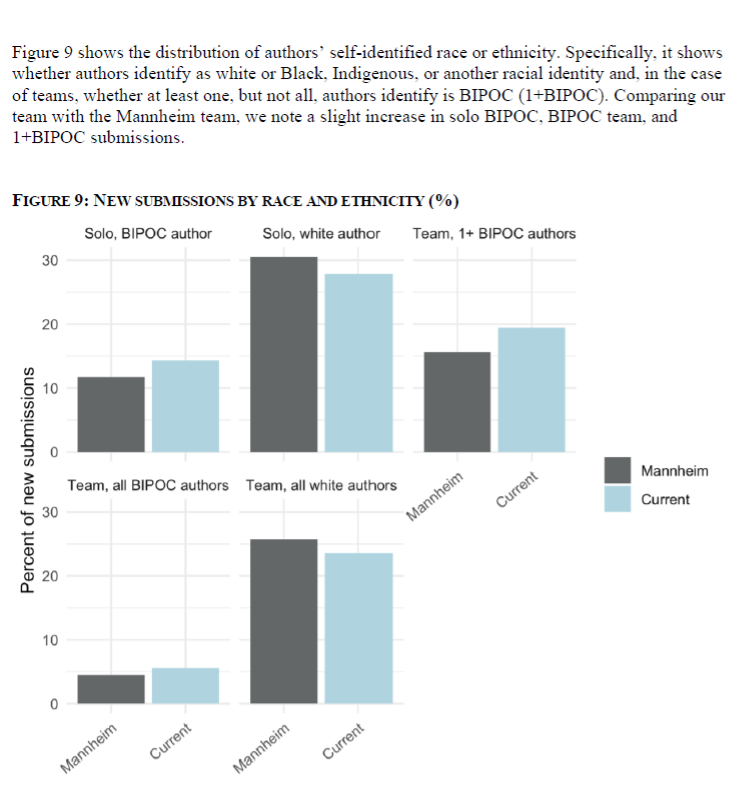
The Feminist Collective continued to analyze the race and sex of authors who submitted to the APSR in subsequent annual reports.[xxviii] In a 2023 update, the editorial team reported that it had succeeded in increasing the number of “women, BIPOC and LGBTQ scholars” who published articles in the APSR.[xxix]
The Feminist Collective made its ideological commitments plain in other ways. The editors produced a “virtual issue” highlighting articles in political science journals that addressed the so-called “crisis of American democracy.” The introduction to the virtual issue blamed “political entrepreneurs who mobilize religious and nationalist groups around traditional values, racism, and new media platforms” for bringing on the “crisis.” “Much work remains,” the introduction stated, “to better comprehend the conflict and violence associated with populism and democratic backsliding.” The issue contained a section dedicated to articles on the Trump presidency, making it clear that the editors believed the “crisis of American democracy” was brought on by conservative and right-leaning politicians and their supporters.[xxx]
APSA Endorses DEI
The Feminist Collective’s four-year term concluded in June 2024, and the group was succeeded by an editorial team headed by John Gerring, the University of Texas political scientist who had lost to the Feminist Collective in 2020. His team had proposed a triple-blind review process that sought to remove considerations of an author’s race, ethnicity, and sex. Some might hope that the decision to grant APSR editorship to this group represents a corrective to the discriminatory policies of the Feminist Collective. But the fact remains that the APSA allowed the Feminist Collective—a group committed to a leftist agenda—to exercise total control over one of the elite journals in political science for four years. Furthermore, the APSA continues to push a DEI agenda, showing that a change in editorial control does not reflect a broader commitment to reforms that restore equal opportunity and scholarly integrity to the organization.
The APSA continues to heartily endorse the crusade against supposed systemic oppression in American society. The APSA website includes numerous pages devoted to DEI. As just one example, the APSA website offers “Resources on Systemic Racism and Social Justice,” which includes links to such content as the “antiracist” ideas of Ibram X. Kendi, Harvard’s “implicit bias assessment test,” and a TED Talk titled “How to be an Ally for Social Justice.”[xxxi]APSA has also undertaken extensive programming “to promote and encourage diversity and inclusion in the profession, to identify and remove systemic barriers to participation, and advance the early careers of scholars who focus on underserved community groups.”[xxxii] The obsession with race and sex in the APSR is merely one aspect of a larger project represented by the APSA, the most prominent political science organization in the country.
Analyzing Research Published in the APSR, 2020-2025
The editorial team that ran the APSR from 2020 to 2024 pursued an agenda informed by leftist ideology. How did the editorial team’s goals for the journal influence the research that was ultimately published?
To analyze a large sample of the research published by the APSR, we examined all articles published between August 2020 and May 2025, covering five full years of the journal. Although the Feminist Collective’s editorial tenure ended in June 2024, it is standard practice that some articles accepted by the previous editorial team are published in journal issues officially edited by the new editorial team. Articles published after June 2024, therefore, still reflect the influence of the Feminist Collective’s editorial practices.
Finding 1: The APSR publishes large amounts of research focused on race, gender, systemic oppression, and related topics.
The Feminist Collective committed to promoting research that focused on various identity categories (race, gender, and sexual orientation) and the oppression of various groups defined by these categories. They proudly noted their commitment to “equity.” And they expressed interest in studies of “structural injustice” and endorsed the goal of “dismantl[ing] … settler colonialism.”[xxxiii] To examine the prevalence of research on these topics, Goldwater reviewed each abstract (the summary of an article’s claims and evidence) for all 549 articles published in the APSR during the review period. We noted the abstracts that discussed one or more of the following topics:
- Race or ethnicity
- Gender
- Sexual orientation
- Colonialism, postcolonialism, or decolonization
- Systemic oppression or structural injustice
- Equity
We found that nearly one quarter of article abstracts (132 articles) addressed these issues.
Furthermore, our review revealed the stark partisanship of articles focused on these topics. Despite many of these pieces being indistinguishable from left-wing policy activism, the APSR nonetheless published them as prestigious scholarship.
One article “develops a conceptualization of political misogyny: nasty claim-making that instills repugnant connotations into women’s collective political identities (e.g., their partisan identities).” Approvingly quoting Representative Alexandria Ocasio-Cortez, the author claims that “calling Hillary Clinton a ‘nasty woman’ makes it easier to apply that moniker to Senator Elizabeth Warren, Vice President Kamala Harris, House Leader Nancy Pelosi, and San Juan Mayor Carmen Cruz.” Furthermore, the author suggests that insults might “extend beyond the individual women who are targeted in ways that construct and maintain gendered political identities that contribute to structural barriers that prevent gender parity in politics.”[xxxiv] In other words, the article argues that insults directed towards female Democratic politicians reinforce systemic misogyny within American society. This long-winded criticism of political attacks against female Democrats did not appear in The Atlantic, The New York Times, or any number of other left-leaning opinion journals, but rather in the self-proclaimed “premier scholarly research journal” of political science. The author of this article is a professor at the University of Arizona, a public institution.[xxxv]
The APSR published other similarly partisan projects, including a 2021 article in which three political scientists “investigate the extent to which citizens’ animus toward (Democratically aligned) minority groups drove political support for Donald Trump, whose incendiary rhetoric regarding such groups is unique in modern presidential politics.” Using survey data, the researchers find that “Trump’s support is . . . uniquely tied to animus towards minority groups.” In other words, the authors suggest that Trump’s supporters are “uniquely” racist when compared to supporters of other politicians or supporters of the two major parties. One of the three authors of this paper is a professor at the University of Mississippi, a public institution.[xxxvi]
This leftist bent was not limited to articles about American politics specifically. Another article, titled “Wages for Earthwork,” argued for “reparations” for people around the world impacted by climate change:
Proponents of climate reparations have focused on reparations for unequal climate damages from emissions. By contrast, I propose “wages” or reparations to Indigenous peoples for debt owed to them for their devalued climate work. This framework makes use of an analogy to the 1970s feminist wages for housework movement, which sought to reveal the exploited and yet indispensable character of systematically devalued work rendered natural and invisible. I contend that (re)valuing earthwork must also be central to projects aimed at decolonizing climate justice, that is, anticolonial climate justice. More than monetary transfers alone, wages for earthwork prioritize the restoration of Indigenous sovereignty and land and wider structural transformation of colonial capitalism.[xxxvii]
Notice that the article does not focus on understanding the effects of climate change, but rather on arguing for a specific political outcome: paying reparations to groups that are allegedly oppressed by “climate injustice.” The use of terms like “decolonizing” shows that the article proceeds from the assumptions of postcolonial ideology, which deems countries like the United States as illegitimate occupiers of indigenous land. “Decolonization” is a rallying cry for, among other things, the anti-Israel movement that plagued American campuses following the Hamas attacks of October 7, 2023. The author works at the University of Michigan, a public institution.
In “Feminist Demands and the Problem of Housework,” the author studies “two feminist demands: the demand for wages for housework and for the socialization of housework.” The author writes, “I endorse the demand to socialize housework as apt for the contemporary care economy and show how my account of demand-making contributes to the political theory of social movements by clarifying movement demands for ‘non-reformist reforms,’ such as defund the police.”[xxxviii] Not content with simply demanding a government takeover of housework, this author also supports “defund[ing] the police.”
Strikingly, both the article arguing for climate reparations and the article calling for socializing housework center on the opinions of the authors, not on an objective analysis of the effects of the proposed policies. The first article “propose[s]” climate reparations, while the second “endorse[s]” the socialization of housework. The APSR is giving space for authors to advocate for their preferred leftist policies, making the journal little more than an organ for a progressive think tank.
Finally, an author devotes an entire scholarly paper to “Gender, Race, and the Politics of Superheroes.” Observing that “law enforcement officers adopted the skull logo of the Punisher,” a Marvel character, in 2020, the author asserts that “Punisher’s unrestricted violence valorizes white male grievance, and this is precisely what appeals to armed agents of the American state.”[xxxix]
These are just a few examples of blatantly partisan articles that littered the APSR from 2020-25. More examples of agenda-driven research may be seen in the appendix.
Finding 2: The APSR shows shockingly little interest in the U.S. Constitution and attacks conservative constitutional thought as racist.
One would expect that “political science’s premier scholarly research journal” would publish at least a handful of articles analyzing America’s long history of constitutional government. As one of the most successful and longstanding frameworks for self-government in world history, the Constitution should merit at least some interest from political scientists.
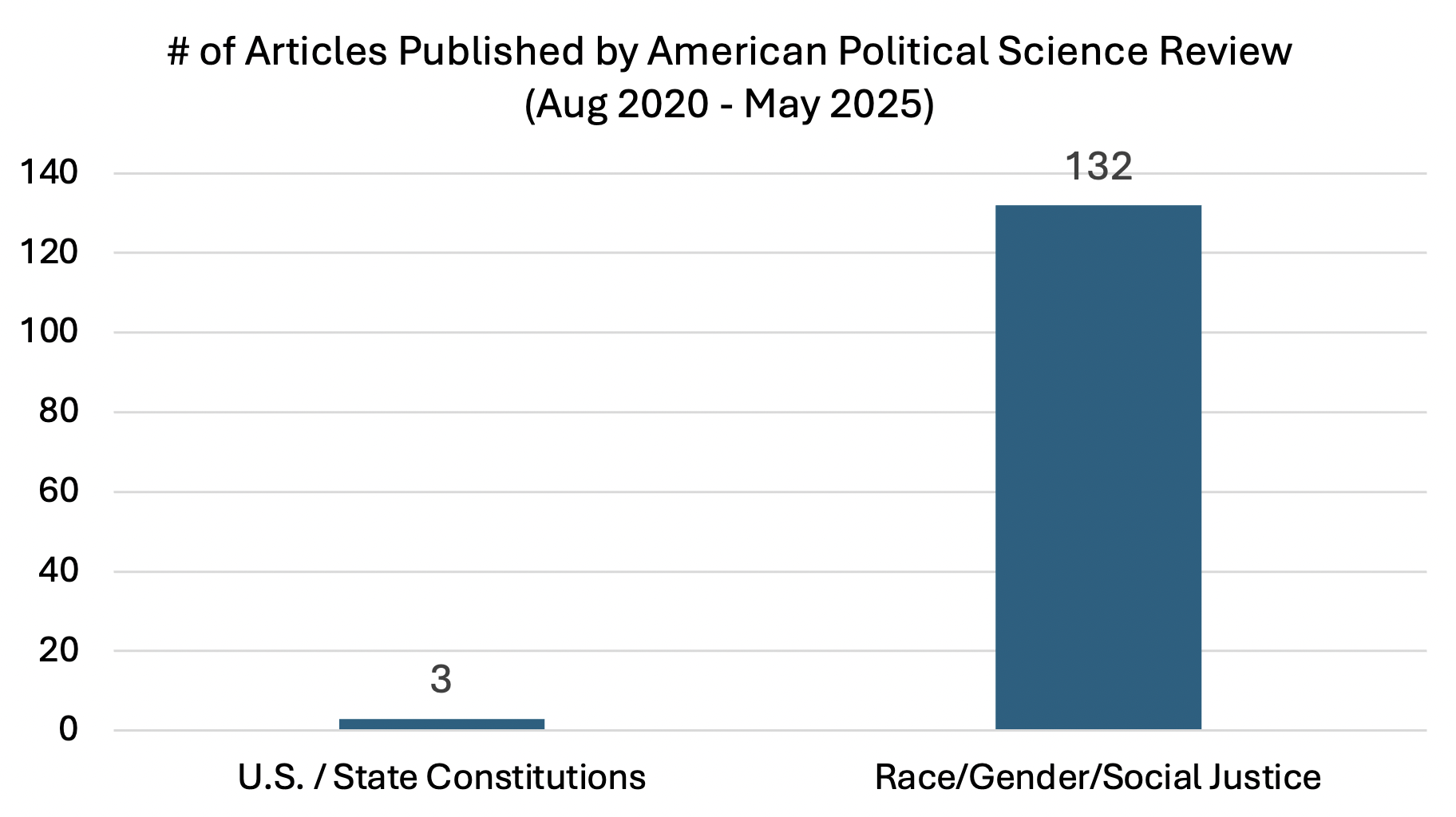
But for the past five years, the APSR did not even publish a handful of articles on American constitutions. Goldwater conducted a search of articles whose abstracts included the words “constitution” or “constitutional,” when used to refer to U.S. Constitution or the 50 state constitutions. This search yielded a grand total of three (3) articles out of the 549 total that APSR published. Less than one percent of articles published by the APSR mentioned American constitutions in their abstracts.[xl]
Compare this pitiful quantity with the 132 articles focusing on race, gender, oppression, and related topics. This latter number was more than 40 times the number of articles with abstracts mentioning American constitutions.
Figure 2
But it gets worse. One of the articles that mentioned American constitutions in its abstract was titled “‘Clocks Must Always Be Turned Back’: Brown v. Board of Education and the Racial Origins of Constitutional Originalism.” The author claims to use “untapped archival data” to show that constitutional originalism (the notion that the Constitution should be interpreted based on the public meaning of the document at the time it was ratified) “grew directly out of political resistance to Brown v. Board of Education by conservative governing elites, intellectuals, and activists in the 1950s and 1960s.” Furthermore, the author argues for “the importance of race to constitutional conservatism’s development.”[xli] Thus, the author asserts that originalism is a doctrine held not for principled reasons, but because of racism. Reflecting the Feminist Collective’s priorities, the author analyzed the history of American constitutionalism through the lens of race and systemic oppression.
It is beyond the scope of this report to rebut the article’s claims (other than to observe that the principles of originalism existed long before the 1950s, as likewise recently articulated by Harvard and University of Chicago scholars[xlii]). We reiterate, however, that one of the three articles including the U.S. Constitution in its abstract is a “scholarly” study purporting to show that American conservatives are racist. Conservatives who believe that the Constitution means what it says and does not “evolve” over time, the article suggests, are the heirs of racist resistance to integration. This anti-conservative screed is one of the few pieces of constitutional “scholarship” that the APSR saw fit to publish in the last five years.
Finding 3: The APSR shows a similar lack of interest in federalism.
A key feature of American government is its federal character. The Constitution specifically recognizes the sovereignty of the states. In contrast to the federal government, which is granted limited and enumerated powers, state governments have much wider latitude for action. As state governments are much closer to the people than the federal government, it is appropriate that state governments have a much greater impact on citizens’ everyday lives than the federal government.
As with scholarship on American constitutions, the APSR published almost nothing on federalism during the review period. A search for “federalism” in article abstracts returned only two articles.
These findings reveal that the supposedly elite ranks of political scientists are simply uninterested in producing and promoting scholarship that examines core principles of American government. Instead, researchers are pumping out huge amounts of work on race, gender, and systemic oppression.
Finding 4: APSR articles make stunningly obvious and trivial claims, raising further doubts about the value of scholarship in the journal.
Beyond the ideological imbalance of the APSR, many articles use supposedly cutting-edge political science techniques to make obvious or trivial claims, which raises doubts about the value of research in the journal.
For example, one article shows that Donald Trump’s The Apprentice television program “helped Trump brand himself as a competent leader and foster viewers’ trust in him.” The authors “find that exposure to The Apprentice increased Donald Trump’s electoral performance in the 2016 Republican primary.”[xliii] Any minimally informed observer of American politics would likely not have needed a postdoctoral academic to explain that President Trump’s celebrity sped his political rise, making it difficult to see what new knowledge has been generated through this study.
Another article makes the entirely unsurprising claim that significant court cases addressing gay marriage prompted increased media coverage of gay marriage. The authors use “computational social science techniques with qualitative analysis” to show that there was “increased attention to same-sex marriage” in “LGBTQ+ media” following important gay marriage cases in the early 2000s.[xliv]
Finally, an article uses statistical techniques to find, predictably, that depression decreases political participation in countries with democratic processes. Depression, the authors show, reduces the likelihood that someone will vote, decreases interest in politics, and lowers the probability that a person will perform “physically demanding” political acts.[xlv]
Reforming What is Expected of Faculty
Universities rely on academic journals like the APSR to judge the quality of their faculty. If a professor’s research passes the peer-review process, the thinking goes, then her research is legitimate. After publishing enough articles, the professor can receive tenure, which all but guarantees a job until retirement.
The triviality—at best—and corruption—at worst—of academic journals revealed in this report, however, means that taxpayers may no longer be able to trust them to provide disinterested evaluation of faculty research at public universities. The APSR and other scholarly publications are private entities and thus rightly free to determine their own standards and practices. But this also means, therefore, that public universities, their governing boards, and state governments have had no means to restore standards of excellence to these journals.
Indeed, despite recent actions at the state and federal levels to end discriminatory DEI practices, public universities are still beholden to entities such as the APSR that have committed to vetting research through the ideological screening mechanism of DEI. But universities need not defer to corrupt academic gatekeepers. They can choose to adopt alternate metrics for faculty advancement.
In short, universities and their governing boards should reset expectations for faculty to reduce wasted time and resources on politicized and academically worthless research.
New Policy Proposals
Public universities should make it clear that (non-STEM) faculty are paid by taxpayers primarily to teach, and that any reduction in teaching responsibilities for the purpose of research should occur only where it is actually advancing human knowledge.
It is for this reason that the Goldwater Institute, Defending Education, and the James G. Martin Center for Academic Renewal have proposed a new suite of higher education reforms: the American Higher Education Restoration Act. Under these proposed policies, all new (non-STEM) faculty would be required to teach a minimum number of courses per year (thereby restoring faculty to their historical expectation of teaching at least 3 courses per semester). While faculty would remain free to conduct research on any topic and even to devote a portion of their contracted time to it, (non-STEM) faculty members would no longer have an automatic blank check to spend more than half of their taxpayer-supported contracted hours on such pursuits. Faculty seeking to spend a greater share of their taxpayer-supported time on research would be required to clear a minimal baseline of assent from peers and taxpayer representatives.
The new model policies would couple this reform with a change in requirements for tenure and advancement. Achieving tenure typically requires a long record of publications in academic journals. Under our proposal, faculty in departments that focus on teaching core courses in American institutions and Western Civilization could earn tenure from their teaching performance, rather than their research profile. This shift in expectations would incentivize faculty to provide excellent instruction, and the publication chase would no longer distract them from their main function of educating students in the pillars of our constitutional republic. Additionally, scholars focusing on American institutions would no longer be beholden to ideologically captured academic journals like the APSR for career advancement. The quality of instruction in higher education would almost certainly increase.
These reforms would eliminate the incentive for academics to pump out politicized and parochial publications that, after all, have very little reach outside of professional circles. Education would be restored to the center of the mission of universities.
Reducing Demand for Radical Faculty
Finally, some may rightfully observe that having ideologically radical faculty spending more time indoctrinating students in the classroom—rather than simply wasting time on “research”—is a potentially even worse outcome. But increasing faculty teaching loads will not increase students’ contact time with radical professors. Rather, it will actually reduce the demand for such radical instructors and will put more pressure on universities to cut the bloated payrolls that currently sustain them in such excess. For instance, under the proposal, universities could cover with just 2 faculty members the same number of course sections currently spread out across 3 faculty members.
Moreover, especially when paired with curricular reforms that have eliminated radical DEI courses from state general education and/or program requirements (thus shutting off the artificial demand for such classes), it will be increasingly difficult for institutions to justify keeping bloated ranks of faculty members whose courses have little value or demand when they can no longer be sheltered in the safe harbor of “research” activity. Although these proposals do not propose altering existing contractual arrangements with current faculty, they will help phase in a transformational shift away from the current model that is failing students and taxpayers alike.
Appendix: APSR Published Articles on Race/Ethnicity, Gender/Sexual Orientation, Colonialism/Decolonization, and Equity/Systemic Oppression/Structural Injustice
(August 2020 – May 2025, ordered reverse chronologically)[xlvi]
| Title | Abstract (Summary) Excerpts |
| To Report or Not to Report on Research Ethics in Political Science and International Relations: A New Dimension of Gender-Based Inequality | “We identify a new dimension of gender-based inequality in the profession which, we argue, stems from voluntary practices of ethics reporting that persist globally in academic publications.” |
| Separate but Unequal: Ethnocentrism and Racialization Explain the “Democratic” Peace in Public Opinion | “We hypothesize that the democratic peace in public opinion owes, in large part, to racialized assumptions about democracy. Rather than regime type per se doing the causal work, the term “democracy” inadvertently primes the presumption that target countries are predominantly white. This implicit racialization, in turn, explains the reluctance of the American public to support aggression against fellow democracies, most notably among respondents higher in ethnocentrism.” |
| Trading Diversity? Judicial Diversity and Case Outcomes in Federal Courts | “We find that assignment of cases to judges of color or women has no statistically significant effect on case outcomes among Democratic appointees… Republican presidents take advantage of Democrats’ preference for diversity on the bench to appoint more conservative judges.” |
| Democratic Equality Beyond Deliberation | “When the frames, interpretations, and concepts speakers bring into debate disproportionately reflect the perspectives of socially advantaged groups, they contribute to hermeneutic injustices that impede marginalized citizens’ voice even under the most favorable deliberative rules.” |
| Tradition and Disruption in Latinx and Latin American Political Thought | “This article presents Latinx political thought as a distinctive tradition in political theory that reworks central concepts in response to historical experiences of conquest, colonialism, migration, and transnational politics.” |
| Geo-Political Rivalry and Anti-Immigrant Sentiment: A Conjoint Experiment in 22 Countries | “We find that discrimination against immigrants from rival states is so pronounced that it results in a net preference for racially and culturally dissimilar immigrants.” |
| On Political Misogyny | “This article develops a conceptualization of political misogyny: nasty claim-making that instills repugnant connotations into women’s collective political identities (e.g., their partisan identities). Attention is also paid to how political misogyny can distribute hatred burdens disproportionately among different groups of women.” |
| Late Homesteading: Native Land Dispossession through Strategic Occupation | “Questionable federal land policies in the late nineteenth century dispossessed massive amounts of Indigenous lands, and exposed the federal government to legal, rather than violent, conflict. Late homesteading was used to make the dispossession permanent, even in cases where a legal defeat eventually occurred.” |
| The Effect of Judicial Decisions on Issue Salience and Legal Consciousness in Media Serving the LGBTQ+ Community | “We find increased attention to same-sex marriage after the decisions in Lawrence, Goodridge, and Lofton, and the coalescence of discussions of courts around same-sex marriage after Lawrence. We also show how LGBTQ+ media informed readers about the political and legal implications of struggles over marriage equality.” |
| The Effect of Protesters’ Gender on Public Reactions to Protests and Protest Repression | “Patriarchy-defiant female protesters like feminists are deemed more deserving of repression despite being perceived as equally likely to be peaceful as female protesters who emphasize patriarchy-compliant femininities, such as women who highlight their roles as mothers and wives. This, I show, is because patriarchy-defiant women are viewed as more immoral, which renders their protest accounts less trustworthy when they clash with government propaganda seeking to legitimize repression.” |
| An Insurgent Mood: Lorraine Hansberry on the Politics of Home | “This article shows how Hansberry’s analysis of many African Americans’ skepticism toward integration into a “burning house” was situated in a global context of anticolonial, anti-capitalist, and feminist struggle. Writing within networks of Black internationalist feminists and presenting a multivalent and relational account of home, Hansberry revealed household labor and relations of intimacy to be central to the making and maintenance of empire, racism, and capitalism, as well as their contestation through acts and affects of insurgency.” |
| Wages for Earthwork | “Proponents of climate reparations have focused on reparations for unequal climate damages from emissions. By contrast, I propose “wages” or reparations to Indigenous peoples for debt owed to them for their devalued climate work. This framework makes use of an analogy to the 1970s feminist wages for housework movement, which sought to reveal the exploited and yet indispensable character of systematically devalued work rendered natural and invisible. I contend that (re)valuing earthwork must also be central to projects aimed at decolonizing climate justice, that is, anticolonial climate justice. More than monetary transfers alone, wages for earthwork prioritize the restoration of Indigenous sovereignty and land and wider structural transformation of colonial capitalism.’ ” |
| An Empire of Development: American Political Thought in Transnational Perspective | “The article demonstrates how developmental ideas and practices have been persistent, if flexible, features across the racialized government of formerly enslaved persons and Native Americans after the Civil War, overseas expansion to the Philippines at the turn of the nineteenth century, and US participation in transnational debates about empire in the early twentieth century and its pursuit of global hegemony after World War II.” |
| From Protest to Child-Rearing: How Movement Politics Shape Socialization Priorities | “A survey of white parents after the summer activism suggests that many—but especially Democrats and those near peaceful protest epicenters—prioritized new forms of race socialization. Further, nearly 2 years after the protests’ height, priming BLM changes support for race-related curricular materials among white Americans.” |
| Leaders but Not Authorities? Gender, Veterans, and Messages about National Security | “Relying on two national studies, we find results that are contrary to our original predictions. First, we find that military bona fides do help women be seen as leaders. However, we do not find evidence that bona fides increase the “authority” to identify and address national security threats for any politicians.” |
| Bureaucratic Representation and Gender Mainstreaming in International Organizations: Evidence from the World Bank | “Deeper implementation of gender mainstreaming is more likely when women staff supervise projects, hold positions of authority, and are more represented as coworkers.” |
| What Is Colonialism? The Dual Claims of a Twentieth-Century Political Category | “It demonstrates how the dual claims of colonialism—a historical reference for the global event of European expansion and a threadbare analytical definition for a particular form of rule—generated a powerful framework in the anticolonial age.” |
| The Apocalypse from Below: The Dangerous Idea of the End of the World, the Politics of the Oppressed, and Anti-Anti-Apocalypticism | “I argue for a form of anti-anti-apocalypticism, using the criticisms directed against the concept as a launchpad to rethink it in viable terms. While acknowledging the value of different ways of defending the apocalypse, I highlight the importance of the causes of apocalyptic movements. Simply put, apocalypses from below are defensible because they have the capacity to clarify the political position of the oppressed and open new political possibilities for the group. By contrast, apocalypses from above, because they fail to fulfill these functions, are not.” |
| Gender, Race, and Interruptions at Supreme Court Confirmation Hearings | “We find that male and white participants are more likely to interrupt women and person of color speakers, respectively, relative to male and white speakers… We also find interruption inequalities are not isolated to women as the interrupted, revealing that people of color in political and legal settings are subject to heightened rates of interruptions as well.” |
| Reversion to the Mean, or Their Version of the Dream? Latino Voting in an Age of Populism | “In 2020, support for Joe Biden among Latina/o/x voters was 8 percentage points lower than support for Hillary Clinton in 2016, the largest drop of any racial/ethnic group. While much media and academic attention has focused on understanding the impact of misinformation, COVID-19 concerns, and racial animus on Latino voters in 2020, we take a step back and clarify the demographic and core ideological characteristics of Latino voters who voted for Donald Trump in 2020… we observe significant pro-Trump shifts among working-class Latinos and modest evidence of a pro-Trump shift among Latinos closer to the immigration experience.” |
| What’s Wrong with Neocolonialism: The Case of Unequal Trade in Cultural Goods | “Historically, colonized peoples were often regarded as inferior based on perceived failures to produce cultural achievements. To the extent that unequal global cultural production and exchange persist, the colonial pattern remains. The duty to relate to foreigners as equals implies that Global North countries should stop pressing for cultural trade concessions and instead favor the import of cultural goods from the Global South.” |
| Willing but Unable: Reassessing the Relationship between Racial Group Consciousness and Black Political Participation | “We find that RGC exhibits a consistently strong relationship with engagement in low-cost political behavior, regardless of whether the behavior has some explicit group-relevant outcome. When engagement becomes more costly, however, Blacks high in RGC are only willing to assume these costs if the engagement has some clear potential for racial group benefit.” |
| From “Chinese Colonist” to “Yellow Peril”: Capitalist Racialization in the British Empire | “I argue that the racial stereotype of “the Chinese” as commercial, industrious, and “colonizing” people emerged from the subsumption of colonial land and labor under capital. Their “colonizing” capacity rendered Chinese migrants simultaneously an economic asset to the British Empire and a potential threat to the white world order. “Capitalist racialization” therefore highlights new inroads into the entwined histories of capitalism, racism, and empire.” |
| My History or Our History? Historical Revisionism and Entitlement to Lead | “We find that inclusive historical narratives increase Muslim participants’ perceived centrality and entitlement, desire to lead, and demand for real-world Muslim leaders.” |
| Descriptive Representation and Party Building: Evidence from Municipal Governments in Brazil | “We theorize that parties retain and promote incumbents based on gendered criteria, disproportionately incentivizing women to recruit party members. However, gendered resource inequalities lower women’s access to the patronage required for recruitment.” |
| Selecting for Masculinity: Women’s Under-Representation in the Republican Party | “We theorize that Republican voters (especially the most conservative) prefer masculine candidates in intraparty and entry-level elections… Republican (but not Democratic) voters penalize candidates with “feminine” self-presentation regardless of the candidate’s sex.” |
| An Incomplete Recognition: An Analysis of Political Science Department Statements after the Murder of George Floyd | “As a discipline centered on power, political science provides an important window into potential responses to episodes of heightened attention to long-standing racial violence and inequality in the United States. During the summer of 2020, political science departments, like many other entities, issued public statements in response to the brutal murder of George Floyd and the long and ongoing history of deadly violence against Black people at the hands of law enforcement. This paper examines these statements, providing a descriptive analysis of themes raised and types of commitments to action. Rhetorical responses to racism constitute important sites for understanding how discursive power is deployed. Ultimately, we observe that proposed solutions contained in statements are not commensurate with the structural understanding of racism encapsulated in statements. These statements suggest that the status quo prevails even among those who study power. We document limited commitments to addressing racism in political statements.” |
| Engineering Territory: Space and Colonies in Silicon Valley | “By reconstructing technology elites’ political visions for celestial settlements within the literature on colonial-era corporations and property, this study argues that the idea of outer space as an empty frontier relies on the same logic of territorialization that was used to justify terrestrial colonialism and indigenous dispossession. It further traces how the idea of “engineering territory” has inspired wider Silicon Valley political exit projects such as cyberspace, seasteading, and network states, which, rather than creating spaces of anarchical freedom, are attempting to recreate the territorial state in new spaces.” |
| Does Victim Gender Matter for Justice Delivery? Police and Judicial Responses to Women’s Cases in India | “Illustrate a pattern of “multi-stage” discrimination. In particular, I show that women’s complaints are more likely to be delayed and dismissed at the police station and courthouse compared to men. Suspects that female complainants accuse of crime are less likely to be convicted and more likely to be acquitted.” |
| Financial Crises and the Selection and Survival of Women Finance Ministers | “Women remain underrepresented in cabinets, especially in high-prestige, “masculine” portfolios…once in office, crises shorten men’s (but not women’s) time in the post. Together, these results suggest that women can sometimes seize on crises as opportunities to access traditionally male-dominated positions.” |
| Instrumentally Inclusive: The Political Psychology of Homonationalism | “The sustained advance in pro-LGBT+ attitudes in the West often contrasts with the greening of anti-immigrant sentiment propagated by nativist supply-side actors. We argue that these parallel trends are causally connected, theorizing that exposure to sexually conservative ethnic out-groups can provoke an instrumental increase in LGBT+ inclusion, particularly among those hostile toward immigration… In a context where sexuality-based liberalism is nationalized, increasing tolerance toward LGBT+ citizens is driven by a desire among nativist citizens to socially disidentify from those out-groups perceived as inimical to these nationalized norms. Our analyses provide a critical interpretation of positive trends in LGBT+ tolerance with instrumental liberalism masking lower rates of genuine shifts in LGBT+ inclusion.” |
| Representation from Below: How Women’s Grassroots Party Activism Promotes Equal Political Participation | “Evidence from a citizen survey and the natural experiment of gender quotas in India confirm that women politicians are more likely to recruit women party activists, and citizens report greater contact with them in reserved constituencies during elections. Furthermore, with women party activists at the helm, electoral campaigns are more likely to contact women, and activist contact is positively associated with political knowledge and participation.” |
| Taking Stock of Solidarity between People of Color: A Mini Meta-Analysis of Five Experiments | “Recent work suggests that solidarity between people of color (PoC) is triggered when a minoritized ingroup believes they are discriminated similarly to another outgroup based on their alleged foreignness or inferiority. Heightened solidarity then boosts support for policies that benefit minoritized outgroups who are not one’s own.” |
| Turnout Turnaround: Ethnic Minority Victories Mobilize White Voters | “Using data from four U.K. general elections and a regression discontinuity design, we find that the next election’s turnout in constituencies narrowly won by an ethnic minority candidate is 4.3 percentage points larger than in constituencies narrowly won by a white candidate. Consistent with our argument, this turnout difference is driven by majority-white constituencies.” |
| The View from the Future: Aurobindo Ghose’s Anticolonial Darwinism | “I argue that Ghose drew on a nuanced reform Darwinism to criticize British imperialism and advance an alternative grounded in the Indian polity’s mutualism. Evolutionism formed a conceptual ecosystem framing his understanding of progress—national, civilizational, and spiritual—and reformulating the temporal and conceptual coordinates of the liberal empire he resisted. The article thus exposes the constructiveness of anticolonial politics, the hybridity of South Asian intellectual history, and the surprising critical potential of Darwinism in colonial settings.” |
| Discrimination Without Traits: From Social Construction to the Politics of Discrimination | “Theories of discrimination have so far neglected the important question of how understanding the nature of these properties impacts our theoretical views of the kind of phenomenon discrimination is. This article outlines some pitfalls of assuming away complexities regarding the ontology of the underlying properties, and systematically develops a constructionist account of discrimination, which I call Discrimination without Traits. I argue pursuing a constructionist view of grounds reveals discrimination to be not a discrete process involving a discriminator and a victim, but an ongoing process of (re)negotiating social reality that is fundamentally political. This uncovers neglected avenues for designing political remedies to discrimination.” |
| Can Racial Diversity among Judges Affect Sentencing Outcomes? | “I find that as the percent of Black judges in a courthouse increases white judges are less likely to render incarceration sentences in cases with Black defendants…However, I find no relationship between judge’s racial identities and disparities in their decisions. This study highlights the importance of conceptualizing diversity as a group characteristic and the relationship between institutional context and outcomes.” |
| Civic Responses to Police Violence | “We find that exposure to police violence leads to significant increases in registrations and votes. These effects are driven entirely by Black and Hispanic citizens and are largest for killings of unarmed individuals. We find corresponding increases in support for criminal justice reforms, suggesting that police violence may cause voters to politically mobilize against perceived injustice.” |
| Demographic Regulation and the State: Centering Gender in Our Understanding of Political Order in Early Modern European States | “European states were constituted through the construction and maintenance of gender regimes. I propose strategies for empirical investigation and argue that a more accurate account of early modern European state-building needs to incorporate demographic regulation and therefore requires gender to be at its center.” |
| Who Shapes the Law? Gender and Racial Bias in Judicial Citations | “Female judges receive less attention from other courts than those by similarly situated men and that this is largely attributable to disparities in citing Black women and Latinas. We also find that additional efforts by Black and Latinx judges to ground their opinions in precedent yield a much lower rate of return in subsequent citations by outside circuits than comparable work by white men and women judges.” |
| Imperfect Victims? Civilian Men, Vulnerability, and Policy Preferences | “In war, dominant narratives construe women as paradigmatic victims, even while civilian men are disproportionately targeted in the most lethal forms of violence. How are such gender-essentialist notions reflected in public opinion? In support of our expectations, respondents consistently underestimate the victimization of men, perceive civilian male victims as less innocent, and hold anti-male biases when it comes to accepting refugees and providing aid. |
| Racial Equality and Anticolonial Solidarity: Anténor Firmin’s Global Haitian Liberalism | “I contextualize his Equality of the Human Races in metropolitan Paris during his first exile, arguing that his critique of anthropological racism should be seen as integral to his commitment to Haitian liberalism. I then situate his discussion of what he called “European Solidarity” in wider legitimating languages of French colonialism. This recovers Firmin’s neglected critique of colonialism as a reciprocal system of economic exploitation and discursive domination, and his attempt to rescue the universal ideal of solidarity from its truncated expression in languages of racial inequality and practices of colonization.” |
| Diversity Matters: The Election of Asian Americans to U.S. State and Federal Legislatures | “The data show Asian Americans preferring candidates of their own ethnic origin and of other Asian ethnicities to non-Asian candidates, indicating strong ethnic and panethnic motives. Asian candidates have comparatively strong crossover appeal, winning at higher rates than Blacks or Latinos for any given percentage of the reference group. All else equal, Asian American candidates fare best in multiracial districts, so growing diversity should benefit their electoral prospects. This crossover appeal is not closely tied to motives related to relative group status or threat.” |
| Contested Killings: The Mobilizing Effects of Community Contact with Police Violence | “These effects are larger when they “trend” on Google, occur in Black communities, or if the victim is Black. Proximity to a killing also increases support for abolishing the police. We conclude that police violence increases electoral participation in communities where narratives about racially unjust policing resonate most.” |
| The Silenced Text: Field Experiments on Gendered Experiences of Political Participation | “We find that female-named volunteers receive more offensive, silencing, and withdrawal responses than male-named or ambiguously named volunteers. However, supporters were also more likely to respond and agree to their asks. These findings help make sense of prior research that finds women are less likely than men to participate in politics, and raise new questions about whether individual women may be perceived as symbolic representatives of women as a group. We conclude by discussing the implications for gender equality and political activism.” |
| Fathers’ Leave Reduces Sexist Attitudes | “Research shows that sexist attitudes are deeply ingrained, with adverse consequences in the socioeconomic and political sphere. We argue that parental leave for fathers—a policy reform that disrupts traditional gender roles and promotes less stereotypical ones—has the power to decrease attitudinal gender bias… we provide causal evidence that the reform increased gender-egalitarian views in the socioeconomic and political domains among mothers and fathers, and raised support for pro-female policies that potentially displace men among mothers….. These results show that direct exposure to progressive social policy can weaken sexist attitudes, providing governments with a practical and effective tool to reduce harmful biases.” |
| Female Representation and Legitimacy: Evidence from a Harmonized Experiment in Jordan, Morocco, and Tunisia | “To investigate how citizens respond to gender representation in committees. We find that women’s presence promotes citizens’ perceptions of the legitimacy of committee processes and outcomes and, moreover, that pro-women decisions are associated with higher levels of perceived legitimacy. Thus, this study demonstrates the robustness of findings from the West regarding gender representation and contributes to the burgeoning literature on women and politics.” |
| Evidence of Caste-Class Discrimination from a Conjoint Analysis of Law Enforcement Officers | “Conducting a survey of law enforcement officers in Nepal, we find evidence of discriminatory investigation practices…and further demonstrate that concerns over systemic bias in policing are warranted.” |
| Antidote to Backsliding: Ethnic Politics and Democratic Resilience | “Mobilized ethnic minorities provide socially rooted electorates with almost an existential need for political rights and civil liberties.” |
| The Politics of Respectability and Black Americans’ Punitive Attitudes | “They are also more likely to support a range of punitive policies that target group members, including restrictive dress code policies, tough-on-crime policies, and paternalistic welfare policies”. |
| Women Grab Back: Exclusion, Policy Threat, and Women’s Political Ambition | “Seeing the policy consequences of their exclusion causes some women to seek a seat at the table.” |
| The “Need for Chaos” and Motivations to Share Hostile Political Rumors | “Across eight studies of individuals living in the United States, we show that this need is a strong predictor of motivations to share hostile political rumors, even after accounting for partisan motivations, and can help illuminate differences and commonalities in the frustrations of both historically privileged and marginalized groups.” |
| Language, Skin Tone, and Attitudes toward Puerto Rico in the Aftermath of Hurricane Maria | “I draw on a framework of racial and ethnic subordination with two dimensions: inferiority–superiority, operationalized by skin color, and foreignness–Americanness, operationalized by language.” |
| Equality, Reciprocity, or Need? Bolstering Welfare Policy Support for Marginalized Groups with Distributive Fairness | “Moreover, dominant groups often hold minoritized groups to a deservingness double standard.” |
| Ticketing and Turnout: The Participatory Consequences of Low-Level Police Contact | “Although even low-level contacts with the police can reduce political participation across the board, our results point to a unique process of political socialization vis-à-vis the carceral state for Black Americans.” |
| Failing the Test: The Countervailing Attitudinal Effects of Civil Service Examinations | “Because more applicants fail than pass, these results suggest that civil service examination outcomes may have unintended consequences for social cohesion—particularly in contexts where successful applicants disproportionately hail from specific ethnic, racial, or religious groups.” |
| Laboratories of Democratic Backsliding | “The Trump presidency generated concern about democratic backsliding and renewed interest in measuring the national democratic performance of the United States…Difference-in-differences results suggest a minimal role for all factors except Republican control of state government, which dramatically reduces states’ democratic performance during this period… The racial, geographic, and economic incentives of groups in national party coalitions may instead determine the health of democracy in the states.” |
| Trauma and Turnout: The Political Consequences of Traumatic Events | “Black social identity conditions this effect—church arsons and Hurricane Katrina mobilize Black voters. “ |
| Misperceptions about Refugee Policy | “This letter explores the prevalence of misperceptions about refugee policy and tests whether correcting these misperceptions changes attitudes toward refugees.” |
| Sanctuary after Asylum: Addressing a Gap in the Political Theory of Refuge | “Given the prevalence of racism, xenophobia, and homophobia in the Global North, and the growing norm of dissident persecution in foreign territory, protection is not guaranteed after either territorial or legal admission.” |
| When Do Männerparteien Elect Women? Radical Right Populist Parties and Strategic Descriptive Representation | “Electorally struggling RRP parties with large gender gaps in voter support increase their proportion of women MPs to attract previously untapped women voters.” |
| Armed Violence and Patriarchal Values: A Survey of Young Men in Thailand and Their Military Experiences | “We conclude that patriarchal values drive voluntary participation in armed conflict, whereas military service as a conscript in a conflict zone does not cause patriarchal values.” |
| Electoral Systems and Gender Inequality in Political News: Analyzing the News Visibility of Members of Parliament in Norway and the UK | “A recent meta-analysis reveals how, in countries with proportional representation (PR), the media pay considerably more attention to men politicians.” |
| Facing Change: Gender and Climate Change Attitudes Worldwide | “Gender differences in concern about climate change are highly correlated with economic development: when countries are wealthier, a gap emerges whereby women are more likely than men to express concern about our changing climate.” |
| Settler Empire and the United States: Francis Lieber on the Laws of War | “Tracing GO100 further exposes the founding of the discipline in Native peoples’ dispossession and extermination.” |
| Whitman’s Undemocratic Vistas: Mortal Anxiety, National Glory, White Supremacy | “That teleology entailed violations of Native sovereignty, the political inequality of Black Americans, and the projection of both Black and Native peoples’ evolutionary extinction.” |
| Political Solutions to Discriminatory Behavior | “Discriminatory treatment of minorities by public authorities remains a serious challenge and breaks with the central principles of impartiality.” |
| Gender and the Influence of Proportional Representation: A Comment on the Peripheral Voting Thesis | “These findings suggest that electoral systems, more than gender, made women peripheral voters” |
| White Americans’ Reactions to Racial Disparities in COVID-19 | “I fielded a survey experiment on a nationally representative sample of 591 white Americans to test whether exposure to information about the disparate impact of COVID-19 on Black people influenced white Americans’ opinion about COVID-19 policies.” |
| Canvassing the Gatekeepers: A Field Experiment to Increase Women Voters’ Turnout in Pakistan | “How can we close persistent gender gaps in political participation? We develop a theory highlighting the role of male household members as “gatekeepers” of women’s participation in patriarchal settings and argue that the answer involves targeting these men.” |
| The Effect of Gender on Interruptions at Congressional Hearings | “We examine speech patterns during more than 24,000 congressional committee hearings from 1994 to 2018 to determine whether women Members are more likely to be interrupted than men. We find that they are.” |
| “This Hearing Should Be Flipped”: Democratic Spectatorship, Social Media, and the Problem of Demagogic Candor | “I thus argue that empowerment requires audiences to interrogate their own spectating practices—a possibility I locate in Hannah Arendt’s thought and interactions surrounding Black Lives Matter protests.” |
| Prejudiced When Climbing Up or When Falling Down? Why Some People of Color Express Anti-Black Racism | “We contend that some people of color express anti-Black prejudice to cope with their own marginalization.” |
| “It’s Like Shouting to a Brick Wall”: Normative Whiteness and Racism in the European Parliament | “The article asks how European whiteness, as a norm, is related to and sustains racism in the European Parliament and how this affects efforts to tackle racism and formulate internal antiracist practices within the institution.” |
| Development in Decolonization: Walter Rodney, Third World Developmentalism, and “Decolonizing Political Theory” | “Eurocentric developmental discourses as ideological weapons of imperial domination, specifically because they defer colonial claims to popular self-rule. “ |
| Policing, Democratic Participation, and the Reproduction of Asymmetric Citizenship | “Yet citizen participation in policing often produces demands to repress marginalized groups, thereby contracting their citizenship rights.” |
| Feminist Demands and the Problem of Housework | “In light of this, I endorse the demand to socialize housework as apt for the contemporary care economy and show how my account of demand-making contributes to the political theory of social movements by clarifying movement demands for “non-reformist reforms,” such as defund the police.” |
| Coming out to Vote: The Construction of a Lesbian and Gay Electoral Constituency in the United States | “The lesbian and gay case provides insights about group and identity formation previously overlooked in party and LGBT politics scholarship” |
| Enfranchisement and Incarceration after the 1965 Voting Rights Act | “Our findings indicate the potentially perverse consequences of enfranchisement when establishment power seeks—and finds—other outlets of social and political control.” |
| The Creative Advance Must Be Defended: Miscegenation, Metaphysics, and Race War in Jan Smuts’s Vision of the League of Nations | “I argue that the League figured in Smuts’s thought as the culmination of the creative advance of the universe: white internationalist unification and settler colonialism was the cosmological destiny of humanity that enabled a racial peace.” |
| Saving Migrants’ Basic Human Rights from Sovereign Rule | “States cannot legitimately enforce their borders against migrants if dominant conceptions of sovereignty inform enforcement because these conceptions undermine sufficient respect for migrants’ basic human rights.” |
| Changing In-Group Boundaries: The Effect of Immigration on Race Relations in the United States | “Consistent with the theory, Mexican immigration improves whites’ racial attitudes, increases support for pro-Black government policies, and lowers anti-Black hate crimes while simultaneously increasing prejudice against Hispanics.” |
| Labor Migration and Climate Change Adaptation | “States may not impose restrictive terms on labor migrants to make accepting greater numbers less costly for themselves because doing so unfairly shifts the costs of adaptation onto the most vulnerable” |
| Ethnic Bias in Judicial Decision Making: Evidence from Criminal Appeals in Kenya | “Judges use more trust-related terms writing for coethnics, suggesting that in-group favoritism motivates coethnic bias in this context.” |
| “Outside Lobbying” over the Airwaves: A Randomized Field Experiment on Televised Issue Ads | “We randomized 31,404 voters to three weeks of interest group ads about either immigration or transgender nondiscrimination.” |
| Violence in the American Imaginary: Gender, Race, and the Politics of Superheroes | “I identify three modes of violence in operation: the unrestricted rage of a white male vigilante, the vulnerability of a feminist heroine, and the sacrificial control of a Black male hero. The article demonstrates the gendered and racialized conditions under which heroic violence is rendered legitimate to American audiences.” |
| This One’s for the Boys: How Gendered Political Socialization Limits Girls’ Political Ambition and Interest | “We find that children not only perceive politics to be a male-dominated space, but with age, girls increasingly see political leadership as a “man’s world.” Simultaneously, as children grow older, they internalize gendered expectations, which direct their interests toward professions that embody the gendered traits that fit with their own sex.” |
| Payments and Penalties for Democracy: Gendered Electoral Financing in Action Worldwide | “This article examines the interplay between gendered electoral financing (GEF) and other crucial factors in democratic elections worldwide to determine whether, how, and why these understudied mechanisms help achieve gender balance in national parliaments.” |
| Under the Microscope: Gender and Accountability in the US Congress | “Our results show that accountability standards are applied differently across legislator gender and suggest a link between the quality of policy representation and the gender composition of American legislatures.” |
| Legal Civic Orders and Equitable Lived Citizenships | “It illustrates the value of this framework by using it show why realistic efforts to achieve equal citizenship must aim for not uniform legal rights and duties but instead equity in the possession of economic resources, political representation, and social recognition among different categories of citizens.” |
| At the Borders of the Body Politic: Fetal Citizens, Pregnant Migrants, and Reproductive Injustices in Immigration Detention | “Debilitation (systematic degradation of a disposable population) enables the appearance of fetal protection to coexist with de facto exposure to death, injury, and risk.” |
| Rethinking Rape Culture: Revelations of Intersectional Analysis | “I argue that conceptual analysis of rape culture must explore other dimensions of power in addition to patriarchy, such as white supremacy, heteronormativity, and capitalist exploitation.” |
| Deprovincializing Racial Capitalism: John Crawfurd and Settler Colonialism in India | “The article concludes with the broader implications of a transimperial analytic framework for writing connected histories of racial capitalism and settler colonialism.” |
| Effective for Whom? Ethnic Identity and Nonviolent Resistance | “We argue that because of prevalent negative stereotypes associating minority ethnic groups with violence, such groups are perceived as more violent even when resisting nonviolently, increasing support for their repression and ultimately hampering campaign success.” |
| Collaboration and Its Political Functions | “However, it has also played nefarious political roles: shoring up patriarchy, legitimizing ethnic cleansing, and bolstering a myth of national unity.” |
| The Curious Case of Theresa May and the Public That Did Not Rally: Gendered Reactions to Terrorist Attacks Can Cause Slumps Not Bumps | “We conclude that conventional theory on rally events requires revision: women leaders cannot count on rallies following major terrorist attacks.” |
| Coalitional Lobbying and Intersectional Representation in American Rulemaking | “Interest groups representing the marginalized regularly neglect advocacy on behalf of their most vulnerable constituents—those with intersectional disadvantage.” |
| A Note on Posttreatment Selection in Studying Racial Discrimination in Policing | “Our reanalysis shows that the naive estimator that ignores the posttreatment selection in administrative records may severely underestimate the disparity in police violence between minorities and whites in these and similar data.” |
| Overcoming the Political Exclusion of Migrants: Theory and Experimental Evidence from India | “Migrants are politically marginalized in cities of the developing world, participating in destination-area elections less than do local-born residents.” |
| Workplace Contact and Support for Anti-Immigration Parties | “increased interactions with minorities can reduce opposition to immigration among native-born voters, which, in turn, leads to lower support for anti-immigration parties” |
| A “Common Spectacle” of the Race: Garveyism’s Visual Politics of Founding | “The convention’s spectacular performances were a vehicle through which participants came to understand themselves as constituting the Universal Negro—a transnational and empowered political subject.” |
| A Logical Model for Predicting Minority Representation: Application to Redistricting and Voting Rights Cases | “Understanding when and why minority candidates emerge and win in particular districts entails critical implications for redistricting and the Voting Rights Act. “ |
| Public Perceptions of Women’s Inclusion and Feelings of Political Efficacy | “Citizens gain important symbolic benefits when they are represented by gender-inclusive institutions…I find that believing women are included is associated with higher levels of external efficacy among both men and women. “ |
| Gender, Candidate Emotional Expression, and Voter Reactions During Televised Debates | “Angela Merkel expresses less anger than her male opponents, but she is just as emotive in other respects. Combining these measures of emotional expression with continuous responses recorded by live audiences, we find that voters punish Merkel for anger displays and reward her happiness and general emotional displays.” |
| The Opinion-Mobilizing Effect of Social Protest against Police Violence: Evidence from the 2020 George Floyd Protests | “We find that the Floyd protests swiftly decreased favorability toward the police and increased perceived anti-Black discrimination among low-prejudice and politically liberal Americans.” |
| Activating Animus: The Uniquely Social Roots of Trump Support | “Trump’s support is thus uniquely tied to animus toward minority groups.” |
| Close to Home: Place-Based Mobilization in Racialized Contexts | “We develop a theory of place-based mobilization to explain the role of “the community” in acting as a site of coidentification and political action for marginalized groups. |
| “Clocks Must Always Be Turned Back”: Brown v. Board of Education and the Racial Origins of Constitutional Originalism | “Finally, by showing the importance of race to constitutional conservatism’s development, this article posits that the received understanding of a “three-corner stool” of social, economic, and foreign policy conservatism needs revision.” |
| Constitutional Reform and the Gender Diversification of Peak Courts | “Scholars have debated whether concentrating appointment power in a single individual or diffusing appointment power across many individuals best promotes gender diversification.” |
| Gender and Party Discipline: Evidence from Africa’s Emerging Party Systems | “We theorize that parties select candidates based on gendered criteria, leading to the (s)election of more disciplined women” |
| The Democratic Deficit in U.S. Education Governance | “These gaps are most pronounced in majority nonwhite jurisdictions and school districts with the largest racial achievement gaps. Our novel analysis provides important context for understanding the political pressures facing school boards and their likely role in perpetuating educational and, ultimately, societal inequality.” |
| Does Health Vulnerability Predict Voting for Right-Wing Populist Parties in Europe? | “The influence of health on support for right-wing populist parties appears to be greater than that of income and self-reported economic insecurity, while less than that of gender and attitudes about immigrants.” |
| Women Thinkers and the Canon of International Thought: Recovery, Rejection, and Reconstitution | “Rather it is due to the gendered and racialized selection and reception of work that is deemed to be canonical.” |
| From Thin to Thick Representation: How a Female President Shapes Female Parliamentary Behavior | “women parliamentarians still face significant discrimination and stereotyping, inhibiting their ability to have a real voice and offer “thick” representation to women voters.” |
| To Emerge? Breadwinning, Motherhood, and Women’s Decisions to Run for Office | “These findings have important implications for understanding how the political economy of the household affects candidate emergence and descriptive representation in the United States.” |
| Universal Suffrage as Decolonization | “Universal suffrage as decolonization. The dream emerged from efforts by Black Atlantic radicals to conscript universal suffrage into wider movements for racial self-expression and cultural revolution.” |
| When Are Legislators Responsive to Ethnic Minorities? Testing the Role of Electoral Incentives and Candidate Selection for Mitigating Ethnocentric Responsiveness | “Studies have documented ethnic/racial bias in politicians’ constituency service, but less is known about the circumstances under which such ethnocentric responsiveness is curbed” |
| Gone For Good: Deindustrialization, White Voter Backlash, and US Presidential Voting | “We argue that deindustrialization threatens dominant group status, leading some white voters in affected localities to favor candidates they believe will address economic distress and defend racial hierarchy.” |
| Slavery, Reconstruction, and Bureaucratic Capacity in the American South | “Yet, contrary to expectations, in ranked societies—where social status is a cleavage—elites can instead build cross-class coalitions to undertake a strategy of bureaucratic weakening to limit future redistributive taxation.” |
| Family Matters: How Immigrant Histories Can Promote Inclusion | “Our findings show that priming family history generates small but consistent inclusionary effects. These effects occur even among partisan subgroups and Americans who approve of President Trump.” |
| Suppressing Black Votes: A Historical Case Study of Voting Restrictions in Louisiana | “The findings of this paper have important implications for understanding the potential for discrimination in the enforcement of modern, ostensibly nonracial, voter eligibility requirements, such as voter ID laws, which grant substantial discretion to local officials in determining voter eligibility.” |
| Fundraising for Stigmatized Groups: A Text Message Donation Experiment | “As government welfare programming contracts and NGOs increasingly assume core aid functions, they must address a long-standing challenge—that people in need often belong to stigmatized groups.” |
| Women’s Descriptive Representation and Gendered Import Tax Discrimination | “Our work highlights a previously unacknowledged government policy that penalizes women and also provides powerful evidence that descriptive representation can have a substantial, direct impact on discriminatory policies.” |
| Reconciling the Theoretical and Empirical Study of International Norms: A New Approach to Measurement | “In turn, I develop a modified Bayesian model with substantively informed dynamic priors. The proposed approach is evaluated with the lesbian, gay, and bisexual (LGB) equality norm, using 13 policies and laws across 196 countries (1990–2017).” |
| Which Identity Frames Boost Support for and Mobilization in the #BlackLivesMatter Movement? An Experimental Test | “The Black Lives Matter (BLM) movement has organized hundreds of disruptive protests in American cities since 2013 (Garza 2014; Harris 2015; Taylor 2016)…. In this paper, we use a survey experiment to test the effect of three of these frames—Black Nationalist, Feminist, and LGBTQ+ Rights—on the mobilization of African Americans. We find that exposure to these frames generates differential effects on respondents’ willingness to support, trust, canvass, and write representatives about the Black Lives Matter movement. These findings raise new questions about the deployment of intersectional messaging strategies within movements for racial justice.” |
| The Distinctive Political Status of Dissident Minorities | ” ‘Dissident minorities’ are members of marginalized groups who dissent from the consensus group position on matters seen as critical to their group’s collective liberation… Both the powers and vulnerabilities of dissident minorities, in turn, converge around the prospect of ‘tokenization’—the use of the dissident minority’s dissident opinion by majority group actors as a means of discharging a stipulated obligation to engage with the minority group writ large.” |
| Women’s Representation and the Gendered Pipeline to Power | “We examine the gendered pipeline to power across three potential candidate pools: lower-level officeholders, those named in newspapers as likely candidates, and lawyers who made political contributions… For the gender disparity in candidates to close, women have to be far more likely to run for office than men, particularly on the Republican side. Our results highlight the need to consider the gendered pipeline to power alongside rates of entry in studies of women’s underrepresentation.” |
| How Much is One American Worth? How Competition Affects Trade Preferences | “Here we examine how two forms of this phenomenon—ethnocentric valuation and moral exclusion—affect attitudes toward international trade. We hypothesize that attitudes toward competition and believing that trade is a competition moderate the extent of ethnocentric valuation and moral exclusion.” |
| Does Political Affirmative Action Work, and for Whom? Theory and Evidence on India’s Scheduled Areas | “There are large gains for targeted minorities, and that these gains come at the cost of the relatively privileged, not other minorities. We also find improvements in other pro-poor programs, including a rural roads program and general public goods… Contrary to the expectations of skeptics, results indicate that affirmative action can redistribute both political and economic power without hindering overall development.” |
| Who Governs? A New Global Dataset on Members of Cabinets | “We then demonstrate how the data can be used to gain new insights into diverse fields such as the study of autocracies, gender studies, the study of regime types, and government formation.” |
| Administrative Records Mask Racially Biased Policing | “We develop a bias-correction procedure and nonparametric sharp bounds for race effects, replicate published findings, and show the traditional estimator can severely underestimate levels of racially biased policing or mask discrimination entirely.” |
| Agenda Seeding: How 1960s Black Protests Moved Elites, Public Opinion and Voting | “I hypothesize protest tactics influence how news organizations frame demands. Evaluating black-led protests between 1960 and 1972, I find nonviolent activism, particularly when met with state or vigilante repression, drove media coverage, framing, congressional speech, and public opinion on civil rights. “.” |
End Notes
[i] Frederick M. Hess and Richard B. Keck, “It’s Time for College Professors to Teach,” Manhattan Institute, April 29, 2025, https://manhattan.institute/article/its-time-for-college-professors-to-teach.
[ii] Hess and Keck, “It’s Time for College Professors to Teach.”
[iii] Jennifer Schuessler, “Hoaxers Slip Breastaurants and Dog-Park Sex Into Journals,” New York Times, October 4, 2018, https://web.archive.org/web/20181010200500/https://www.nytimes.com/2018/10/04/arts/academic-journals-hoax.html; Yascha Mounk, “What an Audacious Hoax Reveals About Academia,” The Atlantic, October 5, 2018, https://www.theatlantic.com/ideas/archive/2018/10/new-sokal-hoax/572212/.
[iv] Emma Pettit, The Chronicle of Higher Education, “‘I Don’t Feel Safe in This Classroom,’” November 5, 2025, https://www.chronicle.com/article/i-dont-feel-safe-in-this-classroom.
[v] Daniel Buck (@MrDanielBuck), X post, October 21, 2025, https://x.com/MrDanielBuck/status/1980688215440019462.
[vi] “The New Loyalty Oaths: How Arizona’s Public Universities Compel Job Applicants to Endorse Progressive Politics,” Goldwater Institute, January 17, 2023, https://www.goldwaterinstitute.org/policy-report/the-new-loyalty-oaths/#_edn4.
[vii] Jay Greene, “Educators Overwhelmingly Support Democrats, Even in Republican States,” Educational Freedom Institute, https://www.efinstitute.org/wp-content/uploads/2024/10/EFI-PoliticalDonations_JGreene.pdf (accessed November 14, 2025).
[viii] Jon A. Shields and Yuval Avnur, “Evidence Backs Trump on Higher Ed’s Bias,” The Wall Street Journal, August 13, 2025, https://www.wsj.com/opinion/evidence-backs-trump-on-higher-eds-bias-politics-13d4fec0.
[ix] American Political Science Review, Cambridge University Press, https://www.cambridge.org/core/journals/american-political-science-review.
[x] See ProQuest page for American Political Science Review.
[xi] Aili Tripp and Michelle Dion, “American Political Science Review Annual Editorial Report,” American Political Science Association, July 2024, https://apsanet.org/wp-content/uploads/2024/10/APSR-2023-24-Annual-Report-.pdf.
[xii] Julie Novkov et al., “Proposal to Edit the American Political Science Review,” October 2018, https://ufile.io/kexdm035, 7.
[xiii] Novkov, “Proposal to Edit the American Political Science Review,” 15-20.
[xiv] John Gerring et al., “Proposal: The American Political Science Review,” May 11, 2019, https://utexas.app.box.com/s/gnifxxnbiq4dmvv15uhj8aq0xasg3d4h, 4, 9.
[xv] Colleen Flaherty, “This Journal’s Future Is Female,” Inside Higher Ed, July 29, 2019, https://www.insidehighered.com/news/2019/07/30/political-science-association-pleases-and-surprises-members-its-flagship.
[xvi] Michelle Dion, Clarissa Rile Hayward, Kelly Kadera, and Julie Novkov, “American Political Science Review Editorial Report,” American Political Science Association, April 2021, https://apsanet.org/Portals/54/journals/Editorial%20Report%20for%20APSA%20Council%20Apr%2012%202021.pdf?ver=yBQUPdONe9_iou7kkIadCA%3d%3d×tamp=1620744347710, 2.
[xvii] “Notes from the Editors,” American Political Science Review 114, no. 4 (November 2020): v.
[xviii] APSR Editors, “Moving Beyond the Rhetoric of Diversity and Inclusion,” Cambridge Core Blog, July 27, 2020, https://www.cambridge.org/core/blog/2020/07/27/moving-beyond-the-rhetoric-of-diversity-and-inclusion/.
[xix] “Notes from the Editors,” American Political Science Review 115, no. 2 (May 2021): p. v.
[xx] Dion et al., pp. 22-23.
[xxi] “Notes from the Editors: A Bigger Pie,” American Political Science Review 117, no. 3 (August 2023): v.; The editors used the presence of certain keywords in the article abstract to classify an article as “about race, ethnicity, and politics.” The finding of 51 such articles does not include articles that focus on “sexuality and politics” and “gender and politics,” which the editors placed under separate categories. This method of classification explains why Goldwater found a substantially higher number of articles that focused on race, gender, systemic oppression, and related topics (132 articles).
[xxii] Dion et al., p. 7.
[xxiii] Dion et al., p. 3.
[xxiv] Dion et al., p. 36.
[xxv] “Notes from the Editors: Increasing Qualitative Submissions,” American Political Science Review 116, no. 2 (May 2022): v.
[xxvi] Dion et al., p. 26.
[xxvii] Dion et al., p. 27.
[xxviii] Aili Tripp and Michelle L. Dion, “American Political Science Review Editorial Report,” American Political Science Association, October 2022, p. 24, https://apsanet.org/Portals/54/journals/APSR%202022%20Editorial%20Report%2010.1.22.pdf?ver=JDV-UVzgKu5Ec1xu9W4pnA%3d%3d; Aili Tripp and Michelle Dion, “American Political Science Review Editorial Report,” American Political Science Association, October 2023, pp. 23-25, https://apsanet.org/Portals/54/journals/APSR%202023%20Annual%20Report%20.pdf; Aili Tripp and Michelle Dion, “American Political Science Review Annual Editorial Report,” American Political Science Association, July 2024, pp. 17-20, https://apsanet.org/wp-content/uploads/2024/10/APSR-2023-24-Annual-Report-.pdf.
[xxix] “Notes from the Editors: A Bigger Pie,” August 2023: viii.
[xxx] “Articles on the Crisis of American Democracy,” American Political Science Association, Cambridge University Press, https://www.cambridge.org/core/societies/american-political-science-association/articles-on-the-crisis-of-american-democracy.
[xxxi] APSA Resources on Systemic Racism & Social Justice, American Political Science Association, https://apsanet.org/RESOURCES/APSA-Resources-for-Addressing-Systemic-Racism-Social-Justice/ (accessed November 12, 2025).
[xxxii] Diversity and Inclusion Resources, American Political Science Association, https://apsanet.org/diversity/resources-for-diversity-and-inclusion/ (accessed November 12, 2025).
[xxxiii] APSR Editors, Moving Beyond the Rhetoric of Diversity and Inclusion.
[xxxiv] Suzanne Dovi, “On Political Misogyny,” American Political Science Review 119, no. 2 (May 2025): 1054.
[xxxv] American Political Science Review, Cambridge University Press, https://www.cambridge.org/core/journals/american-political-science-review (accessed November 12, 2025).
[xxxvi] Lilliana Mason, Julie Wronski, and John V. Kane, “Activating Animus: The Uniquely Social Roots of Trump Support,” American Political Science Review 115, no. 4 (November 2021): 1508.
[xxxvii] David Myer Temin, “Wages for Earthwork,” American Political Science Review 119, no. 1 (February 2025): 179.
[xxxviii] Katrina Forrester, “Feminist Demands and the Problem of Housework,” American Political Science Review 116, no. 4 (November 2022): 1278.
[xxxix] Menaka Philips, “Violence in the American Imaginary: Gender, Race, and the Politics of Superheroes,” American Political Science Review 116, no. 2 (May 2022): 470.
[xl] An additional similarly small number of APSR articles published during this time period referenced global datasets of constitutions that may incidentally include the U.S. Constitution and/or other American constitutions among their data points. While these articles are excluded from the present analysis, they do not materially affect the finding that APSR research on such constitutions is minimal.
[xli] Calvin TerBeek, “‘Clocks Must Always Be Turned Back’: Brown v. Board of Education and the Racial Origins of Constitutional Originalism,” American Political Science Review 115, no. 3 (August 2021): 821.
[xlii] Stephen E. Sachs and William Baude, “Yes, The Founders Were Originalists” (July 15, 2025), Yale Journal of Law & the Humanities, Vol. 36 (forthcoming 2025), University of Chicago Law School, Public Law & Legal Theory Research Paper 25-33, https://ssrn.com/abstract=5352553.
[xliii] Eunji Kim and Shawn Patterson, “The American Viewer: Political Consequences of Entertainment Media,” American Political Science Review 119, no. 2 (May 2025): 917.
[xliv] Christine M. Bailey, Paul M. Collins, Jesse H. Rhodes, and Douglas Rice, “The Effect of Judicial Decisions on Issue Salience and Legal Consciousness in Media Serving the LGBTQ+ Community,” American Political Science Review 119, no. 1 (February 2025): 108.
[xlv] Claudia Landwehr and Christopher Ojeda, “Democracy and Depression: A Cross-National Study of Depressive Symptoms and Nonparticipation,” American Political Science Review 115, no. 1 (February 2021): 323.
[xlvi] American Political Science Review.