





The desire to understand humanity’s past is as old as civilization itself, and archaeology and anthropology have long been the disciplines that make key insights possible. By studying ancient bones, tools, and artifacts buried beneath the soil of North America, scientists have reconstructed migrations that occurred thousands of years before written history, traced the rise and fall of ancient cultures, and uncovered clues about how climates and ecosystems changed over millennia. Museums and universities have acted as the custodians of this fragile record, preserving it not only for scholars but also for the public, ensuring that the story of the continent’s earliest inhabitants could be seen, studied, and understood not just today, but by future generations as well.
Now the work of preserving the past is increasingly at risk, threatened by a dangerous mixture of good intentions and harmful ideology.
In 1990, Congress attempted to reconcile the scientific process of analyzing archaeological artifacts with concerns raised by Native American tribes about the treatment of ancestral remains. The result was the Native American Graves Protection and Repatriation Act, or NAGPRA, a law intended to address past abuses while preserving the ability of museums and universities to continue studying materials that could not reasonably be connected to modern, federally recognized tribes. In theory, the statute represented a compromise: Sacred objects and identifiable ancestral remains would be returned to tribes while other artifacts and extremely ancient materials would remain available for research and public education.
In Arizona, state law designates the Arizona State Museum (ASM), located at the University of Arizona, as the official reporting authority when human remains or archaeological artifacts at least fifty years old are discovered. As a result, the museum plays a central role in determining how NAGPRA is interpreted and applied across the state.
Over time, however, the interpretation and application of NAGPRA have changed. Activists, regulators, and increasingly risk-averse museum administrators have begun interpreting NAGPRA regulations as applicable far beyond what Congress originally intended. Remains that predate modern tribes by thousands of years are now slated for tribal reburial. Ordinary artifacts—and even objects created for commercial sale—have been removed from museum collections or withdrawn from displays. In some cases, the expansion of repatriation policies has effectively barred scientists from studying materials that once formed the foundation of much archaeological research.
The consequences are now visible across Arizona’s research institutions. Research on Arizona’s prehistoric past has largely ceased, Native American art associated with museum collections has declined in visibility, and science museums are increasingly turning away from scientific interpretation and toward spiritual or animistic creation narratives to explain the desert’s natural history.
The impact of these changes has been amplified by recent federal regulations instructing museums and universities to defer to tribal “traditional knowledge” when determining the “appropriate” care and handling of human remains and cultural artifacts. What was a modest accommodation has come to carry significant consequences. In some cases, these policies have produced rules that exclude female researchers from handling certain materials, effectively importing traditional gender taboos into modern academic institutions and placing women scholars at a professional disadvantage.
Home to 22 federally recognized tribes,[1] Arizona offers a particularly revealing case study of this transformation. Long regarded as one of the most important centers of archaeological research in the American Southwest, the state now finds many of its collections disappearing from scientific inquiry as increasing numbers of artifacts are placed off limits to researchers. As institutions move to repatriate materials, restrict access to collections, and defer to activist interpretations of cultural affiliation, entire areas of anthropological research may be shutting down. In effect, a significant field of scientific inquiry has been placed at risk by an overzealous activist movement using the regulatory power of the state to pressure museums and universities into compliance with its demands.
The path forward lies not in abandoning NAGPRA entirely, but in restoring the balance Congress originally intended. That may require challenging the sweeping regulatory changes implemented in December 2023 by the Biden administration and reaffirming that repatriations must adhere strictly to the law’s original definitions of sacred objects, funerary objects, and objects of cultural patrimony. Only by returning to those statutory boundaries can museums continue to respect tribal traditions while preserving the archaeological record that enables Americans to understand the continent’s deep past.
State and Federal Laws
Congress passed NAGPRA in 1990 to address complaints by Native American tribes regarding how archaeologists and anthropologists had conducted research in the past. These researchers, operating under now-obsolete research standards, had sometimes excavated human remains and the items buried with them (known as funerary objects) without consideration for the cultural and spiritual beliefs of tribes—in some cases trespassing on tribal lands and removing objects without permission.
NAGPRA gave federally recognized tribes the ability to “repatriate”—that is, demand the return of—human remains and funerary artifacts from federally funded institutions, such as museums and universities, while still allowing anthropologists and archaeologists at these institutions to continue to curate, research, and display items that did not fall into the above-mentioned categories (regardless of the materials’ origins).[2]
Artifacts that fell outside of these categories, and were therefore not subject to repatriation, including:
- Items of everyday use, such as arrowheads used in hunts, and cooking ware
- Refuse, such as butchered animal remains
- Soil and plant materials
- Fossilized feces (also known coprolites)
Replicas or items specifically created for profit or display were also excluded from repatriation, with the Select Committee on Indian Affairs stating in their September 26, 1990 report:
It has been suggested that some Native American artisans create objects which could be construed as falling within the definition of sacred object and therefore this provision would adversely impact the trade in Native American artwork. The Committee does not intend the definition of sacred object to include objects which were created for purely a secular purpose, including the sale or trade in Indian art.[3]
That compromise makes sense: Native American jewelry, fine art, and other crafts provide jobs and income to many Native Americans in Arizona and elsewhere, and NAGPRA was intended to address concerns about the treatment of human burials in areas where living descendants have religious or cultural attachment to the deceased.
For the same reason, NAGPRA does not govern the treatment of human remains or artifacts that could not be tied to a specific tribe. Those items were instead meant to be curated, researched, and displayed. Scientists have a legitimate interest in studying bones and objects of ancient peoples whose connection to modern-day people is purely historical. NAGPRA therefore requires a link between remains or artifacts and a contemporary tribe. Absent such a connection, such items are legitimate objects of scientific study and museum display.
To demonstrate links between a modern federally-recognized tribe and past peoples, the law requires a showing by a “preponderance of the evidence” that a connection exists “based upon geographical, kinship, biological, archaeological, anthropological, linguistic, folkloric, oral traditional, historical, or other relevant information or expert opinion.”[4] A link between the past and the present is required in part because NAGPRA was designed to help federally recognized tribes reclaim materials linked to them. The law was not intended to be a blanket, Pan-Amerindian prohibition on studying materials that are not of European ancestry.
Reburial of bones or artifacts typically renders an object unusable for scientific study. It usually contaminates the item so that radio-carbon dating and other scientific tests cannot be performed. And when an item is repatriated to a tribe, tribal government officials are empowered to refuse scientists any access for research purposes. Repatriation, therefore, functions as the practical equivalent of destruction.
Arizona has its own state version of NAGPRA. State laws[5] designate the Arizona State Museum (ASM), which is located on the University of Arizona campus in Tucson, as the reporting agent responsible for informing the federal government and tribes when human remains or artifacts that are at least 50 years old are discovered.[6] Section 41-844 became effective in 1990, the same year that Congress passed NAGPRA, but it is found in the Arizona Antiquity Act which was originally passed in 1927. Section 41-865 was passed in 2005, and addresses the disturbance of human remains that are also modern, for example, if thefts occur in mortuary homes.[7] These two laws provide the intermediate step between discovery of archaeological materials and the repatriation of those materials through NAGPRA compliance.
Beyond Compliance
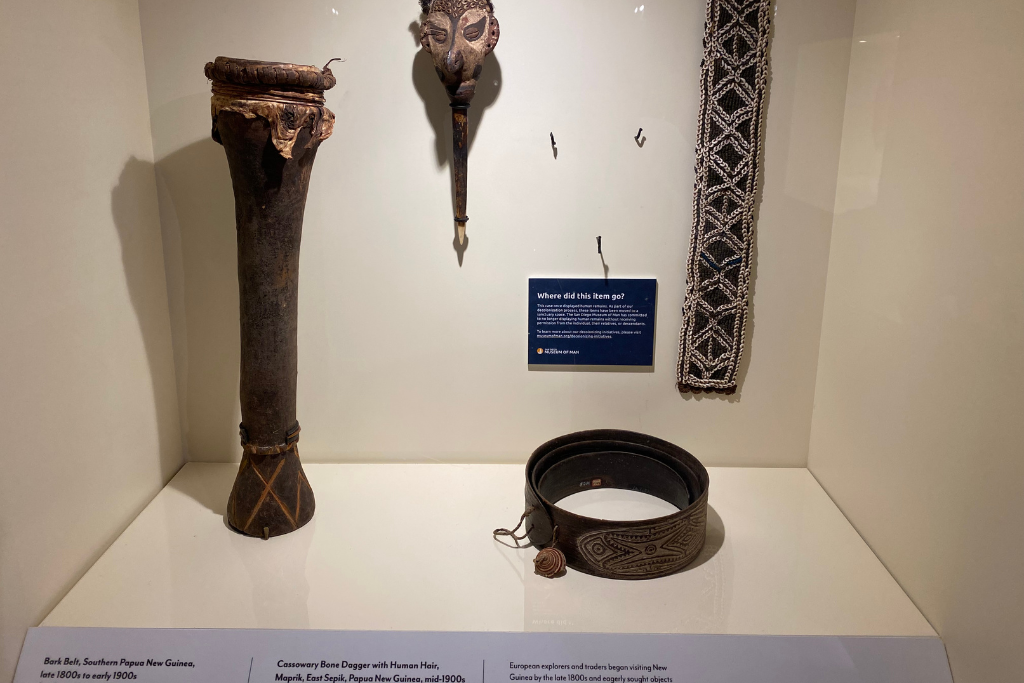
An exhibit at the San Diego Museum of Us, pictured above, shows where human remains were once displayed but were removed as “part of our decolonization process.”
With the passing of NAGPRA, museums and universities set out to repatriate artifacts and human remains. But repatriation activists—who, for ideological reasons, are committed to a policy of “putting everything back”—declared that the process of identifying, cataloging, and transferring such items was too slow, and that too many artifacts and human remains were still in curation facilities or museum display cases.[8] Much of the material was designated unaffiliated or culturally unidentifiable.[9] Such activists, however, often characterized this as a mere excuse, as evidence of obstructionism on the part of museums, or as proof that NAGPRA did not go far enough in mandating repatriation.
These activists also frequently made unsubstantiated accusations that anthropologists and archaeologists were exploiting the law’s exceptions to prevent repatriation. In actuality, many remains and artifacts, especially those excavated long ago, cannot be linked to a specific tribe. For example, in one recent case, cremated bone fragments, no larger than two centimeters in size, were slated for reburial by the Tohono O’odham tribe, even though it is unlikely that their actual affiliation can be confirmed.[10] In another similar example, 27 cremated bone fragments, each 4 cm or less in length, were slated for repatriation to the Gila River Community.[11]
Some delays in repatriation have been due to the inability to determine which tribe materials belong to. In a January 2025 notice of intended disposition, for example, human remains from a single individual were identified as possibly belonging to five tribes. Which tribe is ancestral to those remains is perhaps unknowable—and which tribe will finally rebury those remains is still unknown.[12] But, while this plays out, the Sharlot Hall Museum in Prescott has the remains hidden away from public view. And, when the remains are finally buried, the tribe will likely blame archaeologists for delaying the repatriation process.
Remains that are extremely ancient—including Paleoindians and other fossil finds—may also be difficult to affiliate with a specific tribe. Yet, these materials—some as old as 100,000 years—are nonetheless slated for reburial by tribes that have been in the region less than 500 years.
These materials may antedate the very existence of current tribes, such as in the case of Paleoindians that date to 7,500 years or older. Most tribes cannot trace their origins back beyond a thousand years. Probably the most famous such incident was the case of “Kennewick Man,” a skeleton that is around 9,000 years old that was found in Washington State in 1996, and whose discovery precipitated years of lawsuits. Officials from several tribes, as well as several self-proclaimed religious figures, insisted that they were related to the specimen, but the Ninth Circuit Court of Appeals ultimately ruled that because no tribe could prove a meaningful connection to the bones, the remains were not subject to repatriation.
Unfortunately, government officials had locked the skeleton away from study during the lengthy legal process—while nevertheless allowing tribal members to handle the bones and even perform religious ceremonies with them that contaminated the specimen and made it harder to study. A judge later ruled that the government had acted in bad faith and awarded scientists nearly $3 million in attorney fees as a result.[13] Nevertheless, Congress passed a special law in 2016 ordering that Kennewick Man be turned over to a group of tribes who destroyed the specimen the next year.
Paleoindians
Artifacts from Paleoindians—that is, specimens far older than any known historical tribe—are fascinating and crucial to the advancement of science. One longstanding theory about how North America came to be populated by human beings involves the so-called “land bridge” connecting Alaska to Northeastern Asia. Others believe that the continent may have been settled by ocean voyagers. Ancient human skeletons found in North America can help answer the question of who first came to the Western Hemisphere. But although several skeletons dating back to around 10,000 years have now been found in the Americas, most Paleoindian remains discovered so far have already been repatriated and reburied—that is, destroyed—thanks to overbroad interpretations NAGPRA.[14]
| The nine Paleoindians listed below have been reburied. | ||
| Paleoindian | Antiquity (years before present) |
Location |
|---|---|---|
| Anzick Child | 12,600 | Montana |
| Browns Valley | 8,700 | Minnesota |
| Buhl Burial | 10,000–12,000 | Idaho |
| Hourglass Cave | 7,700–8,200 | Colorado |
| Kennewick | 8,340–9,200 | Washington |
| La Jolla Skeletons | 8,900–9,600 | California |
| Pelican Rapids | 7,840 | Minnesota |
| Prince of Wales | 10,300 | Alaska |
| Tuqan | 9,500 | California |
One Paleoindian site in Florida has an Arizona connection. Human remains found at an underwater sinkhole site called Devil’s Den may be as old as 12,000 years. These remains were sent to Donald Morris, an Arizona State University professor, for study before being returned in 2003 to the Florida Museum of Natural History at the University of Florida.
In addition to the human remains at the Devil’s Den, fossilized nonhuman animals—possibly dating to 115,000 years ago—have been listed as 118 associated funerary objects to be repatriated. These animal fossils were likely natural deposits over time and from landslides instead of funerary objects originally buried alongside the bones.[15]
These ancient Floridian human remains were slated for reburial in September 2025, because of their supposed connection with the Miccosukee Tribe, the Seminole Tribe, and the Muscogee (Creek) Nation. Yet it is well-documented that these tribes are latecomers to the region. The Miccosukee, for example, arrived in Florida in the early eighteenth century, and the Seminole Tribe moved into Florida in the late eighteenth and early nineteenth century after having displaced the Miccosukee Tribe.[16]
Ancient remains from Arizona have also been targeted for reburial. Dr. Michael Waters of Texas A&M University excavated a site in Cochise County called Sulphur Springs, and found remains from an adult female, dating from between 7,000 to 10,000 years ago. In 2010, representatives of the Tohono O’odham Nation and the White Mountain Apache Tribe of the Fort Apache Reservation were invited to consult with Texas A&M University about potential repatriation of the find. The tribes did not respond.[17] Unfortunately, NAGPRA requires permission from every relevant tribe before remains may be studied. As a result, research can be blocked even by inaction: if any one of the half-dozen tribes listed on a NAGPRA notice does not respond, the remains remain off-limits.[18]
Also mentioned in a 2014 NAGPRA notice is the Joe Ben site in Pima County, which was excavated by the ASM in the late 1950s. Cremated human remains dating between 8,000 BC and AD 1450 were uncovered, which is intriguing, because cremation was rare during much of this period. That means the remains probably date from AD 200 to AD 1450. But, do we not owe it to our understanding of Arizona’s prehistory to determine the actual date of these remains, and rule out the possibility that they are in fact the oldest cremains ever found in the American Southwest? Additionally, how can one know which tribe is most likely to be “affiliated” with the remains when the date is so uncertain? Yet thanks to NAGPRA and Arizona’s version of the law, these remains are off-limits to researchers. Meanwhile, the ASM curation facility has set a goal to complete all repatriations before the end of next year.[19]
The bottom line is that because of NAGPRA and Arizona’s version of NAGPRA, research on ancient American skeletons has effectively come to a halt. It is little exaggeration to say that the science of anthropology has been closed down, at least with respect to ancient American bones and artifacts.
Commercial and Contemporary Art
While the fate of Paleoindian research may be a tragedy for science, NAGPRA has also been disastrous for living Native American artisans across the nation. A law originally designed to address concerns about “grave robbing” has increasingly morphed into a weapon deployed by activists to empty museums of modern-day artwork by Native American artists.
One reason for a museum to keep an object is that it was purchased legitimately by the museum to begin with from someone who had the right to sell it. That’s legal under NAGPRA and its state counterpart, which do not require the repatriation or destruction of modern man-made objects. Nonetheless, some Arizona institutions, such as ASM, are going beyond compliance with the law, and repatriating materials not covered by NAGPRA.
For instance, in May 2011, ASM announced its intent to repatriate eagle feathers it claimed were sacred and classified as “cultural patrimony”—the law’s term for objects said to possess a cultural or social connection to a tribe.[20] But these feathers were not ancient, and were not obtained illegally or against anyone’s will. Instead, Mr. and Mrs. Wetmore Hodges bought the feathers in 1938 from a Native American who received them from his grandfather. The ASM purchased the feathers from the Hodges in 1939. Nevertheless, the ASM decided to “return” them to the tribe and remove them from its collection.
In June 2017, the Heard Museum, which exhibits contemporary Native American art, repatriated a painted hide that had been created in 1907 by Jack Tonto, a Native American artist. The piece had originally been made for Taylor Gabbard, a longtime Bureau of Indian Affairs employee.[21] The hide was not a funerary artifact and was not covered by NAGPRA, nor had it been acquired illegally or unethically—yet the museum decided to “return” it to the tribe anyways.
In September 2024, the Denver Museum of Nature and Science listed 14 items for repatriation that had been purchased by Mary and Francis Crane from various shops in the 1950s and 1960s. The items were donated to the museum between 1968 and 1983.[22] One was a beaded shawl purchased in 1959 from National News and Gift Shop in Globe, Arizona. In 1964, the Cranes also bought a dance shield, a T-necklace, a dance cane, and five wooden plaques from the Forestdale Trading post in Show Low. These items were almost certainly made for sale. Yet now they are being classified as “sacred” objects.
Even more absurdly, the Pick Museum of Anthropology at Northern Illinois University announced in 2023 that it intended to repatriate three “False Face masks” bought in 1981 at Desert House Crafts in Tucson.[23] The artist who made these masks, Gene Thomas, a Canadian Iroquois Indian, created them for sale—but they, too, are now being labeled as sacred objects. Thomas’s father, Chief Jake Thomas, who was mentioned in the repatriation announcement, also made materials for sale. He has criticized the movement to blur the lines between commercial pieces and sacred artifacts and noted that selling art is an honest way to make a living:
First of all, in the past the people carved different forms of art to help support their livelihood. Particularly today as there are no jobs this may be the only source for the people to make a living is to sell their art. Therefore many people do carve and sell their art. I believe that this is an honest thing to do rather than living on welfare or having to steal to provide for one’s family. The masks that I carve are not “blessed,” nor given any power for healing, and there is nothing wrong to sell these masks. If masks are forbidden to be sold and it becomes too sacred then it will become a secret and no one will be able to carve a mask and know what it means, and it will become lost among our people.[24]
Some art dealers say they have stopped carrying Native American masks and other works because repatriation activists have threatened them. Customers—including museums—have grown hesitant to purchase the works because of the concerns that the items may be repatriated in the near future.
Cessation of Research
In the last few decades, universities and museums have become obsessed with “decolonizing” museums, smearing early archaeologists as “graverobbers,” and elevating Native American mythology to the status of actual history. Nowhere is this more visible than in the repatriation movement.[25] Perhaps in an effort to avoid bad press, universities and museums have begun collaborating with activists and tribal politicians when designing museum exhibits, asking their permission to perform research—often at the expense of scientific inquiry and standards.
In recent years, tales—largely exaggerated or even false—about museums and universities failing to comply with NAGPRA have been boosted by the mainstream media.[26] And in response, museums and universities have gone far beyond complying with the law. The result has been to abandon the NAGPRA compromise, which was intended to prevent abuses while protecting replicas, art, and legitimate scientific research. For instance, the ASM’s 2022 policy on human remains states:
The Arizona State Museum houses and curates human remains recovered from archaeological sites, primarily from the State of Arizona. ASM recognizes the humanity of these individuals, not to be regarded as objects, and strives to treat them with respect and dignity at all times. ASM additionally recognizes the diversity of cultural practices regarding interaction with the deceased and endeavors to respect the beliefs and customs of descendant communities regarding the remains of their ancestors. ASM further acknowledges that any and all research conducted on the Native American (American Indian) human remains is viewed by descendant communities as disrespectful and harmful to both the Ancestors and their descendants.”[27]
The museum goes on to state, with regards to Native American human remains, “ASM will not grant access, for the purpose of research, to human remains known to be of Native American (American Indian) descent.” This is despite the fact that both state and federal laws allow research on many such remains.
Meanwhile, the ASM policy states that “[a]ccess to human remains known to be of Native American (American Indian) descent will be granted for the practice of traditional religious activities by members of a descendant community that has an established cultural or geographical affiliation with the human remains in question.” As a result, scientific access is banned, but religious and cultural access is not.
As recently as 2018, ASM policy on human remains research was quite different. It required a well-prepared proposal in order to gain access to remains. Destructive data collection (such as DNA analyses that require bone to be cut and the sample to be crushed) was not permitted, but non-destructive research was considered. The ASM’s statement at that time focused on striking a compromise between science and culture:
Finding a balance between concerns for preservation, cultural sensitivity and conducting research with human skeletal remains can be difficult. Therefore, we only encourage and accept proposals for research on the ASM Human Skeletal Collection for significant, well-designed projects that have the potential to contribute to the field of Bioarchaeology and the development of an enhanced understanding of our human experience in the past.[28]
This sensible balance—which reflects the original intention of NAGPRA—is now gone. It has been replaced with an activist policy that seeks to shut down scientific research, while expanding access to human remains for religious or cultural purposes, including to remains that have no connection to today’s tribes.
NAGPRA’s Final Rule
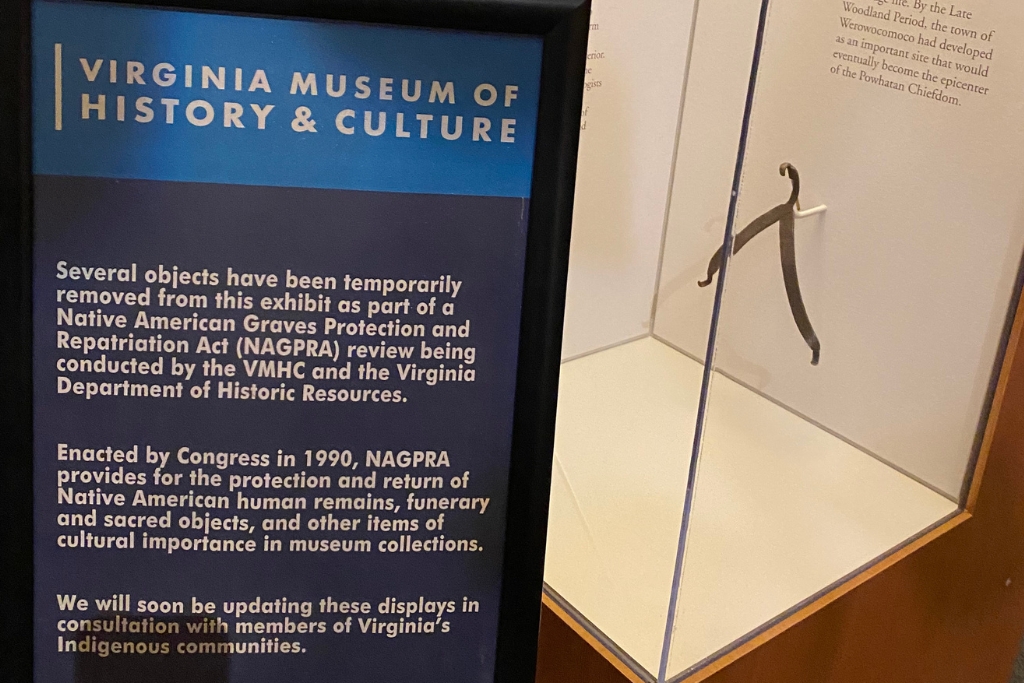
On December 13, 2023, the federal Department of the Interior published new regulations to implement NAGPRA. This “Final Rule” did not change the law, but it did drastically change how museums and universities can operate, much to the detriment of academic study and the future of archaeological history and research.
That new rule included a strict “no research without tribal consent” requirement, under which institutions holding Native bones or artifacts are not even allowed to complete the inventory process that previously was used to determine what should or should not be repatriated to comply with NAGPRA.[29] According to the new regulations, even opening a box to determine what is inside can be considered “research,” and is therefore off limits without permission from tribal authorities.
In 2024, ASM issued paperwork regarding compliance with NAGPRA that defined “research” as “the systematic investigation into, and study of, human remains, objects, and sources in order to establish facts and reach new conclusions.” In its 16-page “Duty of Care Consultation Form for the NAGPRA Repatriation Process at ASM,” the ASM highlighted what qualifies as “research”—and, thus, what does or does not require consultation with tribal authorities. In this document, ASM states that museums must create itemized lists of human remains and funerary objects “based on available information,” and then adds that this list must specify the “[n]umber of individuals identified in a reasonable manner with no additional study or documentation; NOTE: If ancestral remains are present, then a minimum of one individual is present, which is all that is required for repatriation to occur. An accurate [minimum number of individuals] is not required under NAGPRA.”[30]
The reason an “accurate” number is “not required” is that determining this basic information constitutes “research” and therefore cannot be done without the permission of tribal officials. Even counting the number of objects a museum possesses is therefore off limits.
As a result of this research prohibition, scholarly articles and publications using collections curated by Arizona’s museums and universities have ceased entirely. No research articles containing newly collected data on Native American human remains from Arizona appeared in 2024 or 2025. This shutting down of science includes a cessation of forensic research that might have enabled forensic anthropologists to fine-tune their ability to distinguish between Native American skeletal remains and those from relatively recently deceased border-crossers. This is just one example of how caving in to activism has adverse, real-world consequences.
Furthermore, the 2023 regulations emphasize consultation with tribes but remove the requirement that the reason objects are considered sacred or of funerary status of an object be written down.[31] Absent any such record, an object’s status may be changed whenever a new tribal member arrives for consultation. A previous determination—even if by a tribal elder—that an artifact is not sacred, or that a funerary object is not culturally connected to the tribe, can be overturned at any new consultation without warning. And when that happens, the item must be removed from display and prepared for repatriation.
Thanks to outspoken activists, the number and variety of artifacts considered funerary objects, sacred, or objects of cultural patrimony—and therefore off-limits to scientific investigation or even museum display—is now rapidly increasing. But the definitions in NAGPRA are specific and clear:[32]
- Funerary objects are defined in NAGPRA as “objects that, as a part of the death rite or ceremony of a culture, are reasonably believed to have been placed with individual human remains either at the time of death or later.”
- Sacred objects are defined in NAGPRA as “specific ceremonial objects which are needed by traditional Native American religious leaders for the practice of traditional Native American religions by their present-day adherents.”
- An object of cultural patrimony, according to NAGPRA, is “an object having ongoing historical, traditional, or cultural importance central to the Native American group or culture itself, rather than property owned by an individual Native American, and which, therefore, cannot be alienated, appropriated, or conveyed by any individual regardless of whether or not the individual is a member of the Indian tribe or Native Hawaiian organization and such object shall have been considered inalienable by such Native American group at the time the object was separated from such group.”
The Final Rule of 2023 added some more details to these definitions. For instance, with regard to sacred objects, the regulations clarified that “[w]hile many items might be imbued with sacredness in a culture, this term is specifically limited to an object needed for the observance or renewal of a Native American religious ceremony.”[33]
NAGPRA information sessions, however, have made it clear that whether an artifact falls into one of these special categories depends only on information provided by the tribe. The new regulations, furthermore, add that “[c]onsistent with [NAGPRA], these regulations require deference to the Native American traditional knowledge of lineal descendants, Indian Tribes, and Native Hawaiian organizations.”[34]
As a result, the actual definitions in NAGPRA are practically useless. In place of the wording Congress chose when passing the law, museum employees, government officials, and perhaps even judges are required to “defer” to the “traditional knowledge” of tribal members—even politically motivated ideologues, who may have no objective evidence of any actual connection between an artifact and a tribe.
The result has been a series of NAGPRA notices for repatriation that go far beyond what the authors of NAGPRA actually intended. For instance, a March 2025 notice of intended disposition by the U.S. Department of Agriculture, Forest Service, Coronado National Forest, lists 4,707 unassociated funerary objects—meaning no human remains were found with the materials—including “faunal remains” and “flaked stone”[35]—in other words, animal bones and arrowheads that were not buried in a grave and may not even be connected to any of today’s tribes.
In a July 2025 notice of intended repatriation by Arizona State University’s School of Human Evolution and Social Change, even unworked faunal remains are listed as sacred objects and objects of cultural patrimony.[36] In another July 2025 notice, ASU also listed 38 lots of fauna and 59 lots of samples.[37] And, in an inventory completion notice, even “samples” and “botanicals” were listed as possible funerary objects.[38] Essentially, this is just dirt found at the site and animal bones from past meals. These materials can be useful, even crucial, to scientific research—because they help to determine everything from what ancient people ate to the conditions of the environment centuries ago. Yet, under the bizarrely expansive interpretation of NAGPRA—an interpretation not traceable to the actual language of that law—these must be handed over to tribal officials for destruction.
A notice of intended disposition by the Casa Grande Ruins National Monument in Coolidge, Arizona, published in August 2025, does not even specify what is being repatriated:
Based on the information available, human remains representing, at least, one individual have been reasonably identified. The one lot of associated funerary objects are primarily pottery sherds, both burnt and unburnt, as well as faunal remains. These ancestral remains and associated funerary objects have not been itemized out of respect to them and a desire to disturb them as little as possible.[39]
And, in a September 2025 notice of intended disposition, the Arizona State Office published a notice of repatriation that includes “mineral samples, pollen samples, flotation samples and Carbon-14 samples” that have been curated by the ASM since 1990.[40] Carbon-14 samples, of course, were not around a century ago. These items are modern scientific research materials that the state is abandoning to destruction without legal justification.
Absurd repatriations like these have increased since the December 2023 “Final Rule” regulatory guidance—but Arizona institutes were conducting such activities even before. For example, in 2022, dendrochronology (i.e., the dating of tree rings) samples were repatriated.[41] These are hardly the kind of sacred tribal relics that NAGPRA was written to protect.
One may wonder what harm it does to give away materials such as animal bones, plants, and soil. The answer is that it’s not only a waste of resources, but it also makes a mockery of genuine funerary objects. Most importantly, such materials could be used to train forensic scientists in distinguishing between human and nonhuman remains, and they can contribute to further research, including efforts to reconstruct the environment of the past. But worse still, these frivolous actions open the door to the repatriation of even more potential sources of data. And, in fact, the repatriation movement has already done irreparable damage to the entire science of anthropology.
Museum Exhibits Face Erasure
Museum exhibits across the nation have been shuttered as a result of the 2023 regulations, which state that museums “must obtain free, prior, and informed consent from lineal descendants, Indian Tribes, or Native Hawaiian organizations prior to allowing any exhibition of, access to, or research on human remains or cultural items.”[42]
This rule is absurd in many cases—how can one obtain “prior consent” from, say, Kennewick Man’s “lineal descendants”? Yet under such restrictions, museums are emptying out their display cases.
It appears that this new regulatory change has not yet greatly affected Arizona museums for three reasons:
- Many museums in Arizona, such as the Heard Museum, the Museum of Northern Arizona, the Verde Valley Archaeology Center and Museum, and the Museum of Indigenous People, have been consulting with tribes for years; tribes have helped shape exhibits and will likely continue to do so.[43]
- During this period, some museums, such as the ASM[44] and the S’edav Va’aki Museum[45], have closed their public spaces for renovations.
- Some museums in Arizona are tribal museums, such as the White Mountain Apache Cultural Center and Museum, and the Tohono O’odham Nation Cultural Center and Museum.[46]
Nevertheless, this does not mean that museums have been unaffected by the 2023 NAGPRA regulatory changes. The S’edav Va’aki Museum, which reopened in October 2025 after being closed for renovations for nearly five months, has two new exhibits. Neither contains artifacts. Whether the museum’s renovations were a response to the NAGPRA regulations is unknown, but the two new exhibits revolve around tribal culture, sovereignty, and spirituality in relation to water.[47] The main gallery, which once had a Maricopa pottery collection displayed, remains shuttered and still under development.[48]
The Arizona Museum of Natural History recently closed its “Native Peoples of the Past” exhibit, and the museum’s website now states: “The careful process of creating a new gallery is underway.”[49] A new temporary exhibit called “THRIVE: The First People: Yesterday, Today, and Forever” appeared at the museum from January 2025 to August 2025. The Museum describes this exhibit thus:
This groundbreaking exhibit, created in collaboration with the Gila River Indian Community and the Salt River Pima-Maricopa Indian Community, invites visitors to explore the deep connections between the ancestral Sonoran Desert dwellers, their modern O’odham descendants, and the breathtaking landscapes they have called home for thousands of years.[50]
The THRIVE exhibit also had a speaker series. The first speaker, Leland Thomas, whose topic was “O’odham ties to the land,” focused on creation myths—such as discussing how the “Creator” gave us all a song—rather than scientific explanations of how tribes survived and thrived in the Southwest’s deserts.[51] Thomas repeatedly stated that places are “tangible to our creation story,” a catchphrase that is anything but scientific. And while creation myths are certainly of great cultural interest, discussing creationism as “tangible” and real has no place in a science museum, such as the Arizona Natural History Museum, whose mission statement is: “To be a hub of discovery, discourse and positive change that shares evidence-based perspectives about Arizona and the surrounding region.”[52]
Sex-Based Discrimination
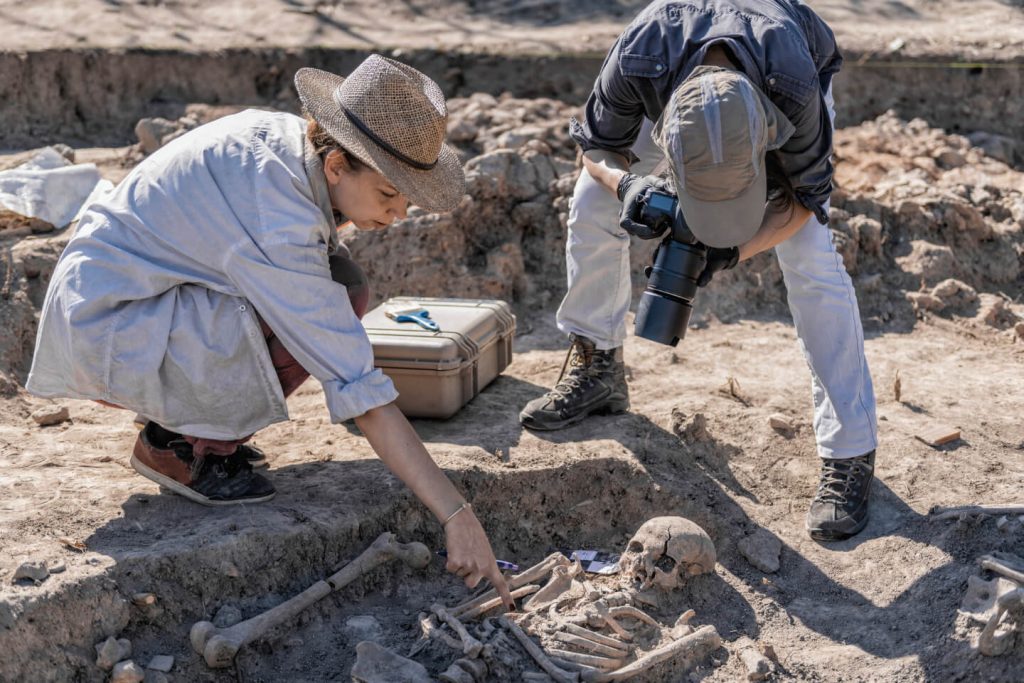
The 2023 Final Rule regulations also added guidance on “Duty of care,” which require museums and universities to “[c]onsult with lineal descendants, Indian Tribes, or Native Hawaiian organizations on the appropriate storage, treatment, or handling of human remains or cultural items.”[53] It added that museums and universities should “[m]ake a reasonable and good-faith effort to incorporate and accommodate the Native American traditional knowledge of lineal descendants, Indian Tribes, or Native Hawaiian organizations in the storage, treatment, or handling of human remains or cultural items.”[54]
These lines may seem innocuous, but in practice the “appropriate” care of human remains and cultural items often excludes women, including female academic researchers.[55] Indian reservations with their own cultural research centers have already demonstrated a willingness to discriminate against women; for example, at the Makah Cultural and Research Center, located on the Makah Indian reservation in Neah Bay, Washington, practices “traditional curation,” which excludes females from handling certain artifacts. At the Smithsonian Arctic Studies Center’s collaboration with the Anchorage Museum at Rasmuson Center, Inuit elders informed an all-women project team that the materials they had planned to study could not be handled by females; thus, the team found a male colleague from the museum staff to handle at least one object for them. And, in a recent article about universities considering hiring students to help with NAGPRA duties, the authors suggest that departments should consider how to “convey accommodations for traditional knowledge about appropriate treatment of Ancestors and cultural items based on gender or sex.”[56]
Ancient taboos against menstruating women are still part of traditional cultural and religious practices in many parts of the world, including among Native American tribes where menstruating archaeologists are subject to special rules.[57] For instance, in 2006 the University of Washington Anthropology department revealed that in their collaborative field school with the Kashaya Pomo, menstruating women were not allowed to enter the kitchen, prepare food, serve themselves, or wash dishes. Also, Kashaya Pomo elders of California, while collaborating with archaeologists during government cultural resource management work, (which aims to bridge the gap between development of land and preservation of archaeological sites and materials) secluded females while they were menstruating, required them to stay away from elders, and even forbade them from talking about spiritual topics.
At San José State University, after California passed a similar law regarding duty of care and consultations, “menstruating personnel” were not allowed in curation rooms. This rule was reversed after the university received the threat of a Title IX suit.[58]
It may be hard to know how often such discriminatory episodes occur, but one can be assured that sex discrimination increases when “traditional curation” practices are followed. This may be especially true in Arizona since many of the federally recognized tribes, such as the Navajo Nation, the Paiute, and the Tohono O’odham have a history of segregating menstruating women.
Conclusion
NAGPRA began as a compromise to allow scientific research and museum exhibits to be preserved, excluded works made for sale and display, and yet also enabled federally recognized tribes to obtain their most culturally valuable materials, funerary objects, objects of cultural patrimony, and sacred objects, along with ancestral human remains. But in Arizona and beyond, this compromise has been gradually chipped away, with repatriations that go beyond compliance (as with the repatriation of scientific material and dendrochronology samples). Collaboration and consultation with tribes with regards to museum exhibits may have prevented the shuttering of exhibits in archaeology museums, but science museums have been left vulnerable, and we may see more tribal demands in the years ahead. After all, the Navajo tribe recently sought to halt a NASA flight on the grounds that the moon is sacred to the tribe.[59] Other tribal members are now arguing that casts—that is, replicas of bones or footprints—can be used to entice spirits and, thus, should be destroyed.[60]
Short of amending or repealing NAGPRA, the best reforms to restore the balance between science and the legitimate cultural demands of tribes would include:
- challenging the December 2023 regulatory changes, perhaps relying on the recent overturning of the Chevron doctrine, which required courts to defer to the decisions of regulatory agencies;[61]
- requiring repatriations to adhere strictly to the original NAGPRA definitions of sacred objects, funerary objects, and objects of cultural patrimony; and
- requiring museums and universities to adhere to their missions that include research and education—often funded by taxpayers.
As Arizona loses archaeology, it loses its ability to train the next cultural resource managers who can save the past from destruction. We lose our capacity to train the next generation of forensic anthropologists, whose job it is to help bring closure to families of crime victims. We also lose our ability to understand the past, which should not be tainted by creation myths or tribal activist propaganda, and instead should be framed in a way that enables us to truly understand history and pre-history in ways that unify people. This is because—rather than pointing fingers at the “bad old colonialists”—we can see that all cultures have had features and experiences both wonderful and horrendous. In relation to Southwest Native Americans, a balanced cultural education should include, for example, both the beauty of Navajo artistry and the evidence of cannibalism in the Anasazi. But perhaps most importantly, it is the job of archaeologists, as scientists, to educate—not to toe the line of political correctness.
End Notes
[1] “Federally Recognized Native Nations in Arizona,” Arizona State Museum, accessed May 12, 2026, https://statemuseum.arizona.edu/native-nations-arizona.
[2] U.S. Congress, House, Committee on Interior and Insular Affairs, Providing for the Protection of Native American Graves, and for Other Purposes, H.R. Rep. No. 101-877, 101st Cong., 2d sess. (October 15, 1990), https://www.nps.gov/subjects/nagpra/upload/HR101-877.pdf.
[3] U.S. Congress, Senate, Select Committee on Indian Affairs, Providing for the Protection of Native American Graves and the Repatriation of Native American Remains and Cultural Patrimony, S. Rep. No. 101-473, 101st Cong., 2d sess. (September 26, 1990), https://www.nps.gov/subjects/nagpra/upload/SR101-473.pdf.
[4] 25 U.S.C. ch. 32, “Native American Graves Protection and Repatriation,” accessed May 12, 2026, https://uscode.house.gov/view.xhtml?path=/prelim@title25/chapter32&edition=prelim.
[5] Ariz. Rev. Stat. § 41-844 governs the duty to report discoveries, the disposition of discoveries, and defines legal terms, and A.R.S. § 41-865 imposes penalties for the disturbance of human remains or funerary objects.
[6] Repatriation Office, Arizona State Museum, accessed May 12, 2026, https://statemuseum.arizona.edu/crm/state-repatriation.
[7] Ariz. Rev. Stat. § 41-865, “Disturbing Human Remains or Funerary Objects; Rules; Violation; Classification; Definitions” (2025), Arizona Legislature, https://www.azleg.gov/ars/41/00865.htm.
[8] Kate Fitz Gibbon, “NAGPRA: Major Changes Proposed for 2023 to Native American Repatriation Law,” Cultural Property News, January 8, 2023, https://culturalpropertynews.org/nagpra-major-changes-proposed-for-2023-to-native-american-repatriation-law/.
[9] Logan Jaffe et al., “America’s Biggest Museums Fail to Return Native American Human Remains,” ProPublica, January 11, 2023, https://www.propublica.org/article/repatriation-nagpra-museums-human-remains.
[10] “Notice of Intended Disposition: U.S. Department of the Interior, Bureau of Land Management, Tucson Field Office, Tucson, AZ,” Federal Register 89 (August 23, 2024): 68196, https://www.federalregister.gov/documents/2024/08/23/2024-18948/notice-of-intended-disposition-us-department-of-the-interior-bureau-of-land-management-arizona-state.
[11] “Notice of Intended Disposition: U.S. Department of Interior, Bureau of Land Management, Arizona State Office, Tucson, AZ,” Federal Register 90 (July 28, 2025): 35549, https://www.federalregister.gov/documents/2025/07/28/2025-14167/notice-of-intended-disposition-us-department-of-the-interior-bureau-of-land-management-arizona-state.
[12] “Notice of Intended Disposition: U.S. Department of Agriculture, Forest Service, Prescott National Forest, Chino Valley, AZ,” Federal Register 90 (January 17, 2025): 5997, https://www.federalregister.gov/documents/2025/01/17/2025-01175/notice-of-intended-disposition-us-department-of-agriculture-forest-service-prescott-national-forest.
[13] Douglas W. Owsley & Richard L. Jantz, eds., Kennewick Man: The Scientific Investigation of an Ancient American Skeleton (College Station, TX: Texas A&M Press, 2014).
[14] Elizabeth Weiss & James W. Springer, Repatriation and Erasing the Past (Gainesville: University of Florida Press, 2020). http://search.ebscohost.com/login.aspx?direct=true&scope=site&db=nlebk&db=nlabk&AN=2591916
[15] “Notice of Inventory Completion: University of Florida, Florida Museum of Natural History, Gainesville, FL,” Federal Register 90 (August 14, 2025): 39219, https://www.federalregister.gov/documents/2025/08/14/2025-15410/notice-of-inventory-completion-university-of-florida-florida-museum-of-natural-history-gainesville
[16] Elizabeth Weiss, “Rewriting Florida’s History: Seminole Indians are Not Descended from the Tequesta,” History Reclaimed, May 5, 2022, https://historyreclaimed.co.uk/rewriting-floridas-history-seminole-indians-are-not-descended-from-the-tequesta/.
[17] “Notice of Inventory Completion: Texas A&M University, College Station, TX,” Federal Register 79 (April 17, 2014): 21800, https://www.federalregister.gov/documents/2014/04/17/2014-08814/notice-of-inventory-completion-texas-aandm-university-college-station-tx
[18] “Anthropology Research Collections,” Texas A&M University, accessed May 13, 2026, https://artsci.tamu.edu/anthropology/resources/anthropology-research-collections.html.
[19] “Repatriation and NAGPRA Compliance,” Arizona State Museum, accessed May 13, 2026, https://statemuseum.arizona.edu/research/repatriation-nagpra.
[20] “Notice of Intent to Repatriate Cultural Items: Arizona State Museum, University of Arizona, Tucson, AZ,” Federal Register 76 (May 13, 2011): 28079, https://www.federalregister.gov/documents/2011/05/13/2011-11866/notice-of-intent-to-repatriate-cultural-items-arizona-state-museum-university-of-arizona-tucson-az.
[21] “Notice of Intent to Repatriate Cultural Items: Heard Museum, Phoenix, AZ,” Federal Register 82 (June 14, 2017): 27282, https://www.federalregister.gov/documents/2017/06/14/2017-12291/notice-of-intent-to-repatriate-cultural-items-heard-museum-phoenix-az.
[22] “Notice of Intended Repatriation: Denver Museum of Nature & Science, Denver, CO,” Federal Register 89 (September 3, 2024): 71388, https://www.federalregister.gov/documents/2024/09/03/2024-19681/notice-of-intended-repatriation-denver-museum-of-nature-and-science-denver-co.
[23] “Notice of Intent to Repatriate Cultural Items: James B. and Rosalyn L. Pick Museum of Anthropology at Northern Illinois University, DeKalb, IL (Formerly Anthropology Museum at Northern Illinois University),” Federal Register 88 (July 7, 2023): 43386, https://www.federalregister.gov/documents/2023/07/07/2023-14386/notice-of-intent-to-repatriate-cultural-items-james-b-and-rosalyn-l-pick-museum-of-anthropology-at.
[24] “Iroquois False Face Masks,” Chichester Inc., accessed May 13, 2026, https://www.chichesterinc.com/FalseFaceMasks.htm.
[25] Elizabeth Weiss & James W. Springer, Repatriation and Erasing the Past (Gainesville: University of Florida Press, 2020), http://search.ebscohost.com/login.aspx?direct=true&scope=site&db=nlebk&db=nlabk&AN=2591916
[26] Various authors, The Repatriation Project, ProPublica, January 11, 2023, https://www.propublica.org/series/the-repatriation-project; “Push to Return 116,000 Native American Remains Is Long-Awaited,” Zachary Small, New York Times, August 6, 2021,
https://www.nytimes.com/2021/08/06/arts/design/native-american-remains-museums-nagpra.html; Sam Ellefson and Aspen Ford, “Misplaced Artifacts, Inaccurate Inventories and 2% of Native American Remains Returned to Tribes: Inside Asu’s Repatriation Record,” Cronkite News, June 10, 2024, https://cronkitenews.azpbs.org/2024/06/10/asu-repatriation-record-nagpra-law-native-american-remains/.
[27] “Policy on Human Remains,” Arizona State Museum, May 24, 2022, https://statemuseum.arizona.edu/sites/default/files/ASM_HR_policy-24May2022.pdf.
[28] “Access to Human Skeletal Collection,” Arizona State Museum, September 2019, accessible at https://web.archive.org/web/20181206023252/https://statemuseum.arizona.edu/sites/default/files/ASM%20Bioarchaeology%20Collections%20Access%20Policy%20%282018%29.pdf.
[29] 43 C.F.R. § 10.1(d) (2026), https://www.ecfr.gov/current/title-43/subtitle-A/part-10#p-10.1(d).
[30] “Duty of Care Consultation Form for the NAGPRA Repatriation Process at ASM,” Arizona State Museum, August 8, 2024, https://statemuseum.arizona.edu/sites/default/files/2024-09/ASM_Duty_of_Care_form_2024-08-08.pdf (emphases in original).
[31] https://youtu.be/UCisun3ZcGk?si=tvE1sC09oREokODr
[32] Native American Graves Protection and Repatriation Act, 25 U.S.C. §§ 3001–3013 (2025), https://uscode.house.gov/view.xhtml?path=/prelim@title25/chapter32&edition=prelim.
[33] 43 C.F.R. § 10.2 (2026), https://www.ecfr.gov/current/title-43/part-10#p-10.2(Sacred%20object)
[34] 43 C.F.R. § 10.1 (2026), https://www.ecfr.gov/current/title-43/section-10.1.
[35] “Notice of Intended Disposition: U.S. Department of Agriculture, Forest Service, Coronado National Forest, Tucson, AZ,” Federal Register 90 (March 19, 2025): 12758, https://www.federalregister.gov/documents/2025/03/19/2025-04611/notice-of-intended-disposition-us-department-of-agriculture-forest-service-coronado-national-forest.
[36] “Notice of Intended Repatriation: Arizona State University, School of Human Evolution and Social Change, Tempe, AZ,” Federal Register 90 (July 10, 2025): 30670, https://www.federalregister.gov/documents/2025/07/10/2025-12830/notice-of-intended-repatriation-arizona-state-university-school-of-human-evolution-and-social-change.
[37] “Notice of Intended Repatriation: Arizona State University, School of Human Evolution and Social Change, Tempe, AZ,” Federal Register 90 (July 10, 2025): 30679, https://www.federalregister.gov/documents/2025/07/10/2025-12831/notice-of-intended-repatriation-arizona-state-university-school-of-human-evolution-and-social-change.
[38] “Notice of Inventory Completion: Arizona State University, School of Human Evolution and Social Change, Tempe, AZ,” Federal Register 89 (July 18, 2024): 58401, https://www.federalregister.gov/documents/2024/07/18/2024-15833/notice-of-inventory-completion-arizona-state-university-school-of-human-evolution-and-social-change.
[39] “Notice of Intended Disposition: U.S. Department of the Interior, National Park Service, Casa Grande Ruins National Monument, Coolidge, AZ,” Federal Register 90 (August 14, 2025): 39207, https://www.federalregister.gov/documents/2025/08/14/2025-15413/notice-of-intended-disposition-us-department-of-the-interior-national-park-service-casa-grande-ruins (emphasis added).
[40] “Notice of Inventory Completion: U.S. Department of the Interior, Bureau of Land Management, Arizona State Office, Phoenix, AZ,” Federal Register 90 (September 12, 2025): 44228, https://www.federalregister.gov/documents/2025/09/12/2025-17620/notice-of-inventory-completion-us-department-of-the-interior-bureau-of-land-management-arizona-state.
[41] “Notice of Intent To Repatriate Cultural Items: U.S. Department of the Interior, National Park Service, Tuzigoot National Monument, Clarkdale, AZ; Correction,” Federal Register 87 (March 17, 2022): 15264, https://www.federalregister.gov/documents/2022/03/17/2022-05628/notice-of-intent-to-repatriate-cultural-items-us-department-of-the-interior-national-park-service.
[42] Julia Jacobs and Zachary Small, “Leading Museums Remove Native Displays Amid New Federal Rules,” New York Times, January 26, 2024, https://www.nytimes.com/2024/01/26/arts/design/american-museum-of-natural-history-nagpra.html; Elizabeth Weiss, “The Vanishing Archive, City Journal, January 29, 2024, https://www.city-journal.org/article/vanishing-archive-native-american-exhibits.
[43] “Tribal Relations,” Heard Museum, accessed May 13, 2026, https://heard.org/tribal-relations/; “Tribal Consultation, Repatriation, and Compliance with NAGPRA,” Museum of Northern Arizona, accessed May 13, 2026, https://musnaz.org/collections/our-collections/anthropology-2/anthropology/nagpra/; “Who We Are,” Verde Valley Archaeology Center & Museum, accessed May 13, 2026, https://www.verdevalleyarchaeology.org/about-2; “About the MIP,” Museum of Indigenous People, accessed May 13, 2026, https://www.museumofindigenouspeople.org/about.
[44] “Exhibits Building Closed,” Arizona State Museum, accessed May 13, 2026, https://statemuseum.arizona.edu/.
[45] “S’Edav Va’Aki Museum Closes for Renovations,” City of Phoenix, May 19, 2025, https://www.phoenix.gov/newsroom/sedav-vaaki-museum-news/s-ed_av-va-aki-museum-closes-for-renovations.html.
[46] “Nohwike’ Bagowa,” (House of Our Footprints), Apache Cultural Center & Museum, White Mountain Apache Tribe, accessed May 13, 2026, http://www.wmat.nsn.us/wmaculture.html; https://www.tonation-nsn.gov/cultural-center-museum/.
[47] “S’edav Va’aki Museum Welcomes Fall Reopening with Two New Exhibitions,” City of Phoenix, September 16, 2025, https://www.phoenix.gov/newsroom/sedav-vaaki-museum-news/s-edav-va-aki-museum-welcomes-fall-reopening-with-two-new-exhibi.html.
[48] “A Brief History of the S’Edav Va’Aki Museum,” S’Edav Va’Aki Museum, accessed May 13, 2026, https://www.phoenix.gov/content/dam/phoenix/sedavvaaki/documents/SV%20Museum%20History.pdf.
[49] https://web.archive.org/web/20251115032938/https://www.arizonamuseumofnaturalhistory.org/explore-the-museum/exhibitions/native-peoples-of-the-past.
[50] https://web.archive.org/web/20251212002608/https://www.arizonamuseumofnaturalhistory.org/explore-the-museum/exhibitions/thrive.
[51] “O’Odham Ties to the Land—Mo’ Has Mas Ma Wud Ha Apendagĭ Heg T-Jewed Heg T-Hemajkam—Leland Thomas,” YouTube, August 28, 2025, https://youtu.be/eMJafp5EWpU?si=ut6hnIi8qozptF56.
[53] 43 C.F.R. § 10.1(d) (2026), https://www.ecfr.gov/current/title-43/part-10#p-10.1(d).
[54] 43 C.F.R. § 10.1(d)(2) (2026), https://www.ecfr.gov/current/title-43/part-10#p-10.1(d)(2).
[55] Elizabeth Weiss, “The Problem of Sex Discrimination in Indigenous Archaeology,” Quillette, February 16, 2022, https://quillette.com/2022/02/16/the-problem-of-sex-discrimination-in-indigenous-archaeology/.
[56] Megan E. LeBlanc and Nina M. Schreiner, “Navigating the Challenges and Possibilities of Student Labor in NAGPRA Compliance,” Advances in Archaeological Practice 13, November 27, 2025, https://doi.org/10.1017/aap.2025.10099.
[57] Elizabeth Weiss, “The Problem of Sex Discrimination in Indigenous Archaeology,” Quillette, February 16, 2022, https://quillette.com/2022/02/16/the-problem-of-sex-discrimination-in-indigenous-archaeology/.
[58] Christian Schneider, “San Jose State Lifts Ban on ‘Menstruating Personnel’ Handling Human Remains,” College Fix, April 14, 2022, https://www.thecollegefix.com/san-jose-state-lifts-ban-on-menstruating-personnel-handling-human-remains/.
[59] Elizabeth Weiss, “The Navajo Nation’s Spiritual Battle for the Moon,” Reality’s Last Stand, January 20, 2024, https://www.realityslaststand.com/p/the-navajo-nations-spiritual-battle.
[60] Elizabeth Weiss, “Burying Science,” Aporia, May 29, 2024, https://www.aporiamagazine.com/p/burying-science.
[61] “Chevron Deference,” Cornell Law School, accessed May 13, 2026, https://www.law.cornell.edu/wex/chevron_deference.