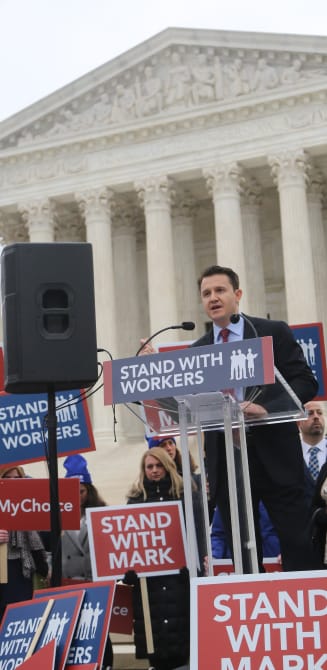
Some call it the “the pursuit of happiness” or simply “the American Dream,” but whatever you call it, the right to earn a living may be the most vital constitutional freedom. It may also be the most neglected. That’s why the Goldwater Institute is urging the Arizona Supreme Court to take historic action and restore economic liberty as a fundamental right of all people, deserving of the full protection of the state’s constitution.
Goldwater made its argument in a brief this week supporting Greg Mills, an electronics engineer who was targeted by state bureaucrats for calling himself an engineer and practicing his trade without their permission. But Arizona’s licensing law for engineers was designed for architectural engineers—the folks who work on buildings and bridges—not electronics engineers like Greg, so it makes no sense for the government to force Greg to go through its expensive and time-consuming licensing process.
For generations, economic freedom was regarded as a basic, legally protected right, but a series of U.S. Supreme Court rulings in the 1930s diminished its importance. The Arizona Supreme Court now has an opportunity to correct this error and protect what former Supreme Court Justice William Douglas once called “the most precious liberty that man possesses.”
Read more here.
The polling is clear: “Americans do not want state-sponsored, raced-based discrimination.” That was the message of the Goldwater Institute’s Matthew Beienburg to Arizona lawmakers during a critical hearing this week on a proposed constitutional amendment aimed at permanently ending state diversity, equity, and inclusion (DEI) mandates.
If approved by voters in November, HCR2044 would be the strongest state-level safeguard in the country against DEI mandates. The measure, which is now advancing through the Arizona legislature, would make it clear that no public entity may discriminate based on race, ethnicity, or sex—even when encouraged to do so by federal “affirmative action” programs. Among its provisions, it would prohibit public employers from requiring “diversity statements” as a condition of hiring and it would prevent public universities from requiring students or employees to participate in DEI trainings or coursework.
During this week’s hearing, Beienburg noted that the measure is “not only grounded in the principles of the constitution,” but it “represents the will of the people.” No one should be forced into discriminatory DEI trainings or courses against their will, which is why Goldwater proudly supports HCR2044.
Read more here.
If anyone understands the need for enhanced protections against DEI mandates, it’s professor Owen Anderson who sued after Arizona State University forced its employees into DEI training. Media outlets around the country—from the Washington Times to the Blaze—are now taking notice as the Goldwater Institute fights for Owen’s right to challenge ASU’s illegal mandate in court.
Goldwater is asking the Arizona Supreme Court to review the case and reverse a lower court’s ruling that Owen doesn’t have any legal recourse against ASU’s unlawful training mandate. Goldwater is urging the court to affirm that when a statute is designed to protect a specific class of people, it necessarily includes the ability for those people to enforce it. “Put plainly, ASU argues that an employee cannot hold his public employer accountable for violating state law,” Owen writes in the Blaze.
“Professors to my political left may sneer at my critique of DEI,” Owen continues. “They should still worry about the precedent.” The law is clear—government employers in Arizona can’t force people into DEI trainings, which is why the Goldwater Institute will continue to stand Owen and other employees willing to stand up for their rights.
Read more here.