by Jacob Huebert
January 17, 2019
Can the state authorize an “exclusive
representative” to speak to the government on your behalf—even if you didn’t
choose it yourself and don’t want it? That’s the question a Goldwater Institute amicus brief is
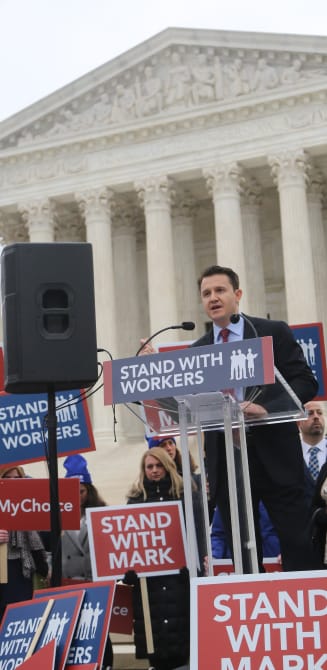
asking the U.S. Supreme Court to decide in a case called Bierman v. Dayton.
The plaintiffs are eight Minnesota parents,
each of whom provides around-the-clock personal care to a severely disabled son
or daughter at home. To help cover their expenses and prevent their children
from being placed in an institution, these parents receive modest financial
assistance through a state-run Medicaid program.
In 2013, Minnesota passed a law authorizing
the government to recognize an exclusive representative—that is, a union—to
bargain with the state on behalf of these parents and others who receive
benefits through the program. The state then recognized a unit of the Service
Employees International Union (SEIU) as the caregivers’ exclusive
representative—and it began taking money out of their Medicaid checks and
giving it to the union.
Minnesota is just one of fifteen states with
a law like this that authorizes a union to speak on behalf of people who aren’t
government employees, who simply receive government money for services they
provide to another private party.
The Supreme Court ruled in 2014 that forcing
caregivers like these to pay union fees is unconstitutional. But that decision
only ended the forced fees—it didn’t stop the unions’ exclusive representation
of these private citizens.
Bierman asks the Court to end the exclusive
representation as well. Appointing an official representative to speak for a
group of individuals, whether they want it or not, violates their First
Amendment right to choose which groups they will and won’t associate with.
In the Goldwater Institute’s brief, we show that public-sector unions are the sort of “faction” the Founding Fathers sought to restrain in designing the Constitution—and allowing the government to unionize groups of private citizens will make the problem of faction worse.
The Founders used the term “factions” to refer
to groups that would use the government to serve their own interests rather
than the public interest. The Founders expected that, in a large and
diverse republic such as ours, the large number of factions competing with each
other in a system governed by checks and balances would prevent each other from
obtaining too much power.
Today, public-sector unions are a prominent
example of a faction: They seek to use the government to enrich themselves and
their members at others’ expense. But they aren’t constrained by our republican
system of government as a typical faction is, for several reasons.
For one, unlike other groups, public-sector
unions can force the government to the bargaining table and compel officials to
negotiate with them—typically behind closed doors, with no outsiders or
dissenting employees there to present competing views.
Making things worse, unions engage in
political activity to help choose the officials they negotiate with—effectively
putting themselves on both sides of the bargaining table. And not only can
union-backed officials give in to unions’ demands for more government spending;
they also can authorize unionization of additional government employees—or, as
in Minnesota, people who aren’t even government
employees—thereby delivering unions more members and even more money to fuel
their agenda. In this way, unions become political perpetual-motion machines,
funded by taxpayer money to demand more taxpayer money for the union and its
members.
Unions also perpetuate their power through
collective bargaining agreements requiring “release
time”—a practice in which the government pays the salaries of
employees who actually work full-time for the union, pursuing its political
agenda at taxpayer expense.
Because of their unique privileges,
public-sector unions in many places have not been reined in by the majority or
counteracted by the other factions competing for power. That’s one reason why
salaries and pension benefits demanded by unions now overwhelm the budgets of states such as Illinois.
So when the government forces a group of
private citizens such as the Minnesota caregivers to accept an exclusive
representative to speak for them, it not only violates First Amendment rights;
it also artificially creates and empowers new factions. That undermines an
important purpose of the Constitution and republican government itself.
The Supreme Court therefore should hear the Bierman case, not only to protect
individuals’ First Amendment right not to
associate with a union, but also to ensure that the problem of faction will be
duly curbed, as the Founders intended, not made worse.
Jacob Huebert is
a Senior Attorney at the Goldwater Institute.