Another election season is in full swing. Unfortunately, so are efforts by public officials and government entities to illegally affect election outcomes. That’s why the Goldwater Institute recently submitted public records requests to several government entities across Wyoming seeking answers regarding the apparent use of taxpayer-funded resources to campaign for preferred elected officials and against a property tax relief measure on the state’s general election ballot.
As the Institute has previously explained, Wyoming law strictly forbids public officials from using “public funds, time, personnel, facilities or equipment for political or campaign activity.” Violations of that law are characterized as a “[m]isuse of office” and—if enforced—can constitute sufficient grounds for fines, termination of public employment, or removal from public office.
That means that public officials and employees cannot engage in political or campaign activity while on public time, with public resources, or in their official capacities, but they can do so on their own time, with their own money, and in their role as private citizens. If they engage in prohibited electioneering that is “[p]roperly incidental” to lawful activity, they still must reimburse the government for any additional costs incurred related to the political or campaign activity.
Unfortunately, even though this law has been on the books for decades, Wyoming officials haven’t gotten the message.
Last year, a proposed sales tax increase failed in one Wyoming county despite dubious efforts to push it across the finish line. (A related, but more modest proposal is also on this year’s ballot in that same county.)
This election, voters statewide will decide whether to adopt a citizen-initiated measure that would reduce residential property taxes for qualified homeowners’ primary residence by 50%. Ballot initiatives are rare in Wyoming given relatively high legal hurdles. According to the Secretary of State’s Office, this is the first initiative that has qualified for the ballot in 30 years. More than 30,000 signatures were gathered among a population of fewer than 600,000 people. That means that over 5% of all Wyomingites—more than 15% of active voters—signed the initiative petition.
That level of initial support apparently spooked many governmental entities that receive property tax funds, as well as their taxpayer-funded lobbying arms and other big-government allies. Several groups, including the Wyoming Education Association (the Wyoming affiliate of the National Education Association, the largest teachers union in the country), the Wyoming Hospital Association, and the Wyoming Association of Community College Trustees, coalesced to oppose the measure, raising over $1 million to spend against it (a large amount for such a small state).
In apparent violation of the law, some government entities and public officials have followed suit.
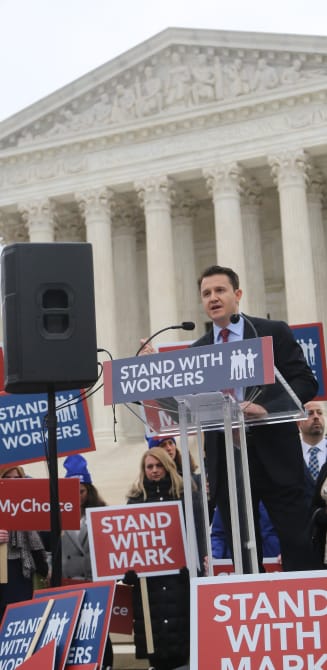
Last month, the Gillette Community College District, the Laramie County Community College District, and even Wyoming Governor Mark Gordon all issued official statements opposing the initiative. It seems that taxpayer-funded resources were used in each instance.
More recently, similar accusations of illegal taxpayer-funded electioneering have been raised surrounding a prominent county sheriff’s race.
Because illegal electioneering appears to be accelerating across Wyoming, the Goldwater Institute has submitted public records requests to these government entities to determine the scope of the problem. We have yet to hear back from most of them.
However, Gillette College has informed the Institute that it will charge nearly $800 to access most of its responsive records, including more than $250 for one hour of attorney review. The fact that public records fees are used as a barrier to transparency—especially on such important matters of public concern leading up to an election—is why the Goldwater Institute is also actively encouraging the Wyoming Legislature to modernize and strengthen the Wyoming Public Records Act next year.
The Goldwater Institute remains committed to ending unlawful public electioneering and public records abuses across the country—even in its least populated state.
Parker Jackson is a Staff Attorney at the Goldwater Institute.