Entrepreneur Joshua Rhines had a vision: to launch a cutting-edge technology company in Missoula, Mont., that would give Montanans new ways to conduct business using the latest digital innovations. His venture was off to a promising start until the city of Missoula decided his business and others like it were the wrong kind of businesses and enacted a zoning ordinance that effectively banned his company from growing, in violation of Rhines’ property rights and state law. Now, the Goldwater Institute is teaming up with the Frontier Institute to sue the city of Missoula in defense of Rhines’ right to operate his business free from unlawful government interference.
Rhines’ company, CubCloud AI, is a small tech firm that provides artificial intelligence and cloud computing infrastructure to local businesses, ranging from neighborhood fitness centers and insurance agencies to telecommunications providers. In other words, CubCloud AI is a data center, albeit a very small one, much different than the large data centers that have faced backlash from politicians. CubCloud AI invested nearly $2 million to establish its facilities, designing an office floor plan that complied with existing city zoning and devoted less than 21% of its square footage to computing equipment.
Then the city changed the rules.
On October 5, the Missoula City Council voted 10-2 to adopt a new ordinance that would make it impossible for CubCloud AI to grow its operations anywhere within the city limits, much less at the property it purchased for that purpose.
The city’s restrictive new ordinance does not expressly ban server facilities like CubCloud AI hopes to provide to clients—but it relegates such facilities in a way that makes them virtually impossible to operate. The city also is using a zoning classification that doesn’t exist anywhere within the city limits. Critically, the new ordinance imposes these restrictions without regard to any perceived externalities for the property use, such as actual physical footprint, noise, light, or energy usage of the relevant computing facilities.
The Right to Compute Act Protects Citizen’s Free Expression and Property Rights
Fortunately for Rhines—a native of Missoula and a fourth-generation Montanan—last year Montana adopted a first-of-its-kind statute called the Right to Compute Act, based on a model bill from the free-market Frontier Institute. It says that whenever the government restricts citizens’ ability to privately own or make use of computational resources for lawful purposes, those restrictions must be “demonstrably necessary and narrowly tailored to fulfill a compelling government interest.” This means the government must bear the burden of proving that any restriction it imposes on the use of computational resources is both “demonstrably necessary and narrowly tailored.”
CubCloud’s Servers Are Not a Nuisance
The Right to Compute Act expressly allows governments to protect citizens against nuisances, such as excessive noise or light, so long as the restrictions are “demonstrably necessary and narrowly tailored” to address the problem. The government must apply the same standards to everyone. CubCloud is happy to comply with the same quality-of-life protections expected of any other business.
The problem is that Missoula isn’t treating all businesses equally, and their ordinance has nothing to do with protecting the public against excessive noise, light, or pollution.
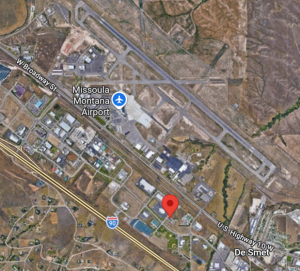
CubCloud’s computing facilities are much smaller and less obtrusive than the large-scale data center facilities that tend to raise concerns about light, noise, and the use of water and electricity. Its existing building is less than 4,000 square feet, and its computing resources take up less than 850 square feet of that space. CubCloud plans to build a small additional warehouse on this property to house additional computing resources. These facilities would exist on 4.5 acres of land zoned for light industrial use, which sits between an interstate highway and the Missoula airport—a development far noisier than anything CubCloud might build.
CubCloud AI’s property is between an interstate highway and the Missoula airport
The city’s new ordinance makes it virtually impossible for CubCloud to provide services in Missoula, no matter how quiet or unobtrusive their facility might be. That is why the city’s new ordinance violates the Right to Compute Act.
“While aimed at big tech, the City of Missoula’s onerous data center zoning harms little tech the most, in this case outlawing the growth of an upstanding local small business,” said Kendall Cotton, President and CEO of Frontier Institute.
Goldwater filed its lawsuit in the Fourth Judicial District Court in Missoula County. This marks the inaugural case of the Big Sky Legal Project, a joint Goldwater and Frontier Institute initiative designed to defend free enterprise and property rights across Montana. It also advances Goldwater’s ongoing efforts to fight against unreasonable municipal permitting hurdles and regulatory abuses nationwide.
And as the most prominent lawsuit in the nation to interpret and apply a statutory Right to Compute, this case holds significance far beyond Missoula.
A victory will affirm that free expression and property rights apply just as vigorously to modern digital infrastructure as they do to printing presses and traditional brick-and-mortar commerce—setting a powerful precedent for other states looking to protect technological innovation and economic freedom.
Dave Roland is the Director of Allied Litigation at the Goldwater Institute.
Since 1988, the Goldwater Institute has been in the liberty business — defending and promoting freedom, and achieving more than 400 victories in all 50 states. Donate today to help support our mission.
We Protect Your Rights
Our attorneys defend individual rights and protect those who cannot protect themselves.
Sign up for the latest news, event updates, and more.
Wait! Don’t close this yet!
We are grateful for your support of the Goldwater Institute’s efforts to advance and defend liberty throughout the United States. For over 36 years, we’ve been defending the rights of Americans to live their lives free from government interference.
And Goldwater is unique in that we direct our efforts to the 50 states where we introduce and advance innovative ideas that expand freedom. And we fight in courtrooms and capitals nationwide to defend individual liberty.
In 2024 alone, we scored over 50 policy and litigation victories defending liberty!
And that’s just the beginning.
Our plans for 2025 include:
Stopping pernicious DEI and other woke programs in America’s universities.
Ensuring that patients suffering from rare and terminal diseases have access to cutting-edge, lifesaving medical treatments, without having to first seek permission from the government.
Defending parental rights across the United States so that parents can send their kids to the school that best fits their needs, free from leftist indoctrination.
Eliminating government interference in the fundamental right of individuals to own property and use it as they see fit.
And much, much more
We seek to restore the presumption of liberty; that people are free to act without first asking permission from the government.
But we cannot do this without you. Will you join us as we fight to preserve and advance liberty throughout the country? As we seek new and innovative ways to defend freedom in all 50 states?
And there’s great news: Thanks to a generous Goldwater supporter, your donation today will be doubled!
So please, join us in fighting to advance liberty and score real wins for freedom from coast to coast!